The best states for real estate agents in 2026 offer more than strong home prices alone. The best markets combine steady sales activity, healthy earning potential, manageable competition, and living costs that leave more room for real income.
A real estate career does not depend on skill alone. Market conditions shape how often deals happen, how crowded the field feels, and how far commissions go in daily life.
In one state, an agent may face intense competition and high expenses. In another, the same level of effort can lead to steadier business and stronger take-home earnings.
This guide ranks the best states for real estate agents in 2026 using five practical factors: median home price, homes sold per 100,000 people, number of agents per 1,000 people, average agent salary, and cost of living.
The rankings and comparisons in this article draw on data from World Population Review, Redfin, Leads Deposit, Colibri Real Estate, and the Missouri Economic Research and Information Center (MERIC).
1. Median Home Price by State
Median home price has a direct effect on commission potential. In general, higher-priced homes can lead to larger earnings per transaction. That does not automatically make a state one of the best places for agents, but it does shape how much income each closed deal can generate.
That is why median home price is a useful starting point. It highlights where transactions carry more financial weight before other factors such as sales volume, competition, average salary, and cost of living are considered.
| Rank | State | Median price | |
|---|---|---|---|
| 1 | 1California | $833,000 | |
| 2 | 2Hawaii | $743,000 | |
| 3 | 3Washington | $630,000 | |
| 4 | 4Massachusetts | $615,000 | |
| 5 | 5Colorado | $582,000 | |
| 6 | 6New York | $576,000 | |
| 7 | 7Utah | $548,000 | |
| 8 | 8Montana | $523,000 | |
| 9 | 9New Jersey | $521,000 | |
| 10 | 10Oregon | $505,000 | |
| 11 | 11Rhode Island | $487,000 | |
| 12 | 12Idaho | $485,000 | |
| 13 | 13Wyoming | $484,000 | |
| 14 | 14New Hampshire | $483,000 | |
| 15 | 15Arizona | $455,000 | |
| 16 | 16Nevada | $455,000 | |
| 17 | 17Virginia | $444,000 | |
| 18 | 18Connecticut | $415,000 | |
| 19 | 19Maryland | $415,000 | |
| 20 | 20Florida | $412,000 | |
| 21 | 21Vermont | $388,000 | |
| 22 | 22Alaska | $383,000 | |
| 23 | 23Maine | $381,000 | |
| 24 | 24South Carolina | $381,000 | |
| 25 | 25Tennessee | $380,000 | |
| 26 | 26North Carolina | $368,000 | |
| 27 | 27Georgia | $366,000 | |
| 28 | 28New Mexico | $357,000 | |
| 29 | 29Minnesota | $354,000 | |
| 30 | 30Delaware | $352,000 | |
| 31 | 31Texas | $338,000 | |
| 32 | 32South Dakota | $320,000 | |
| 33 | 33Wisconsin | $311,000 | |
| 34 | 34Nebraska | $289,000 | |
| 35 | 35Illinois | $286,000 | |
| 36 | 36Pennsylvania | $283,000 | |
| 37 | 37Alabama | $281,000 | |
| 38 | 38North Dakota | $281,000 | |
| 39 | 39Kansas | $279,000 | |
| 40 | 40Kentucky | $263,000 | |
| 41 | 41Missouri | $258,000 | |
| 42 | 42Indiana | $255,000 | |
| 43 | 43Arkansas | $253,000 | |
| 44 | 44Mississippi | $253,000 | |
| 45 | 45Louisiana | $249,000 | |
| 46 | 46Michigan | $249,000 | |
| 47 | 47West Virginia | $249,000 | |
| 48 | 48Oklahoma | $244,000 | |
| 49 | 49Ohio | $241,000 | |
| 50 | 50Iowa | $228,000 | |
Median home prices can strongly influence commission potential, which may lead some people to judge the best places to start a career in real estate on this figure alone.
On that measure alone, states such as Hawaii and California may look more attractive than states such as Mississippi and West Virginia.
Still, this factor does not fully settle the question. A state with expensive homes may also have fewer transactions or tougher competition. Another factor that helps identify the best states for real estate agents is the number of homes sold relative to the size of the population.
2. Market Activity: Homes Sold per 100,000 People
Home prices tell one part of the story, but sales activity shows how often real work happens. A state with lower-priced homes can still offer more chances to close deals if enough properties change hands each year.
The table below ranks states by the number of homes sold per 100,000 people. This metric combines home sales and population data to give a clearer view of market activity across the country.
| Rank | State | Agents per 1,000 | Total agents | |
|---|---|---|---|---|
| 1 | 1Florida | 9.54 | 223,000 agents | |
| 2 | 2Georgia | 8.52 | 96,000 agents | |
| 3 | 3North Carolina | 8.37 | 93,500 agents | |
| 4 | 4Hawaii | 7.24 | 10,500 agents | |
| 5 | 5Ohio | 7.15 | 85,000 agents | |
| 6 | 6Arizona | 7.06 | 53,500 agents | |
| 7 | 7Pennsylvania | 6.38 | 83,500 agents | |
| 8 | 8New Jersey | 6.25 | 59,000 agents | |
| 9 | 9Idaho | 5.68 | 11,500 agents | |
| 10 | 10New York | 5.66 | 112,500 agents | |
| 11 | 11Nevada | 5.66 | 18,500 agents | |
| 12 | 12Utah | 5.57 | 19,500 agents | |
| 13 | 13Texas | 5.56 | 174,000 agents | |
| 14 | 14California | 5.14 | 202,500 agents | |
| 15 | 15Connecticut | 5.02 | 18,500 agents | |
| 16 | 16Montana | 4.90 | 5,650 agents | |
| 17 | 17Rhode Island | 4.75 | 5,300 agents | |
| 18 | 18Tennessee | 4.73 | 34,500 agents | |
| 19 | 19New Hampshire | 4.57 | 6,500 agents | |
| 20 | 20South Carolina | 4.56 | 25,000 agents | |
| 21 | 21Colorado | 4.53 | 27,000 agents | |
| 22 | 22Wyoming | 4.34 | 2,550 agents | |
| 23 | 23Maryland | 4.22 | 26,500 agents | |
| 24 | 24Oregon | 4.07 | 17,500 agents | |
| 25 | 25Delaware | 4.07 | 4,300 agents | |
| 26 | 26Missouri | 4.07 | 25,500 agents | |
| 27 | 27Maine | 3.96 | 5,600 agents | |
| 28 | 28Illinois | 3.92 | 49,500 agents | |
| 29 | 29Virginia | 3.91 | 35,000 agents | |
| 30 | 30Arkansas | 3.71 | 11,500 agents | |
| 31 | 31Minnesota | 3.69 | 21,500 agents | |
| 32 | 32Alabama | 3.58 | 18,500 agents | |
| 33 | 33Kansas | 3.52 | 10,500 agents | |
| 34 | 34New Mexico | 3.51 | 7,500 agents | |
| 35 | 35Massachusetts | 3.50 | 25,000 agents | |
| 36 | 36Michigan | 3.42 | 34,500 agents | |
| 37 | 37Louisiana | 3.36 | 15,500 agents | |
| 38 | 38Oklahoma | 3.27 | 13,500 agents | |
| 39 | 39Indiana | 2.96 | 20,500 agents | |
| 40 | 40Wisconsin | 2.76 | 16,500 agents | |
| 41 | 41Kentucky | 2.71 | 12,500 agents | |
| 42 | 42Vermont | 2.69 | 1,750 agents | |
| 43 | 43Nebraska | 2.65 | 5,350 agents | |
| 44 | 44Washington | 2.54 | 20,500 agents | |
| 45 | 45Mississippi | 2.53 | 7,450 agents | |
| 46 | 46North Dakota | 2.50 | 2,000 agents | |
| 47 | 47Alaska | 2.50 | 1,850 agents | |
| 48 | 48Iowa | 2.47 | 8,000 agents | |
| 49 | 49South Dakota | 2.41 | 2,250 agents | |
| 50 | 50West Virginia | 1.88 | 3,300 agents | |
A busy market does not automatically promise better working conditions for agents. South Carolina and Arizona post far more home sales per 100,000 people than Hawaii, which suggests more room to find active buyers and sellers.
Hawaii, by contrast, stands out for much higher home prices, which means each closed deal may carry more financial weight. One state offers more shots on goal, while the other offers a bigger payoff per sale.
The picture becomes clearer when competition enters the equation. A state with strong sales activity can still feel crowded if too many agents are competing for the same clients. That is why the next factor looks at the number of agents relative to the size of the population.
3. Competition: Number of Agents per 1,000 People

The number of agents relative to the population also helps identify the best states for real estate agents. When more agents compete within the same pool of residents, each one usually faces a tougher fight for listings, buyers, and referrals. In that sense, a higher ratio can point to a more saturated market.
A lower ratio usually suggests more breathing room. It does not guarantee success, but it can improve the odds that an agent can find work without entering an already crowded field.
| Rank | State | Agents per 1,000 | Total agents | |
|---|---|---|---|---|
| 1 | 1Florida | 9.54 | 223,000 agents | |
| 2 | 2Georgia | 8.52 | 96,000 agents | |
| 3 | 3North Carolina | 8.37 | 93,500 agents | |
| 4 | 4Hawaii | 7.24 | 10,500 agents | |
| 5 | 5Ohio | 7.15 | 85,000 agents | |
| 6 | 6Arizona | 7.06 | 53,500 agents | |
| 7 | 7Pennsylvania | 6.38 | 83,500 agents | |
| 8 | 8New Jersey | 6.25 | 59,000 agents | |
| 9 | 9Idaho | 5.68 | 11,500 agents | |
| 10 | 10New York | 5.66 | 112,500 agents | |
| 11 | 11Nevada | 5.66 | 18,500 agents | |
| 12 | 12Utah | 5.57 | 19,500 agents | |
| 13 | 13Texas | 5.56 | 174,000 agents | |
| 14 | 14California | 5.14 | 202,500 agents | |
| 15 | 15Connecticut | 5.02 | 18,500 agents | |
| 16 | 16Montana | 4.90 | 5,650 agents | |
| 17 | 17Rhode Island | 4.75 | 5,300 agents | |
| 18 | 18Tennessee | 4.73 | 34,500 agents | |
| 19 | 19New Hampshire | 4.57 | 6,500 agents | |
| 20 | 20South Carolina | 4.56 | 25,000 agents | |
| 21 | 21Colorado | 4.53 | 27,000 agents | |
| 22 | 22Wyoming | 4.34 | 2,550 agents | |
| 23 | 23Maryland | 4.22 | 26,500 agents | |
| 24 | 24Oregon | 4.07 | 17,500 agents | |
| 25 | 25Delaware | 4.07 | 4,300 agents | |
| 26 | 26Missouri | 4.07 | 25,500 agents | |
| 27 | 27Maine | 3.96 | 5,600 agents | |
| 28 | 28Illinois | 3.92 | 49,500 agents | |
| 29 | 29Virginia | 3.91 | 35,000 agents | |
| 30 | 30Arkansas | 3.71 | 11,500 agents | |
| 31 | 31Minnesota | 3.69 | 21,500 agents | |
| 32 | 32Alabama | 3.58 | 18,500 agents | |
| 33 | 33Kansas | 3.52 | 10,500 agents | |
| 34 | 34New Mexico | 3.51 | 7,500 agents | |
| 35 | 35Massachusetts | 3.50 | 25,000 agents | |
| 36 | 36Michigan | 3.42 | 34,500 agents | |
| 37 | 37Louisiana | 3.36 | 15,500 agents | |
| 38 | 38Oklahoma | 3.27 | 13,500 agents | |
| 39 | 39Indiana | 2.96 | 20,500 agents | |
| 40 | 40Wisconsin | 2.76 | 16,500 agents | |
| 41 | 41Kentucky | 2.71 | 12,500 agents | |
| 42 | 42Vermont | 2.69 | 1,750 agents | |
| 43 | 43Nebraska | 2.65 | 5,350 agents | |
| 44 | 44Washington | 2.54 | 20,500 agents | |
| 45 | 45Mississippi | 2.53 | 7,450 agents | |
| 46 | 46North Dakota | 2.50 | 2,000 agents | |
| 47 | 47Alaska | 2.50 | 1,850 agents | |
| 48 | 48Iowa | 2.47 | 8,000 agents | |
| 49 | 49South Dakota | 2.41 | 2,250 agents | |
| 50 | 50West Virginia | 1.88 | 3,300 agents | |
Taken together, these three tables already reveal a few clear patterns. Florida, for example, shows strong sales activity, but it also has the highest agent density, which points to heavier competition.
California presents a different tradeoff. Home prices are high, but sales per 100,000 people are relatively low, while the number of agents remains high.
These factors still do not settle the full question. They help narrow the field, but more variables still shape which states offer the best overall conditions for real estate agents in 2026.
4. Average Real Estate Agent Income by State
Income data adds a practical reality check. Strong home prices and active sales matter, but they do not always lead to stronger earnings for the average agent. Some states reward agents better than others once competition, pricing, and local market conditions are taken into account.
Average agent income also helps test the market from a more practical angle. If agents in a state already earn more on average, that state often offers stronger earning conditions than one where agents earn less.
| Rank | State | Average salary | |
|---|---|---|---|
| 1 | 1Indiana | $191,098 | |
| 2 | 2Alabama | $137,196 | |
| 3 | 3North Dakota | $124,822 | |
| 4 | 4West Virginia | $123,390 | |
| 5 | 5Nebraska | $122,306 | |
| 6 | 6Arizona | $120,765 | |
| 7 | 7Maine | $120,265 | |
| 8 | 8Vermont | $115,948 | |
| 9 | 9Montana | $114,792 | |
| 10 | 10Minnesota | $111,797 | |
| 11 | 11Colorado | $110,688 | |
| 12 | 12California | $109,603 | |
| 13 | 13North Carolina | $108,667 | |
| 14 | 14Virginia | $107,082 | |
| 15 | 15Hawaii | $103,654 | |
| 16 | 16Maryland | $103,208 | |
| 17 | 17Georgia | $102,761 | |
| 18 | 18Nevada | $102,639 | |
| 19 | 19Wyoming | $102,433 | |
| 20 | 20Rhode Island | $102,153 | |
| 21 | 21Connecticut | $101,224 | |
| 22 | 22New Jersey | $100,920 | |
| 23 | 23Oregon | $99,728 | |
| 24 | 24Tennessee | $99,164 | |
| 25 | 25Michigan | $98,793 | |
| 26 | 26Illinois | $98,674 | |
| 27 | 27Delaware | $98,334 | |
| 28 | 28South Carolina | $98,235 | |
| 29 | 29Idaho | $98,166 | |
| 30 | 30Florida | $97,842 | |
| 31 | 31Arkansas | $96,125 | |
| 32 | 32Louisiana | $94,805 | |
| 33 | 33Alaska | $94,510 | |
| 34 | 34Missouri | $94,233 | |
| 35 | 35Kansas | $93,769 | |
| 36 | 36New Hampshire | $93,512 | |
| 37 | 37Ohio | $93,474 | |
| 38 | 38Wisconsin | $92,608 | |
| 39 | 39Pennsylvania | $91,528 | |
| 40 | 40New Mexico | $90,966 | |
| 41 | 41Oklahoma | $90,279 | |
| 42 | 42Iowa | $89,592 | |
| 43 | 43Washington | $89,254 | |
| 44 | 44South Dakota | $88,884 | |
| 45 | 45Mississippi | $88,301 | |
| 46 | 46Massachusetts | $87,851 | |
| 47 | 47Texas | $86,455 | |
| 48 | 48New York | $84,829 | |
| 49 | 49Utah | $82,822 | |
| 50 | 50Kentucky | $80,525 | |
Average income changes the picture in a meaningful way. Some states that do not lead on home prices or sales activity still show strong agent income, which suggests that market quality is not defined by volume or price alone.
Indiana is a clear example. Its median home price sits well below that of the highest-priced states, yet its reported average agent income reaches $191,098.
Minnesota also looks stronger once income enters the picture, with an average salary of $111,797, moderate home prices, and lower agent density than many busier markets.
5. Cost of Living by State
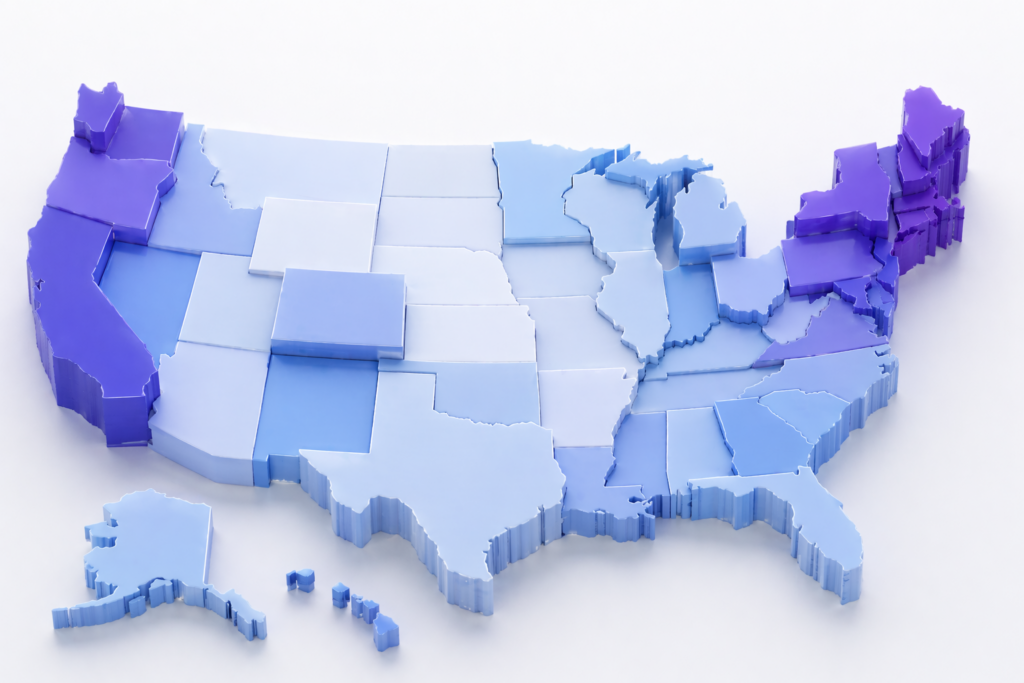
Income does not mean much on its own. A higher salary loses value quickly in a state where daily expenses are high. Housing, groceries, transportation, and healthcare all shape how far an agent’s earnings really go.
That is why cost of living matters in this comparison. States that combine solid agent income with moderate living costs often put agents in a stronger financial position than states where earnings look good only on paper.
| Rank | State | Cost of living index | vs. average | |
|---|---|---|---|---|
| 1 | 1Hawaii | 186.9 | +86.9 | |
| 2 | 2Massachusetts | 145.9 | +45.9 | |
| 3 | 3California | 144.8 | +44.8 | |
| 4 | 4New York | 123.3 | +23.3 | |
| 5 | 5Alaska | 123.2 | +23.2 | |
| 6 | 6Maryland | 122.6 | +22.6 | |
| 7 | 7Oregon | 119.3 | +19.3 | |
| 8 | 8Washington | 118.0 | +18 | |
| 9 | 9New Hampshire | 117.8 | +17.8 | |
| 10 | 10Vermont | 114.4 | +14.4 | |
| 11 | 11Rhode Island | 113.4 | +13.4 | |
| 12 | 12Connecticut | 113.1 | +13.1 | |
| 13 | 13New Jersey | 113.0 | +13 | |
| 14 | 14Colorado | 106.3 | +6.3 | |
| 15 | 15Virginia | 105.9 | +5.9 | |
| 16 | 16Arizona | 104.7 | +4.7 | |
| 17 | 17Maine | 104.3 | +4.3 | |
| 18 | 18Delaware | 103.4 | +3.4 | |
| 19 | 19Florida | 102.8 | +2.8 | |
| 20 | 20Utah | 102.7 | +2.7 | |
| 21 | 21Nevada | 101.5 | +1.5 | |
| 22 | 22Minnesota | 98.7 | −1.3 | |
| 23 | 23Idaho | 98.4 | −1.6 | |
| 24 | 24Pennsylvania | 97.8 | −2.2 | |
| 25 | 25Wyoming | 97.5 | −2.5 | |
| 26 | 26Texas | 96.5 | −3.5 | |
| 27 | 27Montana | 96.4 | −3.6 | |
| 28 | 28Illinois | 95.9 | −4.1 | |
| 29 | 29North Carolina | 95.7 | −4.3 | |
| 30 | 30Wisconsin | 95.6 | −4.4 | |
| 31 | 31South Carolina | 95.5 | −4.5 | |
| 32 | 32Tennessee | 94.8 | −5.2 | |
| 33 | 33Georgia | 94.4 | −5.6 | |
| 34 | 34Nebraska | 94.3 | −5.7 | |
| 35 | 35Missouri | 93.8 | −6.2 | |
| 36 | 36Michigan | 93.4 | −6.6 | |
| 37 | 37Indiana | 92.9 | −7.1 | |
| 38 | 38South Dakota | 92.7 | −7.3 | |
| 39 | 39Kansas | 92.4 | −7.6 | |
| 40 | 40Ohio | 92.1 | −7.9 | |
| 41 | 41North Dakota | 91.9 | −8.1 | |
| 42 | 42Iowa | 91.5 | −8.5 | |
| 43 | 43Alabama | 91.1 | −8.9 | |
| 44 | 44Kentucky | 90.8 | −9.2 | |
| 45 | 45New Mexico | 90.6 | −9.4 | |
| 46 | 46Louisiana | 89.8 | −10.2 | |
| 47 | 47Oklahoma | 88.9 | −11.1 | |
| 48 | 48Arkansas | 88.5 | −11.5 | |
| 49 | 49West Virginia | 87.2 | −12.8 | |
| 50 | 50Mississippi | 85.3 | −14.7 | |
Cost of living can change the rankings, but it should not control them by itself. A cheaper state is not automatically a better market for agents. Lower expenses help, but agents still need enough sales activity, workable competition, and income to make the market worthwhile.
The strongest states for real estate agents in 2026 perform well across the full set of factors: home price, sales activity, agent density, average income, and cost of living. The final table brings those measures together.
| Rank | State | Median home price | Homes sold / 100k | Agents / 1,000 | Avg. agent salary | Cost of living |
|---|---|---|---|---|---|---|
| 1 | 1South Carolina | $381,000 | 77.30 | 4.56 | $98,235 | 95.5 |
| 2 | 2Tennessee | $380,000 | 72.53 | 4.73 | $99,164 | 94.8 |
| 3 | 3Maine | $381,000 | 58.58 | 3.96 | $120,265 | 104.3 |
| 4 | 4Colorado | $582,000 | 58.46 | 4.53 | $110,688 | 106.3 |
| 5 | 5Minnesota | $354,000 | 49.46 | 3.69 | $111,797 | 98.7 |
| 6 | 6Virginia | $444,000 | 46.44 | 3.91 | $107,082 | 105.9 |
| 7 | 7Vermont | $388,000 | 48.28 | 2.69 | $115,948 | 114.4 |
| 8 | 8Idaho | $485,000 | 64.46 | 5.68 | $98,166 | 98.4 |
| 9 | 9Indiana | $255,000 | 57.58 | 2.96 | $191,098 | 92.9 |
| 10 | 10Nevada | $455,000 | 59.27 | 5.66 | $102,639 | 101.5 |
Taken together, the 10 states above offer the most balanced conditions for agents. South Carolina, Tennessee, Maine, Colorado, and Minnesota lead because they perform well across several metrics rather than depending on one advantage.
Some states rise because the market stays active. South Carolina records 77.30 home sales per 100,000 people, and Tennessee reaches 72.53. Others stand out for pricing power. Colorado, for example, posts a median home price of $582,000, which can support larger commissions per transaction.
Income also reshapes the picture. Maine reports an average agent salary of $120,265, while Minnesota reaches $111,797. Both also keep living costs below many higher-cost coastal markets.
Competition helps explain the rest. Several of the top-ranked states avoid extreme agent saturation, which gives agents more room to win listings, buyers, and referrals. That balance is what makes a market attractive in practice, not just in theory.
Implications for Real Estate Agents
Strong states can improve the odds, but they do not make the job easy. Even in the best markets, agents still need time, discipline, and consistent follow-up to build a client base. Better conditions help, but they do not replace the work.
Relocation also comes with risk. Moving to a higher-ranked state does not guarantee stronger income right away.
Many attractive markets already have established agents, local relationships, and clear competitive pressure. Starting over usually means rebuilding from scratch while learning a new market.
Broader real estate trends can also change how useful a ranking remains over time. Mortgage rates, inventory levels, buyer demand, and transaction volume can all shift the outlook in a state.
City-level differences matter just as much as state rankings. One metro area may stay active while another part of the same state moves more slowly.
Use the state list as a starting point, then look more closely at cities, neighborhoods, pricing patterns, and local competition before making a move.
Final Thought
There is no single formula for choosing the right state to work as an agent. Different rankings produce different results because they use different data and weigh each factor differently.
This article used five practical factors to compare states side by side and identify the best states for real estate agents in 2026. Even so, broader market shifts, local demand, and changing conditions can still reshape the picture.
A state that looks strong on paper can still include weaker cities, while a lower-ranked state may contain excellent local markets. Use this list as a starting point, then look more closely at the cities and areas that match your goals, market style, and preferred way of working.
FAQs
What are the best states for real estate agents?
The best states for real estate agents in 2026 are South Carolina, Tennessee, Maine, Colorado, Minnesota, Virginia, Vermont, Idaho, Indiana, and Nevada. These states performed well across home prices, sales activity, competition, income, and cost of living.
What factors matter most when comparing the best states for real estate agents?
The most important factors are home prices, sales activity, agent competition, average income, and cost of living. Together, these metrics show where agents may have better earning potential, steadier demand, and more room to keep what they earn.
Which states have the highest income potential for real estate agents?
States with higher home prices, such as California, Hawaii, Colorado, and Washington, often offer stronger commission potential per sale. Even so, actual income also depends on sales activity, competition, and local living costs.