AI for Real Estate Investors: Deal Analysis, Comps & Forecasting
AI for real estate investors starts with a repeatable workflow: comps, pro forma, sensitivity, forecasting, and risk checks, plus an audit trail for every assumption.
In short
- Workflow beats tools: consistent comps, pro forma, scenarios, forecasts, and risk flags outperform random AI outputs.
- Validate every number: treat AI values and rent estimates as drafts until a second source confirms them.
- Document assumptions: an audit trail makes investor memos credible for partners and lenders.
Fast deal flow rewards speed, but speed without discipline creates expensive mistakes. Real estate ai deal analysis works best when it follows the same path on every address, with the same inputs, outputs, and checks.
Many investors try AI as a shortcut for valuation or rent estimates. The bigger edge comes from using AI like a junior analyst that drafts the first pass, then forces validation and documentation before an offer or lender package goes out.
The sections below lay out an end-to-end underwriting workflow that investors can repeat, share with partners, and improve over time.
Where AI Actually Helps Investors and Where It Does Not
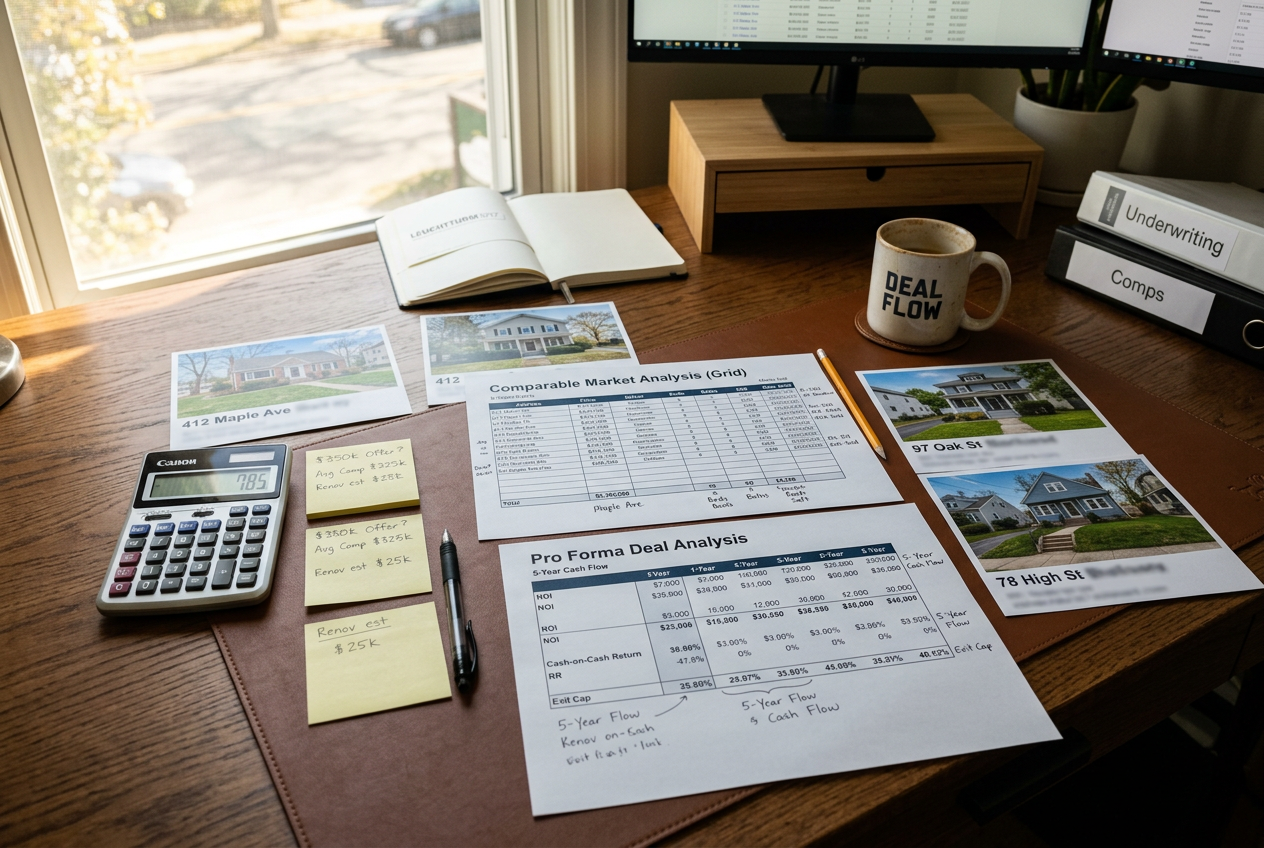
Speed shows up in the boring parts. AI can clean messy inputs, format comp grids, draft a pro forma, and run scenarios fast. That frees time for the work that still needs judgment, like picking the right comp set and deciding how much risk fits the strategy.
AI also helps investors stay consistent. A standard prompt and output format can force the same KPIs across every deal. That makes deals easier to compare and reduces optimistic assumptions that creep in under time pressure.
The boundary matters. AI does not know a property’s condition from a street photo. It does not know that a nearby sale had a roof issue, a cash buyer, or seller credits. It also cannot guarantee data freshness unless the inputs include current facts.
A practical rule: treat AI outputs as drafts. Numbers move into the underwriting model only after two checks, a human reason, and a source note. More detail sits behind the number than the number itself.
real estate ai deal analysis workflow: A Repeatable Underwriting Spine
The most useful workflow feels simple enough to run on every lead, not just the “maybe” deals. Investors can think of it as a spine that produces the same deliverables each time, even when the property type changes.
Start by building a comp set that can defend a value range. Then convert that range into a pro forma with explicit assumptions. Next, pressure test those assumptions with sensitivity analysis. After that, use forecasting as a directional check, not a promise. End by writing risk flags and a short investment memo.
A reasonable operations target is a same-day initial screen and a deeper memo within three days. Same-day speed supports offers, while the three-day window leaves room for comp cleanup, document review, and partner questions.
For deal pipeline context, the underwriting spine sits downstream of sourcing. A consistent intake form pairs well with AI-driven deal sourcing and lead generation so leads arrive with the fields AI needs.
Pulling and Cleaning Real Estate Comps With AI
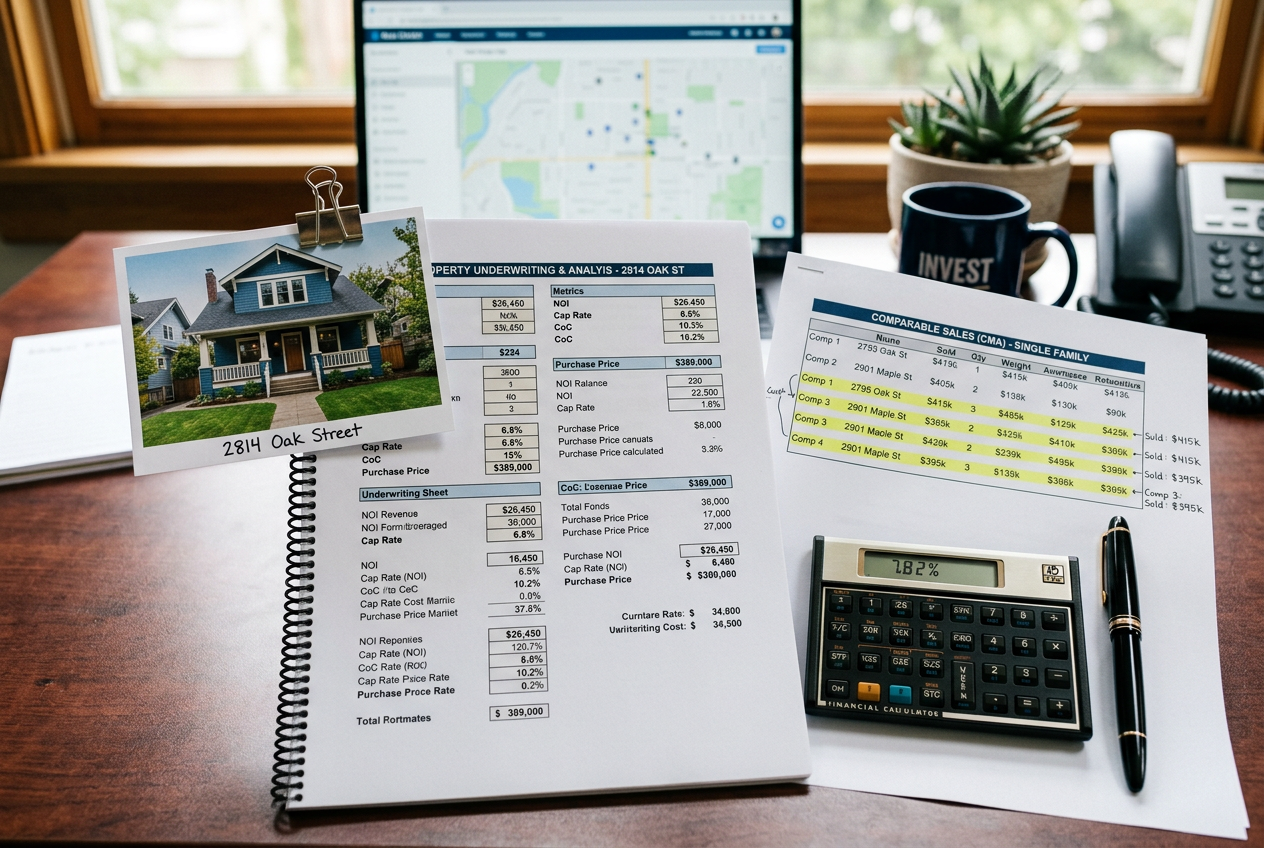
Bad comps break every downstream metric. AI can pull a first-pass comp list quickly, but the investor still needs rules for similarity and recency. The goal is not “more comps.” The goal is a small set that matches property type, size band, condition band, and neighborhood boundaries.
A clean comp set starts with filters. Keep the geography tight enough to stay inside the same buyer pool. Keep the time window tight enough to reflect the current market, and widen it only when inventory is thin. Rentals need the same discipline. A rent comp that comes from a different school zone or bedroom mix can distort the whole model.
Adjustments should stay transparent. AI can propose adjustments for square footage, beds and baths, parking, and condition. Those adjustments still need a plain-English note, such as “comp has an extra bath” or “subject backs to a collector street.” That note matters more than the math.
AI-derived values also need a second source. Investors can compare an AI value range against an AVM range, a broker opinion, or a manual comp reconciliation. This check fits naturally alongside AI property valuation and AVMs, which explains why automated estimates drift on unique homes.
Building a Pro Forma That AI Can Stress Test
A pro forma becomes useful when it makes assumptions visible. AI can calculate cash flow, cap rate, debt coverage, and cash-on-cash return fast. The investor still needs to control the assumption sheet that drives those metrics.
A clean split helps. Put hard inputs on one side, such as verified rent rolls, tax bills, insurance quotes, and debt terms. Put soft assumptions on the other side, such as vacancy, repair reserves, rent growth, and exit cap. AI can draft soft assumptions, but it should label them as assumptions and explain the rationale.
Investors often get better results by asking AI for output structure, not final numbers. For example, AI can produce a pro forma table with required fields, then the investor fills the fields with verified data. That avoids hidden math and reduces hallucinated values.
Fee transparency matters in partner packages. A pro forma should include a transaction cost line item bucket, but avoid locking in broker commissions or lender fees inside the memo unless verified quotes exist. Many teams keep detailed fee negotiations for the partner call and keep the memo focused on decision drivers.
Sensitivity Analysis and Scenario Planning Without Rebuilding the Model
The first underwriting pass often assumes one financing path and one exit. AI can help generate alternative scenarios quickly, but the investor should define what “downside” means before running it.
Sensitivity analysis works best when it focuses on a short list of variables that swing the outcome. Common drivers include rent, vacancy, operating expenses, interest rate, rehab scope, and exit value. AI can produce a sensitivity grid, but the grid should reference the assumption sheet so changes stay auditable.
Scenario planning is different from sensitivity. Scenarios package multiple changes into one story, such as “higher rate plus slower rent growth” or “rehab overruns plus longer hold.” AI can draft scenarios in plain language, which helps partners understand risk without scanning cells.
A simple control keeps this honest: scenarios should output a pass or fail against the same KPI benchmarks every time. That forces consistency across the buy box and reduces story-driven underwriting.
Forecasting for Buy and Hold, Fix and Flip, and Small Multifamily
Forecasting often looks precise, but it rarely is. AI can summarize market signals, infer directional rent pressure, and flag risk markers. Investors get the most value when forecasts come as ranges with confidence notes and a list of drivers.
Different strategies need different forecast outputs. Buy-and-hold cares about rent trend, expense pressure, and debt coverage durability. Fix-and-flip cares about resale demand, ARV band, and timeline risk. Small multifamily sits between the two and cares about NOI stability and exit cap sensitivity.
| Strategy | Forecast outputs that matter | Validation focus | Common failure mode |
|---|---|---|---|
| Buy and hold | rent range, vacancy pressure, expense drift | rent comps and local supply changes | over-trusting future rent growth |
| Fix and flip | ARV band, buyer demand signals, days-on-market direction | comp condition matching and sale concessions | ignoring condition and finish level |
| Small multifamily | NOI range, expense ratio pressure, exit cap stress | trailing expenses and unit mix comps | assuming stabilized performance too early |
Comparison of forecast outputs by strategy and validation focus.
For rental strategy depth, investors can extend this with AI for rental property analysis and keep the same KPI targets across the pipeline.
Worked Example Deal Using the Workflow
A worked example can stay realistic without pretending to be market data. Use a fictional address and placeholders that mirror a real underwriting sheet. The output still shows the full loop, from comps to memo.
Start with a single intake block: property type, bed and bath count, rough condition notes, target strategy, and current rent status. Add the investor’s maximum offer formula and required KPI benchmarks. Then ask AI to produce a comp grid template and a rent comp grid template, each with a field for “why this comp matches.”
Next, fill the comp grids with verified comps from the MLS or a trusted data feed, and let AI draft adjustment notes. Investors should reject comps that rely on vague similarity. Each accepted comp should have a clear match reason.
Move into the pro forma with placeholders. Use variables for purchase price, rehab budget, closing costs, rent, and debt terms. Ask AI to compute the metric outputs and to list the assumptions it used. If AI adds any assumption that was not provided, treat that as a red flag and remove it.
Prompt Templates That Turn AI Into an Underwriting Analyst
Prompts work when they constrain output. A good prompt names the role, defines the inputs, demands an output format, and asks for red flags. It also bans invented numbers and requires an assumption log.
Below are copy-paste templates investors can adapt. These borrow patterns from prompt techniques for real estate but focus on underwriting instead of listing work.
Comp set builder prompt
Role: investment analyst.
Inputs: address, property type, bed and bath count, size, lot, year built, condition notes, target strategy.
Task: propose a comp selection rubric and an empty comp grid with columns for similarity notes and adjustment notes. Ask clarifying questions where inputs are missing. Do not provide any values without a source field.
Pro forma structure prompt
Role: underwriting analyst.
Inputs: rent comps, expense notes, debt terms, hold period assumption.
Task: output a pro forma table format with an assumption sheet. Label each line item as verified input or assumption. Provide formulas for cap rate, cash-on-cash return, and debt coverage. Do not insert any numbers.
Downside scenario prompt
Role: risk analyst.
Inputs: the assumption sheet.
Task: produce downside scenarios as short narratives, each paired with a list of the assumptions it changes. Output a pass or fail against stated KPI benchmarks. List the top three drivers that cause failure.
Model Risk, Audit Trails, and Investor Ready Memos
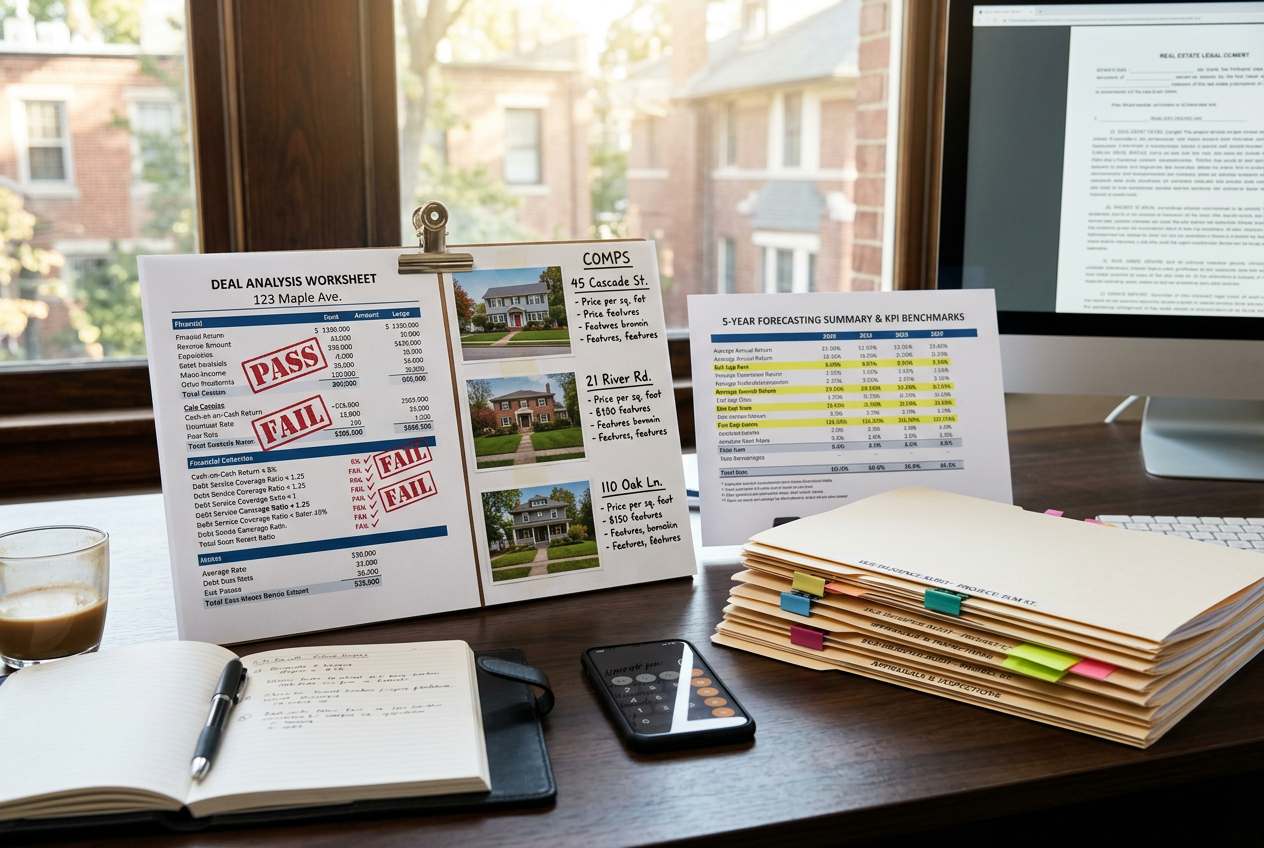
AI mistakes usually look confident. That makes model risk a process problem, not a math problem. A repeatable audit trail keeps the underwriting defensible for partners, lenders, and future self.
A simple control is to log every assumption with a source, a date, and an owner. “Owner” means the person who decided the number, even if AI suggested it. That single step makes it harder for hallucinated values to slip in.
Investors can also standardize a red-flag checklist so every deal gets the same scrutiny. The point is not to catch every issue early. The point is to catch avoidable misses.
For fix-and-flip presentations, visuals can support the ARV story. AI virtual renovation to visualize ARV can help show a plausible finish level that matches the comp set, and AI HomeDesign fits best as that visualization layer, not as the underwriting model.
After acquisition, operational systems matter more than forecasts. Investors who self-manage often extend the workflow into tenant and maintenance workflows with AI property management tools.
Frequently Asked Questions
Can AI accurately value a property for investment?
AI property valuation can produce a fast value range, but the range depends on comp quality and data freshness. Investors get the best results by treating AI as a starting point, then validating the value against a hand-picked comp set and a second source like an AVM or broker feedback. The final value decision still sits with the investor.
How does ChatGPT fit into real estate underwriting?
ChatGPT works best as a drafting assistant for structured outputs, such as a comp grid template, an assumption sheet, a pro forma layout, and a red-flag checklist. It should not serve as the source of rent, expenses, or exit value. Investors can improve reliability by feeding verified inputs and requiring the model to label assumptions clearly.
What belongs in an investor memo versus a partner call?
An investor memo should carry the comp logic, the assumption sheet, scenario outputs, and the specific risks that could break the deal. A partner call can cover negotiation strategy, subjective risk tolerance, and open questions that still need documents or quotes. Keeping that split helps the memo stay factual and reduces debate over opinions.
How can AI help with ARV on a fix and flip?
AI can help by organizing ARV comps by finish level and by generating a renovation scope checklist from inspection notes. Visualization tools can also create “after” images to match the finish level implied by the ARV comps, which can support lender or partner discussions. The ARV still needs comp support, not images alone.
How can investors reduce hallucinations and stale data in AI outputs?
Investors can reduce errors by supplying verified inputs, forcing an assumption log, and requiring a second-source validation for rent and value ranges. A date field for every comp set and forecast input also helps. Any number without a traceable source should stay out of the underwriting model until verified.
Does AI replace underwriting spreadsheets and models?
AI rarely replaces a spreadsheet in serious underwriting. It speeds up the inputs and the first draft of calculations, then supports scenario generation and memo writing. Spreadsheets still provide transparency, version control, and lender-friendly structure. The strongest setup pairs AI speed with a documented model that keeps assumptions visible.