Real Estate Slogans: 167 Taglines for Agents and Teams
In short
- Pick by niche: the right line depends on who gets served and what gets listed.
- Test before print: run a four-second clarity test, then a cheap A/B.
- Screen for risk: remove Fair Housing tripwires and check trademark exposure.
A slogan gets judged in motion. Real estate slogans have to work on a yard sign at speed, in a short social bio, and under a logo on print.
This guide keeps the job practical: 167 original lines, grouped by niche and listing context, plus placeholders, a mix-and-match word bank, and screens for clarity and compliance.
Skim one category, pull three lines, then run the tests and checks further down.
Jump to a category:
- Catchy and short
- Trust and service-first
- Local authority and neighborhood-expert
- Luxury and high-end
- First-time buyer
- Seller and listing-focused
- Investor and rental-property
- Relocation and military
- Condo, townhome, and urban
- Land, farm, ranch, and rural
- Downsizing and life-transition
- Witty and funny
- Team and brokerage
- Short taglines for bios and riders
Real Estate Slogans That Survive Real Life
A line earns its keep when it explains the business fast. That means the slogan can survive distance, repetition, and a cold read by a stranger. Clever comes later.
Five tests that strong lines pass:
- The line says who gets served, what gets done, or where the work happens.
- A verb appears somewhere, even if it is implied.
- The claim stays provable, not a ranking.
- The line sounds normal out loud.
- The line still makes sense without a logo.
Five killers show up on most signs. Each has a simple fix.
Forced rhyme dies first.
- Before: “Let [Team Name] be the key to the sea.”
- After: “[Neighborhood] homes, straight answers.”
Abstract language disappears at sign distance.
- Before: “Elevating experiences.”
- After: “Clear pricing. Clean timelines.”
Unprovable superlatives create risk and distrust.
- Before: “The top agent in [City].”
- After: “Local data, clear next steps.”
Pun overload gets a laugh once, then ages fast.
- Before: “Deed done right.”
- After: “Offer to closing, handled.”
Borrowed brokerage language creates a legal and brand problem.
- Before: using a franchise slogan that is not owned.
- After: “Built for [Niche]. Known in [Neighborhood].”
Some situations need a different style of line.
Luxury sellers often react better to restraint than to cheerleading. Investors respect blunt, deal-first language. Rural and land buyers often prefer plain phrasing over “brand voice.” That is why the library below stays organized by who gets served and what gets listed.
Slogan vs Tagline Explained With One Brand Example
A tagline sits next to the logo. It is brand-level, short, and built for recognition. A slogan is campaign-level. It can change by season, niche, or channel.
A clean way to decide:
- Will the line outlive a single season or campaign?
- Does it have to sit beside the logo on every piece?
- Would changing it confuse past clients who already know the brand?
If the answer is “yes” to all three, the line acts like a tagline. If the line changes by listing type or audience, it acts like a slogan.
Here is one fictional brand showing both.
Ridgeline Property Group tagline:
- “Know the block.”
Ridgeline Property Group campaign slogans:
- Spring listing push: “Prep, price, and present with confidence.”
- Investor push: “Deal flow. Clean numbers. Fast closes.”
- First-time buyer seminar: “First keys, zero guesswork.”
Length rules keep the work honest. A tagline usually lands in 2 to 5 words. A slogan usually lands in 4 to 9 words. Past 10 words, the line turns into copy, which works in a brochure and fails on a sign.
How to Write a Line Using Placeholders and a Word Bank
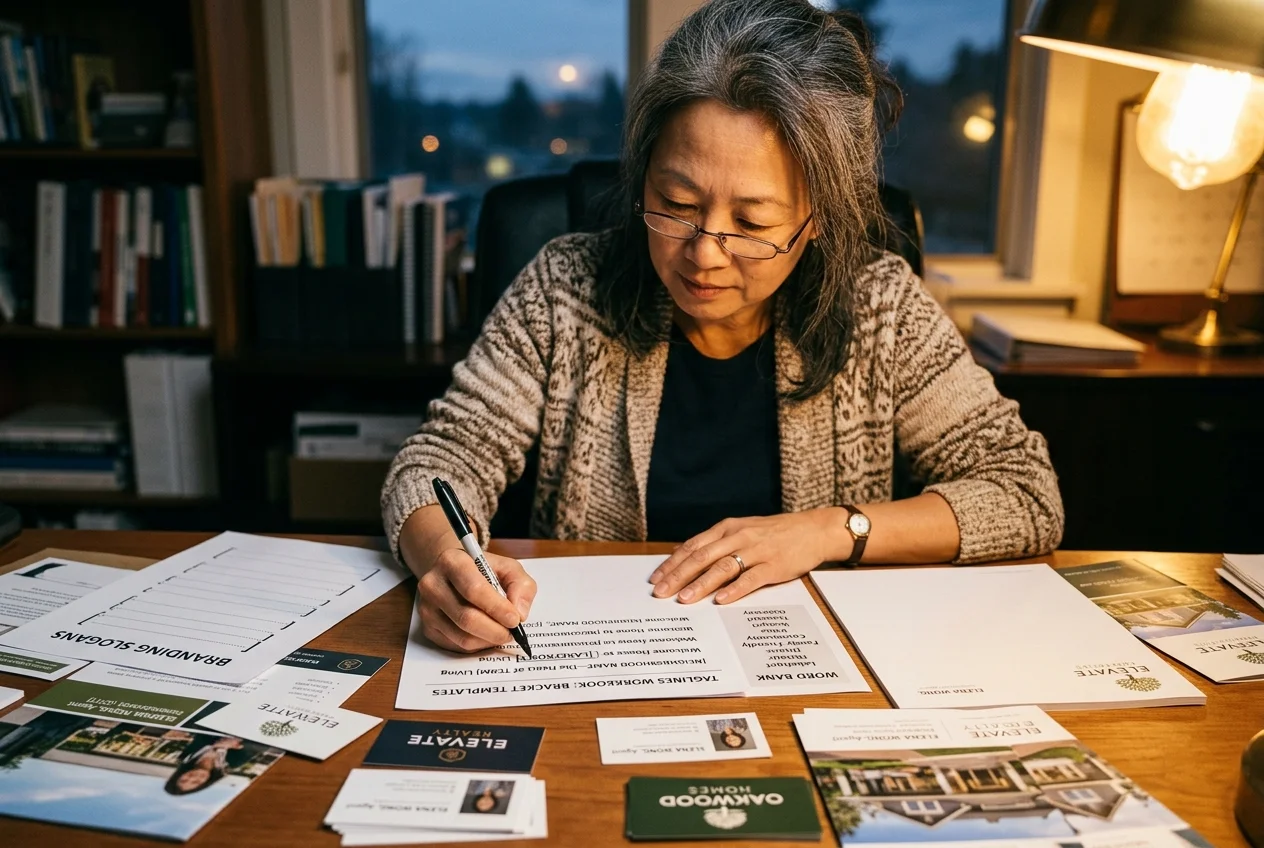
Placeholders keep a slogan custom without turning it into a sentence. Replace every bracket before anything goes to print.
Use these placeholders consistently:
- [City]
- [Neighborhood]
- [Team Name]
- [Niche]
- [Outcome]
- [Year]
A simple build formula keeps the line ownable:
- Audience: [Niche]
- Promise: a clear outcome or process
- Differentiator: what makes the work distinct
- Rhythm: a tight second phrase that reads well out loud
guide
Outcomes: keys in hand
Local authority: [Neighborhood] specialist
Proof words: straight answers
match
Outcomes: a clean offer
Local authority: from [City]
Proof words: no guesswork
price
Outcomes: less back-and-forth
Local authority: on the right block
Proof words: clear next steps
prep
Outcomes: a smoother close
Local authority: [County] to [County]
Proof words: fast replies
negotiate
Outcomes: the right buyer
Local authority: local comps, explained
Proof words: clean timelines
protect
Outcomes: fewer surprises
Local authority: boots on the ground
Proof words: calm process
list
Outcomes: a strong launch
Local authority: built in [Year] knowledge
Proof words: detail first
close
Outcomes: confident decisions
Local authority: hyperlocal, not generic
Proof words: paper-ready
Word bank for building slogans that stay specific and repeatable.
Two finished builds using the same bank:
- “[Neighborhood] specialist. Straight answers to close.”
- “Price smart in [City]. Clean timelines, calm process.”
Slogan Library by Niche and Use Case
The list runs in one continuous count, so shortlist building stays easy. Each category starts with a short note on where the tone fits best.
Catchy and short: built for logos, business cards, and sign riders.
- “Know the block.”
- “Keys, handled.”
- “List smart.”
- “Move with clarity.”
- “Offer to close.”
- “Home, without guesswork.”
- “Local, on purpose.”
- “Fast replies. Clean deals.”
- “The right fit, found.”
- “Calm in the chaos.”
- “Details win offers.”
- “Prep. Price. Present.”
- “Clear comps, clear choices.”
- “Straight talk real estate.”
- “Next move, mapped.”
Trust and service-first: fits listing consults, referral asks, and client updates.
- “Replies that respect the clock.”
- “Paperwork managed, stress reduced.”
- “Clear steps from day one.”
- “A plan for every pivot.”
- “Questions answered in plain words.”
- “Guidance that stays steady.”
- “Options explained, pressure removed.”
- “Deadlines protected, details tracked.”
- “Comps you can check yourself.”
- “No mystery process.”
- “Calm voice, firm negotiation.”
- “Honest pricing, careful prep.”
- “Service that shows up.”
- “Clients first, details always.”
- “Follow-through, not follow-up.”
Note on overuse: “trusted advisor” and “your real estate partner” often read generic.
Local authority and neighborhood-expert: strongest fit for a focused farm and repeat mail.
- “[Neighborhood] homes, week after week.”
- “Local comps, explained in plain words.”
- “From [City], for [City].”
- “Selling the right block in [Neighborhood].”
- “[County] listings, launched on schedule.”
- “Street-by-street guidance in [City].”
- “The [Neighborhood] playbook, applied.”
- “Know the inventory before it hits.”
- “Local timelines, local vendors, local results.”
- “[Neighborhood] details matter here.”
- “Pricing in [City] without guesswork.”
- “Built on [Year] market memory.”
- “The right micro-market, not a wide net.”
- “From showing routes to closing dates.”
- “Hyperlocal work, precise paperwork.”
A place-first line compounds with repetition inside one farm area. Honesty matters more than style. “Born and raised” claims do not belong unless true.
Luxury and high-end: restraint reads premium, and the gallery carries the weight.
- “Quiet marketing. Serious buyers.”
- “A measured launch for high-value homes.”
- “Details first, always.”
- “Presentation that respects the property.”
- “Discreet process, firm negotiation.”
- “A listing plan built for [Neighborhood].”
- “Price discipline. Strong positioning.”
- “High-touch, low-noise.”
- “Comps, craftsmanship, and calm.”
- “Luxury without the fluff.”
- “A brand-level listing approach.”
- “Ready for the serious tour.”
First-time buyer: plain language beats industry vocabulary here.
- “First keys, zero guesswork.”
- “From budget to keys.”
- “Clear steps for first moves.”
- “Offers explained, not rushed.”
- “A first home plan that fits.”
- “Inspection day without the panic.”
- “Guidance that keeps the math honest.”
- “Tour smart, offer ready.”
- “From showing list to signed contract.”
- “No jargon. Real answers.”
- “Confidence for the first offer.”
- “First home, firm strategy.”
Seller and listing-focused: best for listing pushes and repeat seller mail.
- “Prep smart. Launch strong.”
- “Price discipline, clear positioning.”
- “Every listing treated like a brand.”
- “A plan that earns strong offers.”
- “Listing details that reduce surprises.”
- “Firm pricing logic, calm negotiation.”
- “Show-ready, then market-ready.”
- “The right buyer, reached early.”
- “A listing timeline you can follow.”
- “From prep list to closing table.”
- “Marketing that respects the comps.”
- “Clear next steps for sellers.”
Speed promises do not belong in a slogan. Strong lines promise process and care, not guaranteed outcomes.
Investor and rental-property: blunt language signals deal focus.
- “Deal flow for [City] investors.”
- “Clean numbers, fast close.”
- “Cash-flow focus, not window dressing.”
- “Underwrite the street, not the hype.”
- “Rents, returns, and resale paths.”
- “Off-market awareness, on-market discipline.”
- “Acquisitions handled with pace.”
- “Exit plans built in.”
- “Turnover timelines, tracked.”
- “From offer math to keys.”
Relocation and military: logistics competence beats cleverness.
- “Remote tours, local execution.”
- “Landing in [City] with a plan.”
- “Short timelines, tight checklists.”
- “A move plan that stays on time.”
- “Showings staged for time zones.”
- “Neighborhood fit, explained quickly.”
- “From airport visit to signed offer.”
- “PCS moves, paperwork in order.”
- “A local guide for a new city.”
- “Fast decisions, calm process.”
Condo, townhome, and urban: highlight building knowledge, not resident types.
- “HOA details surfaced early.”
- “Building-by-building guidance.”
- “Small space, smart strategy.”
- “Walkable living, clear comps.”
- “Condo docs, reviewed fast.”
- “Townhomes priced with discipline.”
- “Urban launches, sharp marketing.”
- “Know the building rules.”
- “From bylaws to closing day.”
- “City listings, timelines that hold.”
Land, farm, ranch, and rural: plain and grounded wins trust.
- “Acreage details, explained clearly.”
- “Access, water, and use paths.”
- “Land deals without the runaround.”
- “Fence line to closing line.”
- “Rural comps, done carefully.”
- “Road frontage, verified.”
- “Wide-open buying, tight paperwork.”
- “From survey to signed contract.”
- “Ranch listings, marketing that fits.”
- “The land math, done right.”
Downsizing and life-transition: dignity first, no jokes.
- “Right-size with calm guidance.”
- “Transitions paced with care.”
- “A clear plan for next chapters.”
- “Estate timelines, tracked carefully.”
- “Probate details, quietly sorted.”
- “Two homes, one clear plan.”
- “Sell and settle without chaos.”
- “A move that respects the moment.”
- “Forms filed, pressure removed.”
- “Clear steps through change.”
Age and familial-status phrasing needs a Fair Housing read before printing.
Witty and funny: best as short campaigns, not a permanent logo line.
- “Yes, the wallpaper affects the price.”
- “Less drama, more doors.”
- “I read the HOA docs. All of them.”
- “Zillow guessed. I measured.”
- “Cookies at the open house, comps in the car.”
- “Negotiating loudly on the inside.”
- “I move couches for better photos.”
- “Ask me about the crawl space. Please.”
- “Tour smart. Snack later.”
- “Signed, sealed, mildly caffeinated.”
- “Weirdly excited about your attic.”
- “I text back. That is the whole brand.”
Humor has a short half-life. A line that plays on social can read unserious in a listing consult.
Team and brokerage: the team name carries the who, the slogan carries the why.
- “[Team Name]: steady process, firm negotiation.”
- “[Team Name]: local comps, clear options.”
- “[Team Name]: prep, price, present.”
- “[Team Name]: buyers matched, sellers protected.”
- “[Team Name]: one plan, many roles.”
- “[Team Name]: details tracked, deadlines protected.”
- “[Team Name]: built for [Neighborhood] listings.”
- “[Team Name]: deal math and calm execution.”
- “[Team Name]: offer-ready, paper-ready.”
- “[Team Name]: serious strategy, steady service.”
- “[Team Name]: listing-first marketing.”
- “[Team Name]: local work, real results.”
Three examples of shortening a bloated team line:
- Before: “The Ridgeline Group, Local Experts Serving Buyers and Sellers Across [City] and Surrounding Communities.”
After: “Ridgeline Group: know the block.”
- Before: “[Team Name] Real Estate Team, Helping Clients Buy, Sell, and Invest With Integrity and Exceptional Service.”
After: “[Team Name]: clear steps, clean closes.”
- Before: “Your neighborhood team for first-time buyers, relocation clients, and move-up sellers in [City].”
After: “[City] moves, handled.”
Rule: the team name carries the who, so the slogan only has to carry the why.
Short taglines for bios and riders: under 30 characters including spaces.
- “Know the block.” (14 chars)
- “List smart.” (10 chars)
- “Keys in hand.” (13 chars)
- “Clear steps. Clean close.” (23 chars)
- “Local comps, explained.” (21 chars)
- “Calm process.” (13 chars)
- “Offer to close.” (14 chars)
- “Prep. Price. Present.” (19 chars)
- “Details win offers.” (18 chars)
- “Fast replies.” (12 chars)
- “Paperwork, handled.” (18 chars)
- “Home, without guesswork.” (22 chars)
Character limits vary by channel, and short lines travel best. For profile writing that fits the platform, see a full real estate social media strategy.


Stage your first listing in under 5 seconds
15 space types, 10 styles, MLS-compliant by default. All 11 tools on one account. Free trial credits, no credit card.
Start staging freeWhere the Line Has to Work
A slogan is not a mission statement. The yard sign sets the true word limit, because it forces legibility and speed.
On real estate yard signs, assume a driver gives the line about two seconds. If the words do not land in large type, the line belongs in a brochure, not on the sign.
Print pieces offer more room, but repetition becomes the constraint. A farm-area mailer repeats month after month. That makes a clever line feel tired fast. A straightforward line keeps working.
Real estate postcards also push the “logo plus line” layout. A clean tagline often fits better than a campaign slogan.
Digital surfaces create a different kind of pressure. A social bio has a hard character limit and competes with a call to action. An email signature often gets forwarded, so a slogan can date quickly. A listing presentation can carry a longer line, but the slides need proof behind the promise.
One practical rule keeps the editing simple: if the line cannot survive being set in 30pt type, it is copy, not a slogan.
Your Slogan Makes a Promise the Photos Must Keep
A slogan makes a claim, even when it sounds simple. “Every listing shown at its best” sets an expectation before a buyer reads a single word.
The listing gallery is where that promise gets tested. Empty rooms, dark interiors, and flat exterior light can undercut a strong line in one scroll.
That is why strong branding pairs words with consistent visuals. The craft behind real estate visual marketing matters as much as the tagline next to the logo.
AI virtual staging can help when a space needs context, and AI HomeDesign supports that workflow with three hubs, virtual staging, photo editing, and renovation, across 11 tools, one shared credit pool, free regenerations, from $0.24 a photo, and MLS-compliant output by default.
Disclosure belongs in the image, not hidden in the fine print. Use direct language like “virtually staged” or “AI-edited image” on any altered visual.
Commission or fee figures also do not belong in a slogan. Put the promise on the sign. Save pricing, proof points, and negotiation talk for the listing consult.
Screen It for Fair Housing and Trademark Risk
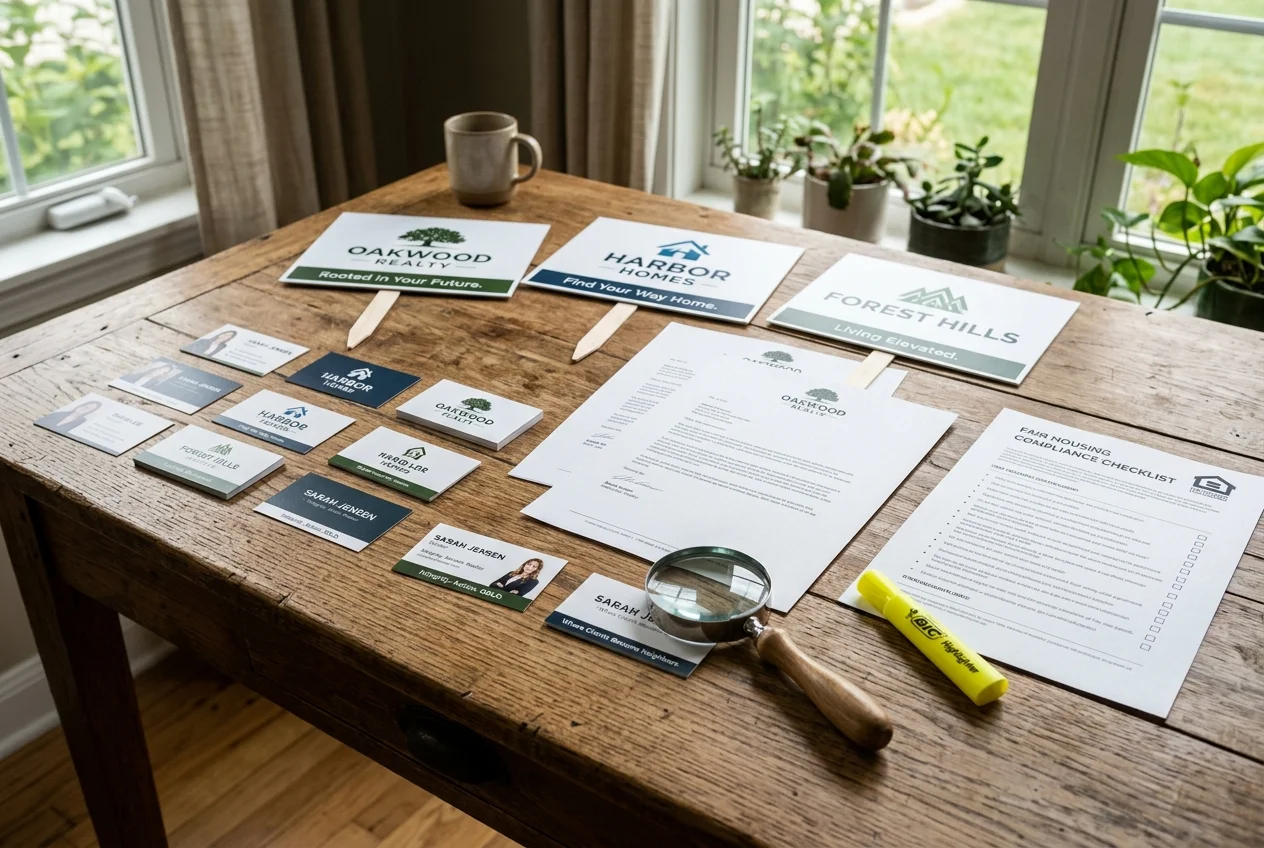
Most slogan pages skip the part that protects a brand. Screening takes less time than reprinting signs.
Fair Housing risk often shows up when a line describes who an area is for instead of what the service does. Risky phrasing includes “family-friendly,” “safe area,” “perfect for young professionals,” and “exclusive community.” Use property facts and service claims instead.
Examples of safer rewrites:
- Risky: “Find a safe neighborhood in [City].”
Safer: “Find the right block in [City].”
- Risky: “Homes in family-friendly [Neighborhood].”
Safer: “[Neighborhood] homes, priced with discipline.”
- Risky: “Perfect for young professionals.”
Safer: “Close to what matters in [City].”
The same discipline helps in listing descriptions, where Fair Housing language also applies.
Trademark screening should happen before printing. Start with the USPTO trademark search database, check the state business registry, then run a plain Google and social handle search for the exact phrase. A slogan can still carry common-law protection even without federal registration.
The National Association of REALTORS keeps a central hub for research and statistics, and it also publishes professional standards that reinforce careful advertising language.
REALTOR® is a collective membership mark with usage rules. Do not build a slogan around it, do not change its spelling, and do not use it as a generic word for agent.
Pre-launch screening checklist:
Not legal advice.
Test and Select One in Twenty Minutes
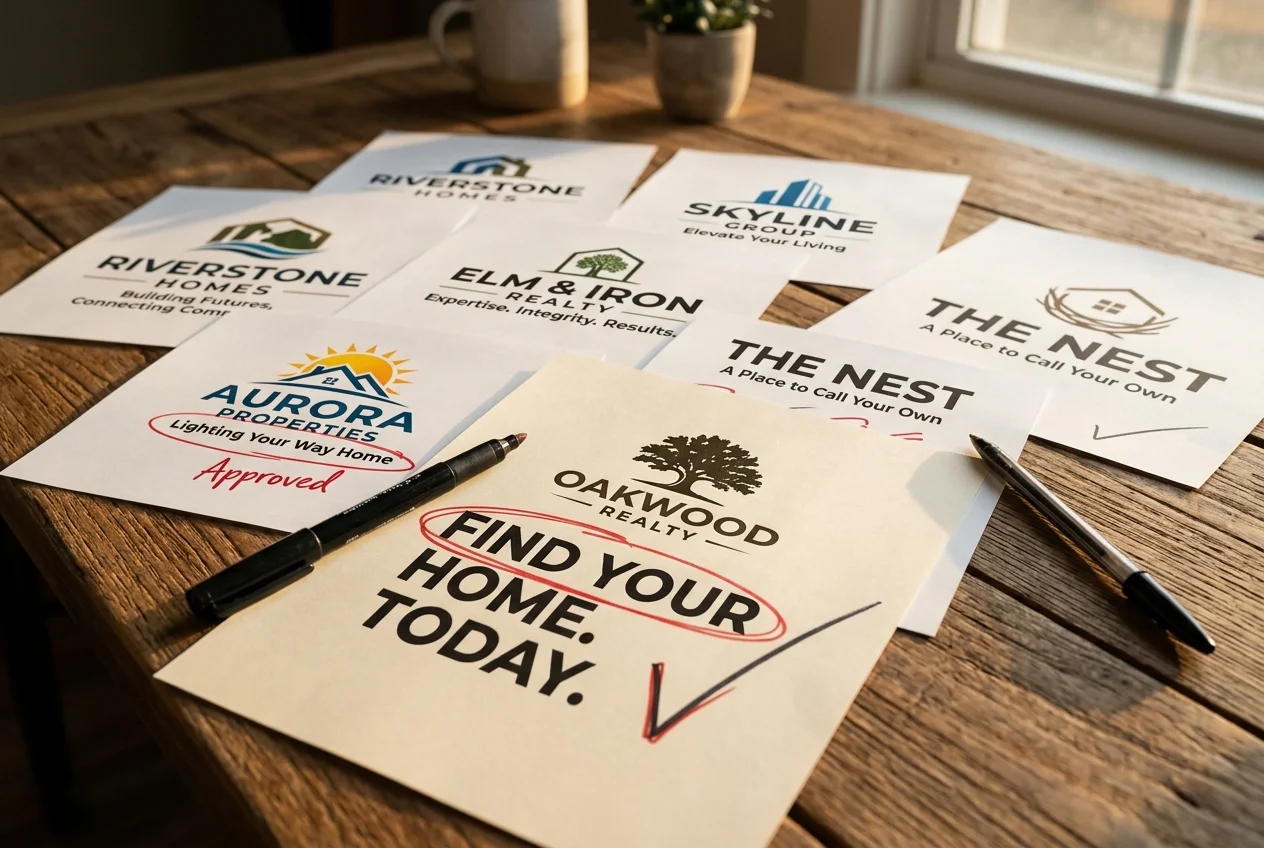
A slogan does not need a committee. It needs fast clarity, basic screening, and a commitment period long enough for repetition to compound.
Write the niche sentence
Start with one sentence that names the niche and geography, such as “Investor sales in [City] condos” or “Move-up buyers in [Neighborhood].” Use that sentence as the filter for every line.
Pull three candidates
Pull three lines from the matching category above, or build one from the word bank with [City] and [Niche]. Keep every candidate under 10 words.
Run the clarity tests
Say the line out loud once. Then run a four-second clarity test on a non-agent friend: show the line for four seconds and ask what service it signals and where.
Run a cheap directional A B
Run two slogan versions as ad headlines for two weeks, then compare clicks and profile taps. The real estate Facebook ads headline field works as a low-budget test bed before printing.
Commit for a seven-day decision window
Set a seven-day window to pick one line, screen it, and place it on the key surfaces. Then leave it alone for at least six months so repeat exposure can do its job.
Frequently Asked Questions
What is a good real estate slogan?
A good slogan stays specific and easy to repeat. It names a place, a niche, or a concrete outcome, and it still makes sense to someone outside real estate. Strong lines also avoid rankings, guarantees, and demographic language that can create Fair Housing risk. If the line survives a fast read on a yard sign, it is usually strong enough everywhere else.
What is the difference between a slogan and a tagline?
A tagline is brand-level and sits with the logo for long periods. A slogan is campaign-level and can change with season, niche, or channel. A simple test helps: if changing the line would confuse past clients, it behaves like a tagline. If the line rotates for listings, events, or ads, it behaves like a slogan.
How long should a real estate slogan be?
Most agents do best with 4 to 9 words for a campaign slogan and 2 to 5 words for a logo tagline. Past 10 words, the line turns into copy and starts failing at sign distance. For bios and sign riders, a short line under 30 characters travels better across platforms and print sizes.
Can an agent use a slogan found online?
Only after a screen. A line posted online may be in active use by a team, brokerage, or franchise, and common-law protection can still apply even without federal registration. Run a trademark sweep in the USPTO database, check the state registry, and search Google and social handles for the exact phrase before printing.
What words should be avoided in real estate slogans?
Avoid language that describes who a neighborhood is for, such as “family-friendly,” “safe area,” “exclusive community,” or “perfect for young professionals.” That phrasing can read like steering and create Fair Housing risk. Also skip “#1” style rankings, guaranteed results, and any slogan built around the REALTOR® mark or MLS branding.
Do real estate slogans generate leads by themselves?
A slogan mainly drives recognition and recall across repeated exposure. Leads come from the offer, the follow-up, and the channels carrying the message. A strong line still matters because it keeps signs, mailers, profiles, and listing materials consistent. That consistency makes each exposure build on the last instead of starting over.