Real Estate Disclosures: What Sellers Must Tell Buyers
In short
- Known facts win: answer with observations, dates, and documents, not diagnoses or guesses.
- Lead paint stacks: pre-1978 homes have a separate federal disclosure packet on top of state forms.
- Marketing must match: label virtually staged and edited photos so images never contradict the form.
A disclosure form often lands as a long, unfamiliar questionnaire. Real estate disclosures work best when sellers treat them like a record of known facts, not a test of perfect memory.
Rushing the form creates the same problem every time: a guess gets written down as certainty. Sellers can avoid that by gathering records first, answering in plain facts, and updating the form if something changes.
This guide fits inside a wider real estate marketing guide because disclosures, photos, and listing copy all represent the property together. This article is general information only, and state forms and duties vary, so local guidance matters.
How real estate disclosures work in practice
A seller disclosure is a written statement of known conditions that could affect value, safety, usefulness, or enjoyment. “Known” is the key word. The form usually asks for what has happened, what has been repaired, and what paperwork exists.
Sellers can move faster with a simple rule: write what was observed and what was done, then attach the record. A disclosure answer is stronger when it reads like an incident log rather than a diagnosis.
Timing also matters. Sellers usually sign the form early, then live in the home for weeks while it is marketed and under contract. Any meaningful new fact can require a written update.
What a seller disclosure actually is and what it is not
A disclosure is not a home inspection. The disclosure reflects the seller’s knowledge. A home inspection is a buyer-paid, third-party evaluation that may find issues the seller never noticed.
Disclosing is not the same as repairing. A seller can disclose a roof leak history and still sell without replacing the roof. Negotiations over repairs or credits happen separately, after facts get shared.
Facts belong on the form. Opinions belong in conversation. The deliverable should include dates, documents, and plain observations. An in-person conversation can cover context, priorities, and how a seller plans to respond to inspection findings.
| response style | what it looks like | why it holds up |
|---|---|---|
| Known fact | “Water stain on basement wall; first noticed after heavy rain; contractor invoice attached.” | It states what happened and points to proof. |
| Speculation | “Probably a gutter issue and it is fine now.” | It guesses at cause and certainty. |
| Unknown | “Unknown, seller has no knowledge; no testing performed.” | It avoids guessing and signals a gap clearly. |
Examples of facts, guesses, and unknowns that sellers can write clearly.
The one federal rule: lead-based paint and pre-1978 homes
Homes built before 1978 carry a separate federal requirement for lead-based paint disclosure. Sellers generally disclose any known lead-based paint and lead hazards, provide any related records or reports on hand, and deliver the required informational materials and acknowledgments as part of the transaction, as described in this seller disclosures overview.
One common mix-up creates problems: “never tested” is different from “no lead.” A seller can truthfully say no testing occurred and still comply by sharing what is known and passing along any existing paperwork.
The buyer side may include an opportunity to conduct a lead inspection or risk assessment unless waived in writing. The exact window comes from the contract documents used locally.
Why every state’s form looks different
After the federal lead-based paint rule, most disclosure duties run through state forms and local addenda. Some states use a long checklist-style property condition disclosure statement. Others use a shorter form. Certain transfers may qualify for limited exemptions, such as some estate or trustee situations.
Sellers should avoid generic templates found through search. The correct form is the current version used by the local brokerage, closing attorney, or state licensing body.
For an example of how detailed state guidance can be, the California Department of Real Estate publishes a California-specific disclosure booklet called disclosures in real property transactions. California’s format should not be treated as the standard everywhere.
What the disclosure form actually asks about

The wording changes by state, but the topics repeat. Most forms focus on safety, water, major systems, legal rights to use the property, and obligations that follow the home. Sellers can answer faster by matching each category to the file that supports it.
Structure, foundation, and roof
This category targets settlement, structural movement, and water entry from above. Disclose known cracks that changed over time, prior foundation work, roof leaks, and repairs. Attach engineering letters, roof invoices, and warranties when available. If the roof age is unknown, say so and attach the oldest available record.
Water intrusion, drainage, and mold
Buyers react strongly to water history because it can repeat. Disclose past basement or crawlspace water, grading issues, flooding history, and remediation work. A seller can say what was seen and what was done, without claiming to identify mold type or source. Attach remediation reports and drainage invoices.
Septic, well, sewer, and water supply
Forms often ask the system type and any known performance issues. Disclose last septic pump or inspection record, well test results, and any shared well agreements or easements. Sewer backups, slow drains tied to mainline issues, or known capacity limits belong here, with service receipts attached.
Pests and infestation damage
This section covers termites and other wood-destroying organisms, plus rodents and recurring infestations. Disclose treatments, ongoing contracts, and warranties or bonds. If repairs occurred due to pest damage, note the repair and attach the invoice. Avoid guessing about “active” or “inactive” without a current report.
HVAC, electrical, and plumbing
Sellers should treat “works” as a known fact, not an assumption. Disclose known non-working components, recurring failures, and major replacements. If the home has older materials or upgrades, note known facts such as a panel replacement or re-pipe, backed by invoices or permits. Leave technical judgments to licensed inspectors.
Repairs, renovations, and permits
Disclose what was done, who performed it, and whether permits and final inspections exist. Unpermitted work is a known fact even if it looks good. Sellers can reduce conflict by attaching permit cards, final approvals, and contractor scopes of work rather than summarizing from memory.
Past insurance claims and losses
Many forms ask about prior claims, losses, and repairs. Disclose known fire, water, wind, or liability incidents tied to the property. Add the repair paperwork and explain the resolution in plain language. Buyers and insurers often find loss history during underwriting, so clear documentation helps.
Boundaries, easements, and encroachments
This section covers the right to use the land as expected. Disclose known survey issues, shared driveways, fence encroachments, access agreements, and utility easements that affect use. Attach surveys, plats, or recorded agreements when available. If no survey exists, the disclosure can say none is on hand.
HOA obligations, fees, and use restrictions
If the property sits in an HOA or condo association, disclose dues, known special assessments, and restrictions that affect everyday use, such as rental rules or exterior-change limits. Attach the governing documents and any recent assessment notices the seller holds. Pending litigation known to the seller belongs on the form when asked.
Hazard zones and neighborhood conditions
Some forms ask about flood zones and other mapped hazards, plus off-site conditions that materially affect enjoyment, such as recurring airport noise. Sellers should answer what is known from documents, prior reports, or official notices. If the form asks and the seller lacks knowledge, “unknown” is safer than silence.



Every tool a listing needs, on one account
10+ tools, including social pack. Free trial credits, no credit card.
Try AI HomeDesign freeThe gray areas sellers ask about most
Sellers often get stuck on questions that feel personal or subjective. A practical approach helps: disclose ongoing facts that a reasonable buyer would care about, and separate those from opinions.
Deaths in the home fall into this gray zone. Some states require little or nothing. Others address it only when the buyer asks, or only within a certain lookback. Sellers should ask a local broker or attorney how the local form handles it before answering.
Neighbor disputes and recurring nuisances also create tension. An ongoing boundary fight, repeated noise, or chronic odor issue can affect enjoyment and value. If the issue is current and known, it often belongs in the disclosure.
Known-but-unpermitted work should be treated as a fact category, not a confession. State what was done, when, and what paperwork exists. Buyers can evaluate quality and risk during inspection and permit research.
“As-is” language rarely erases disclosure duties. It usually shifts who pays for repairs, not whether a seller must disclose known material defects. Repair credits and negotiation strategy belong in a separate discussion, tied to the transaction budget described in what it costs to sell a house.
Agent duties matter too. In many markets, licensees have their own duty to disclose material facts they know. A seller cannot rely on “off the record” discussions to keep a known issue out of the transaction.
Disclosures and your listing marketing: keep the photos and the form in agreement

A disclosure form is a written representation about the home. Listing marketing also represents the home. When photos, captions, and remarks contradict the disclosure, the listing creates the exact misrepresentation risk disclosure rules aim to prevent.
Edits should enhance clarity, not erase facts. Virtual staging can add furniture and decor, but it should not hide a stain, crack, or active damage. Item removal can clean up clutter, but it should not remove evidence of a known condition issue. Day-to-dusk can change sky and lighting, but it should not change structure.
Labeling should be treated as the default. Many MLS systems have specific requirements for remarks and photo labels, so sellers and agents should align with MLS rules and listing do's and don'ts.
AI tools can fit this workflow when labeling stays clear. AI HomeDesign supports AI Virtual Staging, AI Item Removal, AI Day to Dusk, and Image Enhancement, and it is MLS-compliant by default because it preserves original fixtures and structure. Plans start From $19/mo with annual billing, and the free trial provides watermarked results.
Pre-listing disclosure checklist and mid-transaction updates
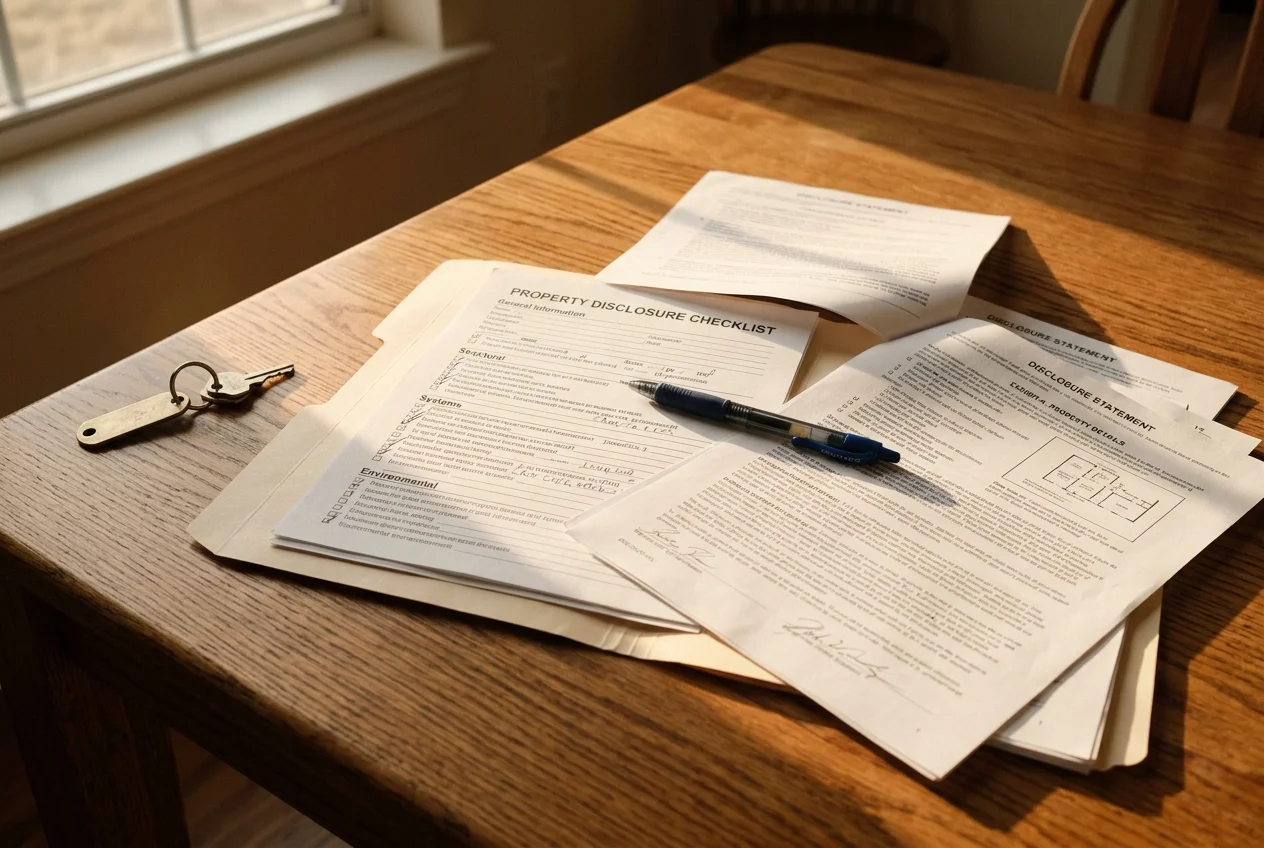
Disclosure work goes smoother when sellers treat it like a short project with a deadline. A practical target is to have the form and attachments ready 3 to 5 days before the listing goes live. That window gives time to locate records, ask contractors for duplicates, and resolve “unknown” items without guessing.
Gather these documents before touching the form
A seller cannot disclose clearly without paperwork. This is the core stack that answers most questions.
Checklist
0 of 10 doneAgents often include this record-gathering step in a pre-listing package so sellers know what to pull before paperwork starts.
Plan the disclosure walk-through and photo day together
Photo day often becomes a forcing function. Sellers should coordinate repair decisions, cleaning, and disclosure drafting so the listing shows the same reality the form describes.
A staging plan also helps sellers document what is cosmetic versus what is a condition issue. Many sellers start with these home staging tips for sellers so the disclosure stays focused on material facts.
Label edited photos so marketing never contradicts the form
If a photo is edited in a way a buyer cannot detect, labeling prevents confusion. Common labels include “virtually staged,” “virtual renovation concept,” “digitally enhanced,” and “day-to-dusk.”
For a practical photo workflow, agents often standardize captions while they enhance your listing photos so every platform carries the same disclosure language.
If something changes before closing, update the form in writing
A disclosure reflects what the seller knows when signing. A new leak, storm damage, a failed appliance, or a repair completed after signing can change a material answer.
Written updates protect both sides. A dated amendment and the attached invoice create a clean record. A verbal mention during a showing or a call does not. The timing pressure between contract and closing is easier to manage with a clear moving checklist that tracks what still needs documentation.
Common mistakes that turn into disputes
Small paperwork errors often cause big deal friction.
Checklist
0 of 6 doneFrequently asked questions
Do I have to disclose a problem I already repaired?
Yes in most transactions, because the repair history itself is a known fact a buyer may rely on. A strong answer pairs the original issue with the fix: what happened, when it occurred, who did the work, and what warranty or invoice exists. A documented repair usually reassures buyers more than an unexplained “no” that an inspector later questions.
What if I genuinely do not know an answer on the form?
Mark the item as unknown and explain the limit briefly when the form allows it. “Unknown, seller has no knowledge; no testing performed” reads cleaner than a blank line or a guessed “no.” If the question covers something visible, the safest path is to describe the observation as a fact, without diagnosing the cause.
Does selling as-is mean the disclosure can be skipped?
Generally no. As-is usually means the seller does not plan to make repairs or offer credits, but it does not erase the duty to disclose known material defects. The federal lead-based paint disclosure still applies to pre-1978 housing. Some states allow narrow exemptions for certain transfers, so local forms and counsel matter.
Do sellers have to disclose a death in the house?
It varies widely by state and sometimes by how the local form is written. Some states require no disclosure, some treat it as a “stigmatized property” topic with limits, and some address it only if a buyer asks directly. The safest approach is to follow the local form instructions and answer direct questions truthfully.
What should be done about unpermitted work?
Disclose what was done and when, and share whatever documentation exists, even if no permit was pulled. Unpermitted work is still a known fact that can affect value and insurability. Buyers and inspectors often find clues during due diligence, so clear disclosure and paperwork reduce renegotiation surprises later.
Do virtually staged or day-to-dusk listing photos need disclosure language?
Treat labeling as standard practice. “Virtually staged,” “day-to-dusk,” and “virtual renovation concept” give buyers the context they need, and they prevent marketing from conflicting with the seller disclosure form. Editing should never remove a visible condition issue. If an edit could hide a known defect, include an unedited photo too.