CMA Real Estate: 2026 Guide to Comparative Market Analysis
In short
- Adjustments drive value: The comp math only works when line‑item differences are priced and documented.
- Different tools, different roles: A CMA guides pricing and offers, while a lender‑ordered appraisal carries formal weight.
- DIY is a starting point: Portal estimates can be close in stable areas, but agents refine them with local comps and context.
A comparative market analysis (CMA) is a study that estimates the suitable selling price for a property based on the prices of recently sold properties in the same area, known as comparable properties, or comps. CMA reports are usually created by real estate agents or brokers to let sellers come up with the right pricing for their property.
Buyers get similar insights from such reports by comparing the property they are buying with recently sold homes in areas that share similar features.
So, a thorough CMA real estate report is essential for both buyers and sellers to make informed decisions. One might say a CMA is more or less like a scale that weighs all factors to strike a balance and give a fair estimation of the property’s worth.
What is CMA in Real Estate?
The sole purpose of a CMA real estate report is to make sure that a property is priced accurately. Back in the day, you might have done this less technically. Perhaps you were at a weekend barbecue, flipping burgers with your neighbor, and you casually asked, “Hey, didn’t you sell your house last month? What did it go for?” Then, as you nibbled on some chips, you followed up with, “Do you know what the Johnsons down the street got for theirs?”
Equipped with that info, you’d then mentally calculate, “Well, if their place sold for $200,000 and ours has a bigger backyard, we could probably aim for $220,000.” Just like that, without spreadsheets or fancy tools, you’d do your very own CMA. The only thing that has changed today is the way we do this comparison, solely to make sure that our estimation is more accurate.
A CMA also fits inside the broader pricing and go‑to‑market plan agents build for each listing, as outlined in real estate marketing strategies.
When a CMA may mislead or fall short
CMAs assume enough recent, comparable sales exist. In thin markets with few closings, small differences skew the math. Rural areas and resort communities often require a wider search window and more judgment than dense urban neighborhoods. Unique or custom properties can also break the model. A home with a one‑of‑a‑kind view, an atypical floor plan, or a compound layout rarely has true peers, so line‑item adjustments carry more weight and uncertainty.
Rapid market shifts create a second risk. If rates move or inventory whipsaws between the comp sale dates and today, a backward‑looking CMA can lag reality. Watching contract velocity and price reductions helps, but when volatility is high, agents should add more real‑time context from active and pending listings.
Some properties need a different approach altogether. Land‑only parcels and tear‑downs follow land value and future use, not finished‑home comps, so agents often pivot to feasibility and entitlement research, starting with guides like how to buy a land. For estate, divorce, relocation, or loan‑driven scenarios, a lender or court may require a formal appraisal regardless of what the CMA shows. Buyer and seller behavior tracked in NAR research on home buyers and sellers reinforces why clear labeling and a defensible method matter when stakes run high.
The Steps of a Comparative Market Analysis

As a real estate agent or broker, you might want to learn how to come up with a CMA real estate report to provide better services to your clients. To do so, you should first take note of all features of the subject property and then, look for similar properties that have recently been sold.
First, let’s see what those features are.
The neighborhood
One of the key factors in determining the value of a property is the location:
- In which area/district is the property located?
- What amenities are in its vicinity?
- How crowded is the neighborhood?
- How safe is the neighborhood?
- What the local schools are like? and,
- How accessible is public transportation?
After assessing these location-based features, you can look for nearby neighborhoods with similar features.
However, this is only half the picture. For the other half, you need to evaluate the property itself, and that entails the following features:
Square footage
Other factors aside, the bigger the property, the higher its price. And apart from the size, you should consider the number of rooms. The more spaces (bedrooms, bathrooms, etc.) a property has–provided that they have a notable size for their purpose–the higher its value.
The property condition
The age of the property and whether it’s been recently renovated should factor into your final evaluation. Generally, properties with fewer maintenance issues are valued higher as they present less hassle for potential buyers. The exception is properties with unique historical or architectural significance, whose value may increase despite potential maintenance needs.
Property taxes
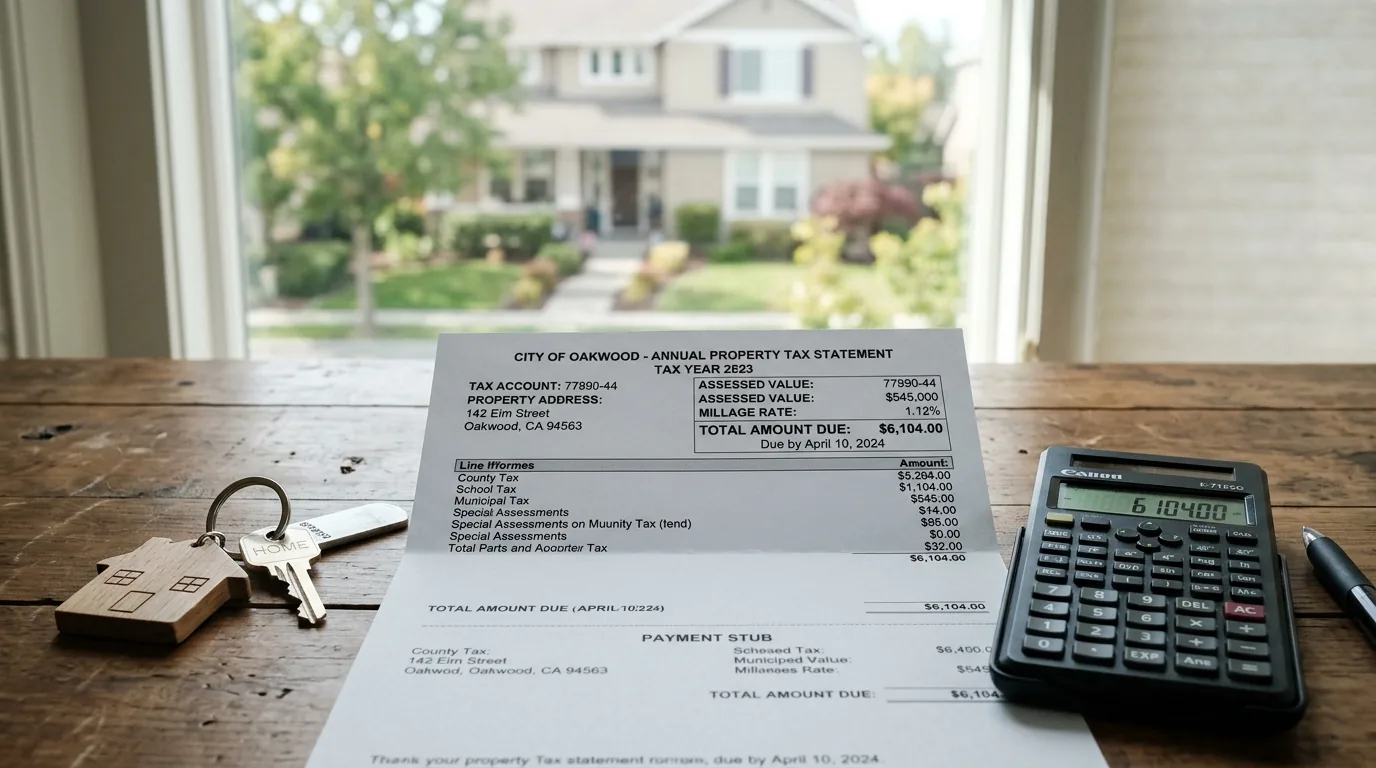
A property's annual tax bill is another key factor that can impact its value. Buyers often consider the tax burden when evaluating the overall cost of owning a property. In some cases, higher taxes deter potential buyers, while lower taxes make a property more appealing.
For a wider view of how tax burdens vary, see the Lincoln Institute of Land Policy property tax data.
Special property features
Some properties have special features like outdoor pools, patios, fenced yards, high ceilings, open floor plans, and so on. Each of these features adds something to the overall value of the place, and you should consider them when making your final comparison.
Utility infrastructure
Another important factor is the quality of essential services like water, electricity, sewage, gas systems, etc. Properties with reliable and modern utility connections are often more appealing to buyers. Poor or outdated utilities can reduce a property's desirability and affect its overall value.
Legal considerations
Legal considerations include factors such as zoning rules, land use regulations, and any disputes tied to the property. Buyers are often attracted to properties with no existing liens or unresolved legal issues, as these ensure a smoother transaction. Complications like boundary encroachments or restrictive easements can deter buyers and affect a property's worth.
Select the Comps

After carefully evaluating the subject property, you should find four to six comparable properties, or comps, to estimate the right price for the property in question. Keep in mind that the properties you choose as comps must:
- Have been sold recently (that is, in the last 3-6 months);
- Be located in the vicinity of the subject property;
- Be located in a similar neighborhood;
- Be as similar to the subject property as possible in terms of size, age, accessibility, number of rooms, etc.;
- Be in a similar condition regarding general upkeep, renovations, upgrades, etc.; and,
- Have almost the same quality for both exteriors and interiors.
Also, be careful about basing your judgment on online listings where property descriptions might not be as detailed as they should and the attached photos/videos might have been edited.
Though the comps are ‘not expected to be exactly the same as the subject property,’ finding valid comps is easier said than done, as properties often differ in at least a few key factors. After making sure that the properties you’ve selected are the most similar ones to the subject property, you can make the comparison.
Start with nearby closed sales and apply tight filters: four to six comps within roughly half a mile in urban areas and a wider radius in rural neighborhoods, the same school district and micro‑location, living area within about 10 percent, the same bed and bath count within plus or minus one, and the same condition tier. Favor closings in the last 90 days when possible, and extend to six months only when inventory is thin. Track active and pending listings as leading indicators because they signal momentum and pricing pressure before they close. Note how quickly similar homes go under contract and whether list‑to‑sale patterns are rising or softening to spot outliers you should exclude.
How to Calculate a CMA Real Estate?
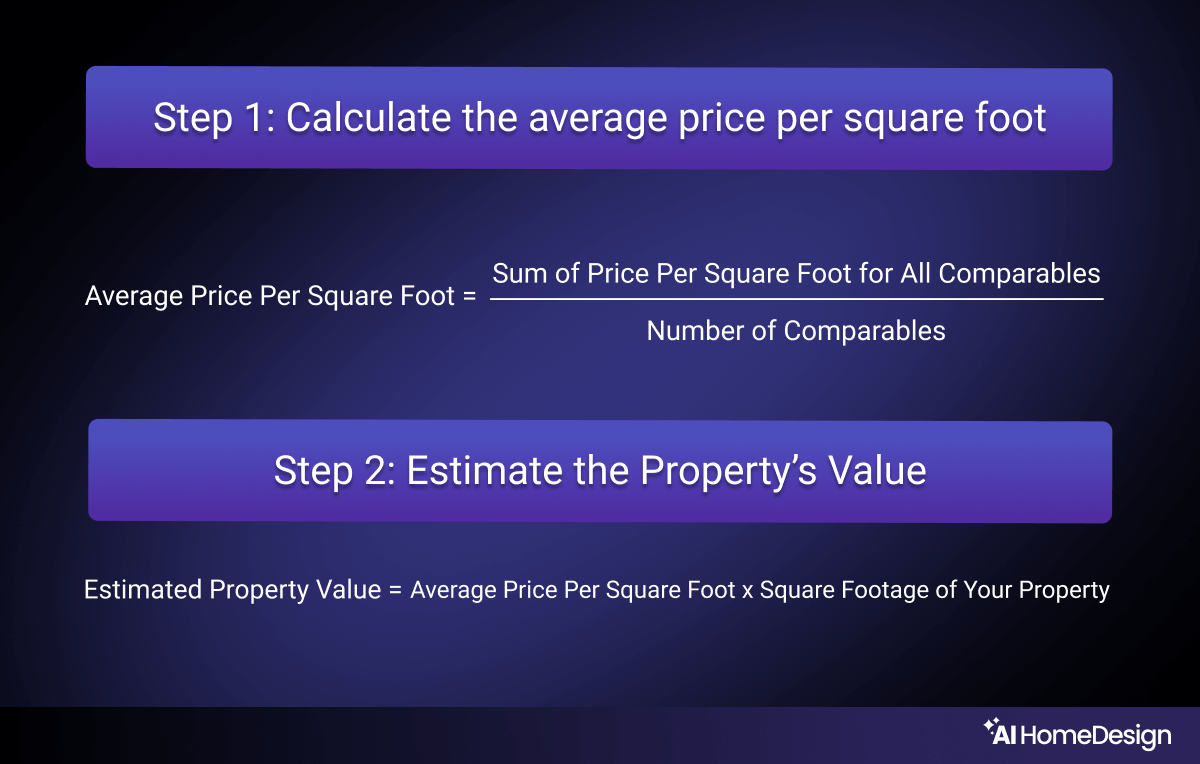
To make a healthy comparison, start by adjusting the sales prices of comps to make them more similar to your property. If a comp is missing something your property has, like a bigger yard, raise its price to reflect that. Similarly, if it has something better, like a renovated bathroom, lower its price accordingly. This helps you figure out what the comp(s) would sell for if they were more like your property.
Next, find out the price per square foot for each comp by dividing its adjusted price by its size. Then, to estimate your property’s value, multiply the lowest price per square foot by your home’s size to get the lower value range. Do the same with the highest price per square foot for the higher range.
Finally, calculate the average price per square foot for all comps, and multiply it by your property’s size to get the best estimate of its value.
Use the common price‑per‑square‑foot method to turn adjusted comps into a range:
Formula: (Adjusted comp price ÷ comp square footage) × subject square footage.
Worked example
Subject home: 2,000 sq ft.
Note: this walkthrough is simplified to three comps for clarity. A working CMA should use four to six comps, as described above.
Comp A: Sold for $445,000, 2,000 sq ft, one extra bath vs the subject. Adjustment −$15,000. Adjusted price $430,000. Price per sq ft = $430,000 ÷ 2,000 = $215.00.
Comp B: Sold for $420,000, 1,950 sq ft, older roof than the subject. Adjustment +$10,000. Adjusted price $430,000. Price per sq ft = $430,000 ÷ 1,950 ≈ $220.51.
Comp C: Sold for $425,000, 2,050 sq ft, corner lot vs the subject’s interior lot. Adjustment −$5,000. Adjusted price $420,000. Price per sq ft = $420,000 ÷ 2,050 ≈ $204.88.
Low and high bound: take the lowest and highest price‑per‑sq‑ft figures and multiply by the subject size. Low ≈ $204.88 × 2,000 = $409,760 (about $410,000). High ≈ $220.51 × 2,000 = $441,020 (about $441,000).
Midpoint estimate: average the three price‑per‑sq‑ft figures, then multiply by 2,000. Average ≈ (215.00 + 220.51 + 204.88) ÷ 3 = 213.46. Midpoint ≈ 213.46 × 2,000 = $426,920. In a tight seller’s market, agents often lean toward the upper third of the range. In a slower market, the midpoint or slightly below it draws more traffic.
Another option you have is to use a CMA real estate calculator that considers the above-listed features and makes the comparisons. If you prefer this option, you’d better avoid free CMA real estate ads and use a trusted tool that provides verified data and in-depth analysis. Now that you’ve calculated the value of the property, it’s time for the report.
Before finalizing the number, align pricing with the launch plan described in real estate marketing strategies. That keeps the math, the marketing, and the timing working together.



Every tool a listing needs, on one account
Free trial credits, no credit card. Staging, photo editing, and renovation on one account.
Try AI HomeDesign freeHow to interpret the CMA range for buyers and sellers
The range is not the price. It is the envelope for a strategy. In a hot market with low inventory, pricing near the top of the range can invite urgency and multiple offers. In a soft or oversupplied market, pricing at or just below the midpoint attracts more showings and reduces time on market. Seasonality also matters, so pair the range with guidance on the best time to sell a house.
Previewing small improvements can also shift where a home sits inside the range. Before the photographer arrives, many teams use real estate marketing strategies to align pricing with marketing steps. As part of that prep, AI HomeDesign’s how to sell a house fast frameworks show how pricing and presentation work together, and its AI Virtual Staging generates furnished listing photos in under 5 seconds, which helps judge renovation ROI before committing to a final list price.
Preparing a CMA Report
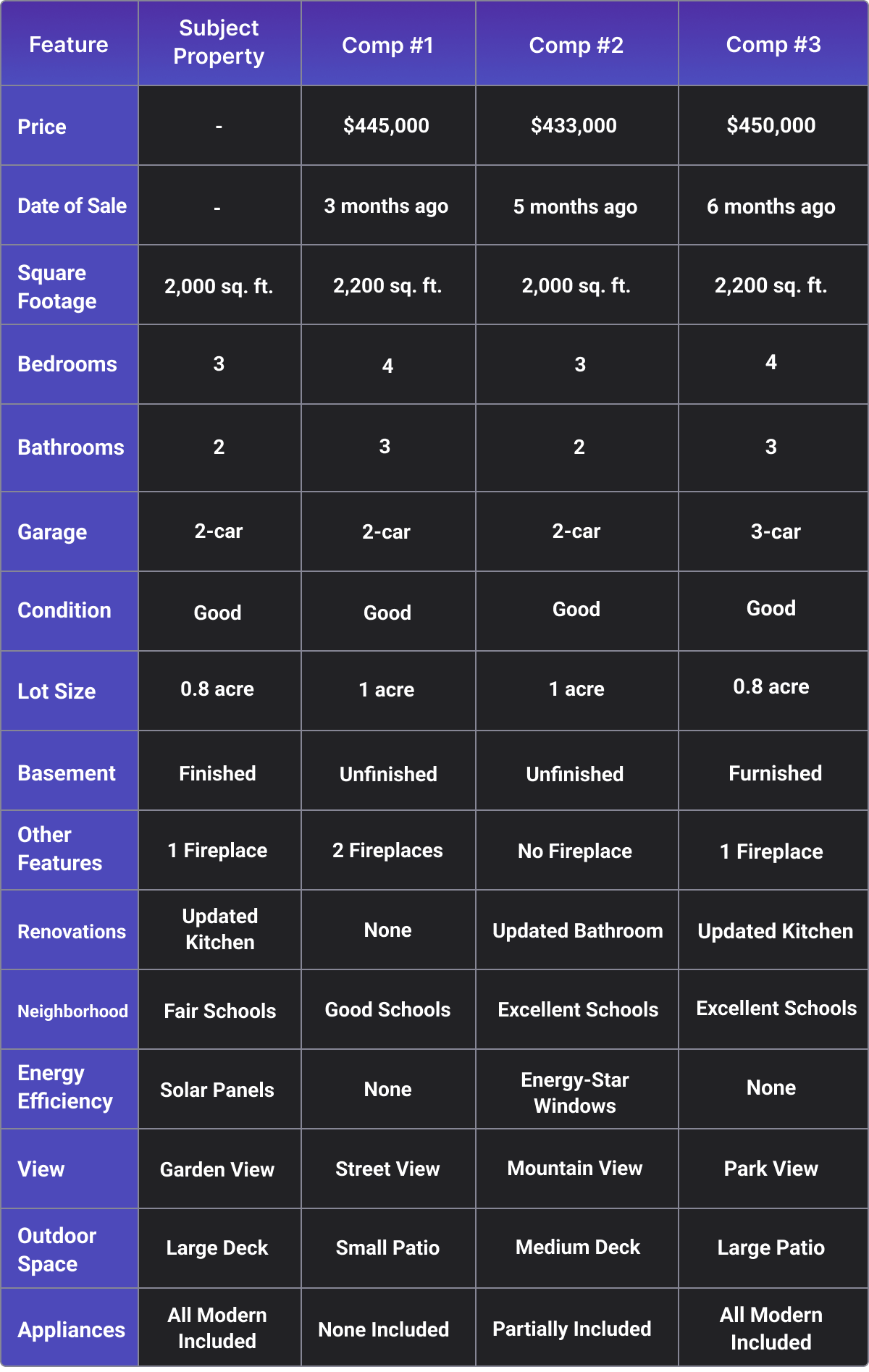
A lot of details can and should go into a CMA report, and it’s important to present those details in a neat and orderly manner. To learn how to prepare your report and present the information, you can search the web and find CMA examples.
In doing so, you’ll come across lots of free CMA templates that provide a clear structure for organizing property data, adjustments, and comparisons in a professional format. Choose one of those templates and customize it to fit your specific property and market data.
Presentation can be digital or print. Many teams package findings with Cloud CMA for live, mobile‑friendly walk‑throughs on a laptop or tablet. Others export a static PDF or build slides with iCMALive.
| Comp | Sold price | Size (sq ft) | Difference vs subject | Adjustment | Adjusted price | Price per sq ft |
|---|---|---|---|---|---|---|
| Comp A | $445,000 | 2,000 | One extra bath | −$15,000 | $430,000 | $215.00 |
| Comp B | $420,000 | 1,950 | Older roof | +$10,000 | $430,000 | ≈$220.51 |
| Comp C | $425,000 | 2,050 | Corner lot vs interior lot | −$5,000 | $420,000 | ≈$204.88 |
| Subject (2,000 sq ft) | Supported range about $410,000 to $441,000; midpoint estimate $426,920 | |||||
Based on the worked example above, we can conclude that the subject property is worth something around $427,000. After adjustments, Comp A and Comp B both land at $430,000 and Comp C at $420,000, which puts the supported range at roughly $410,000 to $441,000 and the midpoint estimate at $426,920. Where the list price sits inside that range is a strategy call: lean toward the upper third in a tight seller’s market, and toward the midpoint or slightly below it when buyers have more choice.
How Does a CMA Differ from Home Appraisal?
Both practices are related to real estate comparative market analysis, but they are done by different individuals and serve different purposes.
A CMA is done by a real estate agent or a broker to estimate the right price for a to-be-sold property. An appraisal is a formal valuation performed by a licensed appraiser on behalf of the lender once a buyer applies for a mortgage, to confirm the property is worth the loan amount.
A CMA primarily helps sellers set a listing price and helps buyers gauge offers, while an appraisal is ordered by the lender in a financed sale to protect the loan. An appraisal follows the Uniform Standards of Professional Appraisal Practice (USPAP), a set of professional appraisal standards, and is more formal, but both methods can land within a few percent of each other because they serve different purposes.
Digital and DIY CMAs: Zillow, Redfin and algorithmic estimates
Owners often start with portal estimates from Zillow, Redfin or Opendoor. These are algorithmic models trained on large datasets. In homogeneous neighborhoods with steady trends, they are typically within about 5–10 percent of a well‑built agent CMA. Accuracy drops when sales are sparse, properties are highly customized, or prices move quickly month to month. Zillow publishes its own median error rate for the Zestimate, broken out separately for on-market and off-market homes, on its Zestimate accuracy page, so the figure can be checked against the model's reported error.
A practical DIY approach is to pull recent closed sales that mirror the subject, then apply the same adjustment logic an agent uses, adding value to comps that lack a feature the subject has and subtracting from comps that are superior. Price‑per‑square‑foot math keeps the comparison consistent across small and large homes. Pair the numbers with on‑the‑ground context: days to pending, price reductions, and whether similar homes are attracting multiple offers.
These digital methods live inside a larger technology shift. For a deeper view of how data and imaging tools shape today’s workflow, see AI in real estate. Buyer and seller behavior summarized in NAR research on home buyers and sellers also explains why transparent methodology builds trust with clients.
How Much Does a CMA Cost?
Most listing agents provide a CMA at no charge as part of winning and servicing the listing.
An appraisal is different: it is a formal opinion of value from a licensed appraiser that follows USPAP, required for federally related transactions, and costs about $400 to $700, more for luxury homes.
When your buyer finances, the lender orders its own appraisal after you are under contract.
Agents offer CMAs free because they are a pricing tool built from MLS data, while an appraisal is the report lenders, courts and the IRS rely on.
Use your CMA to choose a defensible price
Strong CMAs share four traits: recent and relevant comps, the right neighborhood boundaries, clear adjustments for condition and features, and a sufficient sample. Watch for red flags such as outdated comps, crossing school‑district lines, missing or unexplained adjustments, and too few comps to support a range. Those signs often point to a headline number without the math to defend it.
Use the range as a strategy, not a verdict. When conditions favor sellers, price near the top of the range and pair that move with a marketing plan designed to build early momentum. In slower periods, aim for the midpoint to draw traffic, then adjust quickly if buyers hesitate. For a campaign checklist that pairs presentation with pricing discipline, see the playbook on how to sell a house fast.
Frequently asked questions
How accurate is a CMA?
A well-built agent CMA using four to six recent, comparable sales typically lands within a few percent of the eventual sale price in a stable market. Free digital estimates from Zillow, Redfin or Opendoor usually fall within about 5-10% of an agent CMA, but accuracy drops in thin markets, for unique homes, or during rapid price shifts.
What's the difference between a CMA and an appraisal?
A CMA is prepared by a real estate agent, is usually free, and produces a price range to guide listing or offer decisions. An appraisal is performed by a licensed appraiser, costs about $400 to $700, is most commonly ordered by the lender when a buyer applies for a mortgage, and carries formal legal and lending weight.
What is a BPO and how does it differ from a CMA?
A Broker Price Opinion (BPO) is a valuation prepared by a licensed broker, often for lenders in short-sale or foreclosure situations. It sits between a CMA and an appraisal: more formal than an informal agent CMA, but not a full appraisal and typically not accepted for mortgage underwriting.
Can I do my own CMA for free?
Yes. You can pull recent comparable sales from Zillow, Redfin or Realtor.com, filter for homes sold in the last 3-6 months within about half a mile, and adjust for differences in size, condition and features. It's a solid starting point, though an agent with MLS access will usually produce a more reliable range.
How should I use the CMA range to set my list price?
In a hot market with low inventory, list near the top of the range; in a slow or oversupplied market, price at or just below the midpoint to attract activity. Before committing, consider previewing cost-effective improvements — AI HomeDesign's MLS-compliant virtual staging can help you judge renovation ROI before you finalize the price.
When should I get an appraisal instead of relying on a CMA?
Choose an appraisal when the property is unique or has few comparable sales, when the market is shifting fast, or when a lender, court, estate or tax matter requires a formally documented value. In those cases a CMA alone can mislead.