Real Estate Negotiation Tactics: Two-Sided Playbook
In short
- Prep beats posture: the first credible comp story controls the entire negotiation.
- Trade, never concede: each concession should earn a term that matters back.
- Inspection is its own deal: repairs, credits, and price changes work differently for cash and lending.
Most real estate negotiation advice fails at the first counter. Confidence and charm do not defend a number, and they do not explain which term to trade when the other side pushes back.
This playbook treats negotiation as five decision points that repeat in every transaction. It shows the same mechanics from both chairs, buyer move and listing-side counter, with language that can be dropped into a live deal. Negotiation leverage also starts before the offer, inside the seller’s broader real estate marketing strategies.
This is not legal advice. Contract forms, contingency rules, and compensation practice vary by state, brokerage, and MLS. The next sections focus on deal mechanics that travel well across markets.
Real estate negotiation has changed
Longer marketing times in many areas have changed the tone of the deal. Buyers see more options, and sellers see more price sensitivity. That shift brings familiar tools back to the center of the conversation, price reductions, seller credits, and repair negotiations that feel like a second offer.
Written buyer-broker agreements also changed the agenda. Buyer-agent compensation now shows up as an explicit term to discuss rather than a background assumption. That does not make deals more adversarial. It makes them more document-driven, with fewer handshakes and more line items.
Tactics need to match that reality. The strongest move is rarely a clever phrase. A strong move is a defensible position paired with a clear trade. Every give needs an ask attached to it in the same sentence.
Markets stay local. Some zip codes still clear in a weekend, while others carry standing inventory. The decision point framework below teaches how to read leverage in the specific neighborhood, then choose price levers and non-price levers that fit that leverage.
Decision point one: Build leverage before writing anything

The first negotiation happens before a buyer writes a line in the offer. Leverage comes from a clean read on inventory and demand, plus a comp story that survives scrutiny. The same is true for listing agents who need to separate a serious offer from a hopeful one.
Days on market sits at the center of the read. A fresh listing behaves differently than a relisted property with a long history. Price-cut history matters too. A reduction signals that the seller already tested a higher number and met resistance.
The comp set does more work than any script. Closed sales carry the most weight, not active listings. A buyer-side comp story needs three defensible closings that match location, condition, and functional layout. A listing-side comp story needs the same three, plus an explanation for why the subject deserves a premium if it does.
Inventory context ties it together. Agents often use the absorption rate to read whether supply favors buyers or sellers in that slice of the market. That number never replaces local nuance, but it prevents negotiating from vibes.
A buyer’s agent can also read seller-side clues without crossing lines. Public record can hint at a recent purchase date, potential equity, or an estate situation. Those clues guide strategy, but they never justify guessing at private motivation. Client-disclosed motivation stays confidential unless the client authorizes disclosure.
A listing agent should run the same discipline on the buyer. Pre-approval quality, loan type, and reserve strength affect risk. Date flexibility affects convenience. A clean offer with fewer moving parts often beats a slightly higher number that introduces uncertainty.
Checklist
0 of 4 doneBuyer move and seller counter often start here.
Buyer move: “The offer reflects the listing’s time on market and the last price change.”
Seller counter: “Showings increased after the adjustment, and recent feedback supports the current price. The counter keeps the number aligned with comparable closings.”
Decision point two: Structure the opening offer
A credible opening offer starts with a defendable number, then uses terms to make that number easier to accept. The goal is not to win an argument. The goal is to give the other side a clean path to say yes.
Many buyers ask how far below asking price is acceptable. No universal percentage exists. The credible gap depends on three inputs, the comp set, days on market, and price-cut history. When closings support a lower valuation and the listing already sat through at least one reduction, a meaningful gap can be defendable. When a fresh listing is priced in line with recent closings, a low number often earns a full-price counter or no counter.
Non-price levers often decide the deal because they solve a real problem for the seller. Closing date alignment can protect a seller’s next move. Post-settlement occupancy can buy time for a seller to move. Earnest money signals seriousness, but it also increases risk for the buyer if timelines slip. Shorter contingency windows reduce uncertainty for the seller, but only when the buyer has the team ready.
Two clauses deserve extra care because they define risk. An appraisal gap clause shifts appraisal risk toward the buyer. An escalation clause can win a tight contest, but it also reveals the buyer’s ceiling. That transparency can cost negotiating room.
Sellers read offers the way lenders read files. Clear terms beat clever terms. That is also why the cover note matters. It should defend the number with comps and highlight the buyer’s reliability, not tell a life story.
Subject: Offer for [property address]

Body:
The offer price is supported by three nearby closed sales with similar size and condition. The buyer is fully underwritten and can keep timelines tight. Flexibility exists on the closing date, and the buyer can match the seller’s preferred move-out schedule if needed.
| Buyer move | Listing-side counter |
|---|---|
| “Offer price is tied to three closed sales.” | “The counter reflects condition and recent buyer feedback, not just averages.” |
| “Short inspection window to reduce uncertainty.” | “Counter keeps inspection, but limits requests to material items.” |
| “Seller credit requested instead of a lower price.” | “Counter reduces the credit, but offers a faster close.” |
| “Appraisal gap coverage offered up to a stated amount.” | “Counter asks for a cleaner appraisal approach or a higher gap.” |
| “Escalation clause included with proof of competing offer.” | “Counter requests best and final terms without escalation language.” |
Common opening-offer moves and the seller-side response logic.
Buyer priorities change the weighting of each term. A buyer tight on cash may value a credit more than a slightly lower price. A buyer who fears appraisal risk may prefer cleaner pricing. Sellers also value terms beyond price, especially in homes where timing drives the decision. The fastest way to read that is to study what what home buyers are prioritising in the local segment, then mirror the strongest signals.
Decision point three: Handle the counter offer exchange
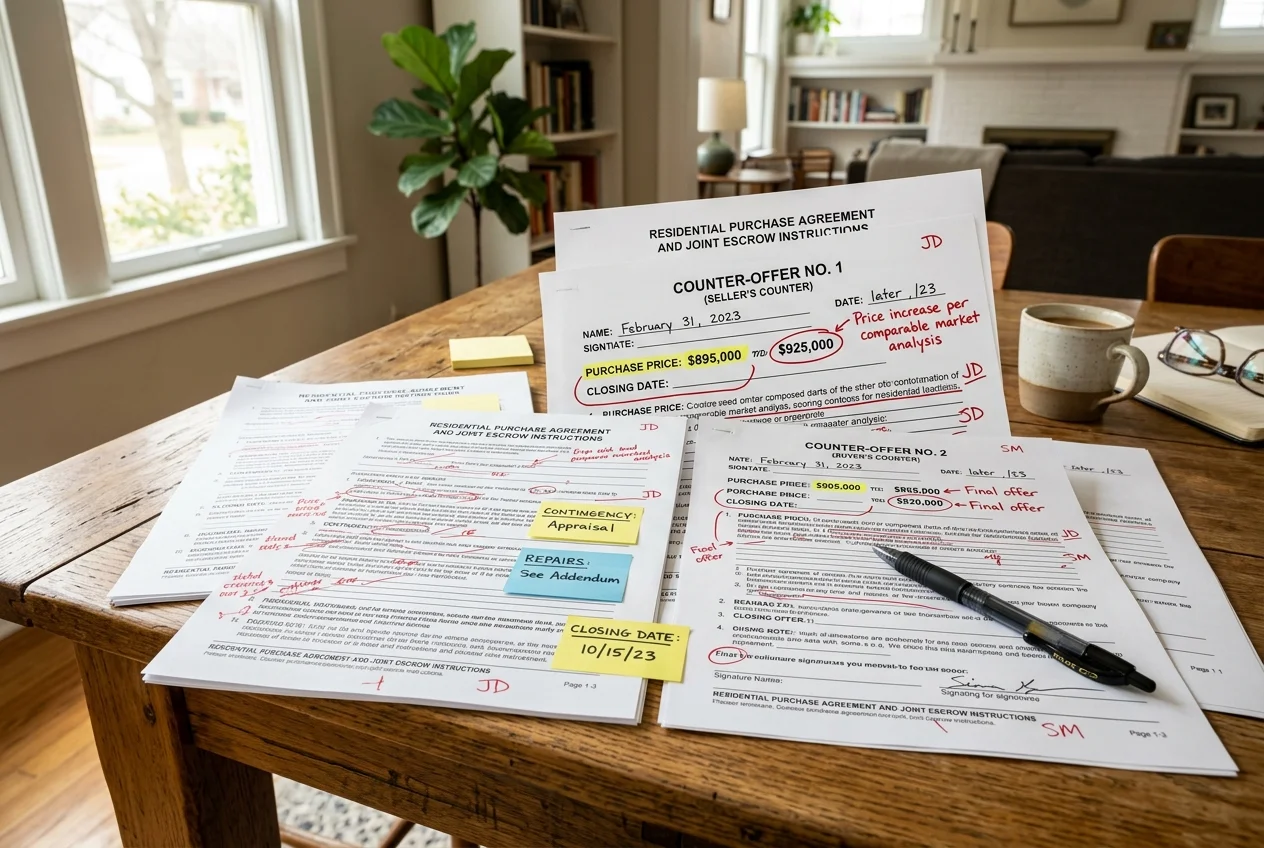
Counters test discipline. The side that stays inside clear decision rules keeps leverage. The side that improvises terms under stress often gives away value without getting anything back.
Anchoring works best when the first number is credible. A buyer-side anchor should cite comps and a clear adjustment story. A listing-side anchor should cite demand signals and condition advantages. Either way, the number needs a reason that survives a second read.
Trading beats conceding. Every give should earn an ask in the same sentence. A buyer can raise price and ask for a credit. A seller can accept a credit and ask for a shorter inspection window. Concession pairing prevents drift.
Response speed matters, but speed should not replace clarity. A useful benchmark is a written response within one day, even if the response is a clean request for more time. Silence creates its own leverage, and it rarely helps the side that goes quiet.
Deadlines work when they are real. A buyer can set a response time tied to rate-lock timing, travel, or a lease deadline. A seller can set a best-and-final time tied to showings and availability. Fake deadlines damage trust and can collapse the deal when called.
Two categories of concessions tend to drive outcomes.
Low cost to give, high value to receive: flexible closing date, post-settlement occupancy, leaving selected personal property, agreeing to a specific communications cadence.
High cost to give: price, large credits, waived protections that shift major risk, or appraisal terms that force cash above value.
Counter framing script:
The counter keeps the price aligned with the comparable closings and the home’s condition. If the other side can meet the timeline term, flexibility exists on [one term]. The goal is a clean agreement that closes on schedule.
Walk-away script that keeps the door open:
This number sits at the top of the buyer’s comfort range based on the comps and the cash plan. If the seller prefers to hold firm, the buyer will step back rather than stretch past the limit. If the seller’s position changes, the buyer is open to re-engaging quickly.
Multiple-offer dynamics flip the playbook. Buyers win more often with clean terms than with complicated fine print. Listing agents protect the seller by keeping every representation accurate and every term in writing. The cleanest path is a clear deadline, clear instructions, and a consistent response process.



Every tool a listing needs, on one account
Free trial credits, no credit card. Staging, photo editing, and renovation on one account.
Try AI HomeDesign freeDecision point four: Renegotiate after the inspection

Inspections create a second negotiation with different currencies. Repairs, price reductions, and credits do not behave the same for lenders, appraisers, or cash-to-close. Good negotiation tactics match the ask to the constraint.
Repairs completed by the seller shift control to the seller. That can help when safety, structural issues, or system failures will block financing. A credit shifts control to the buyer, which often suits cosmetic items or non-urgent fixes. A price reduction lowers the loan amount, but it does not always help a buyer who needs cash for closing.
Buyer-side triage should separate issues into two piles. Material items include safety, water intrusion, structural integrity, and end-of-life systems. Cosmetic items include finishes, minor wear, and deferred maintenance that does not affect habitability. Asking on the first pile protects the buyer. Fighting over the second pile often burns goodwill for small dollars.
Seller-side pre-emption changes the tone. A pre-listing inspection, solid disclosures, and quotes gathered in advance prevent surprise. They also give the seller a credible number to negotiate from instead of negotiating from the buyer’s estimates.
Net proceeds matter when credits enter the picture. Sellers should model how each request affects the closing statement, alongside other costs. A detailed guide on what it costs to sell a house helps frame the credit discussion as a net decision rather than a pride decision.
Inspection credit request script:
The inspection identified two material items that affect safety and function. A contractor estimate supports a credit of [amount] to address those items. If a credit does not work for the seller, the buyer can accept licensed repairs with receipts completed before the final walk-through.
| Buyer move | Listing-side counter |
|---|---|
| “Request a credit tied to written estimates.” | “Counter with a smaller credit tied to the seller’s quotes.” |
| “Ask for seller repairs on lender-sensitive items.” | “Offer licensed repairs with receipts, or a credit if permitted.” |
| “Push for a price reduction to keep payment lower.” | “Offer a credit instead if cash-to-close is the real constraint.” |
| “Re-open price using minor cosmetic findings.” | “Limit negotiations to material issues only.” |
| “Ask to extend timelines after findings.” | “Grant a short extension only if it protects closing certainty.” |
Inspection requests that keep deals moving without re-trading everything.
Appraisal gaps also land here. Options usually fall into four buckets, reconsideration of value with better comps, splitting the gap, adjusting price, or terminating under the contingency. Decision rules should tie to the buyer’s cash plan and the seller’s next move. A buyer with tight cash may need price movement. A seller with a strong backup offer may hold firm.
Appraisal gap response script:
The contract price was based on the comparable sales available at the time of the offer. The appraisal came in lower, so the parties can either adjust price, split the gap, or document better comps for reconsideration. The next step should match the financing timeline and the closing target.
Decision point five: Concessions and compensation conversations
Seller concessions work when they solve a financing problem or a cash-to-close problem. They fail when they show up late as a surprise line item. The cleanest practice is to place the ask in the opening offer, alongside the rest of the economics.
Closing-cost credits, prepaid items, and rate buydown requests all need one check before they become real tactics. The buyer’s loan program may cap seller contributions, and the lender controls the permitted structure. Those caps vary, so agents should verify the rule with the lender rather than quoting a number from memory.
A second check matters for efficiency. A credit that exceeds the buyer’s actual closing costs does not create extra cash back. It becomes wasted value. Buyers often do better by sizing the credit to real costs and trading for another term if more value is needed.
Buyer-agent compensation now belongs in this same category of written economics. Buyers can ask the seller to contribute to compensation as a specific seller contribution in the offer. Listing agents should present it as a net-proceeds decision, not as a norm or a guarantee. Documentation needs to match the agreements that govern it.
Compensation ask script:
The offer includes a seller contribution that covers buyer-agent compensation as part of total closing costs. The buyer can trade for that contribution with a firmer closing date or a tighter inspection window. All terms will be documented in the written agreements and addenda used in this MLS.
Compensation terms also intersect with fee structures. A seller deciding between offers may evaluate how different fee models affect net and service. A separate explainer on how reduced and flat-fee commission models work can support that conversation without turning it into a debate about industry standards.
Ethics, fair housing, and documentation
Professional conduct protects leverage. A side that plays loose with facts often hands the other side an easy reason to slow down, demand proof, or terminate.
Competing offers require special care. A listing agent should never invent an offer, exaggerate the number of offers, or characterize terms inaccurately. A buyer’s agent should also avoid accusing language. A simple request for confirmation and process keeps the file clean.
Client motivation stays private unless the client authorizes disclosure. That includes timeline pressure, divorce, job changes, and financial stress. Agents can infer patterns from public data and observable behavior. They should not disclose client specifics without consent.
Fair housing rules require offers to be evaluated on terms rather than on protected characteristics. Buyer letters that include family details create risk for sellers and agents. Many brokerages discourage forwarding them for that reason.
Everything that changes should land in writing. Text threads and phone calls can support coordination, but they do not replace signed terms. Marketing and photo claims also need care. MLS policies differ, so agents should follow local MLS rules on listing content and use clear Disclosure language for any edits.
One last point matters for teams. Negotiation is coachable, and brokerages can build skill through practice and role-play, as the National Association of REALTORS has noted in guidance on sharpening negotiation skills.
A one-page negotiation checklist
Checklist
0 of 12 doneFrequently asked questions
How much below asking price should a buyer offer?
A buyer should anchor to three closed comparable sales and the listing’s days on market, not a fixed percentage. A fresh listing priced in line with recent closings often justifies a tight range. A listing that sat through one or more price cuts can support a wider gap if the comps still back it up. Local norms vary by market and property type.
What should a buyer say in a counter offer real estate response?
A counter should defend one main point, price or term, with one reason the other side can verify, usually comps, condition, or timeline. The message should also include a trade, such as a higher price in exchange for a credit, or a credit in exchange for a shorter inspection window. Keep the tone procedural and keep everything in writing.
What is the best approach to negotiating after home inspection?
Buyers should separate material items from cosmetic items, then negotiate only on the material list. Safety, water intrusion, structural issues, and major system failures justify a firm ask. Cosmetic wear rarely does. The buyer should choose the right currency, seller repairs for lender-sensitive items, credits for buyer-controlled work, and price changes only when the cash plan supports it.
Is a repair credit vs price reduction better for the buyer?
A repair credit often helps when cash-to-close is tight or when the buyer wants control of workmanship. A price reduction can help when the loan amount needs to drop, but it does not always reduce upfront cash needs. Lender rules and appraisal implications differ by structure, so agents should confirm the acceptable option with the lender before locking the request into an addendum.
How does appraisal gap negotiation usually get resolved?
Most appraisal gaps resolve through one of four paths: a reconsideration of value with stronger comps, splitting the gap, reducing the price, or terminating under the appraisal contingency. The right choice depends on the buyer’s available cash, the seller’s next-move timeline, and whether a backup offer exists. Both sides should set the decision rule before emotions take over.
How should buyer agent compensation negotiation be raised without drama?
The clean approach is to place the ask in the written offer as a specific seller contribution, alongside any closing-cost credit. Listing agents can present it to the seller as a net-proceeds decision, not as a guarantee or a market-wide standard. All compensation terms should match the written agreements and forms used in that state and MLS.