Bad real estate photos are often the result of small mistakes that compound during the listing preparation process. Images that appear too dark, distorted, cluttered, or over-edited can make spaces feel smaller, unclear, or less functional than they actually are.
In property listings, this directly affects how buyers interpret the space and whether they choose to engage with the listing at all.
Most of these issues come from common errors in lighting, composition, lens selection, camera stability, and editing. Understanding where these mistakes occur and how to avoid them helps ensure that listing photos communicate the property clearly and accurately.
Key Takeaways
- Poor lighting reduces clarity and hides spatial detail
- Clutter makes rooms harder to interpret and feel smaller
- Incorrect lens choice distorts proportions and layout
- Camera instability lowers sharpness and consistency
- Overprocessing reduces realism and buyer trust
Mistake #1: Shooting in Poor Lighting
Poor lighting is one of the most common causes of bad real estate photos. It can make a well-prepared property appear dull, uneven, or harder to interpret.
Dark corners hide room depth, blown-out windows remove outdoor detail, and mixed lighting (such as daylight and warm bulbs) can distort wall colors and reduce visual accuracy.
In property listings, these issues don’t just affect image quality; they influence how buyers perceive space, size, and overall condition.
Most lighting problems occur during the shooting stage, especially in interiors with limited natural light or inconsistent artificial sources.
Poor lighting is also a common challenge in real estate photography, particularly for beginners learning how to capture interior spaces effectively.
To reduce these issues, use natural daylight as the primary light source by opening blinds and curtains, but avoid direct sunlight that creates harsh contrast.
Turn on interior lights only when they help balance the frame, not when they introduce unwanted color casts.
In darker spaces, adjustments such as lighter decor, mirrors, and fewer heavy window coverings can improve how the room appears in photos.
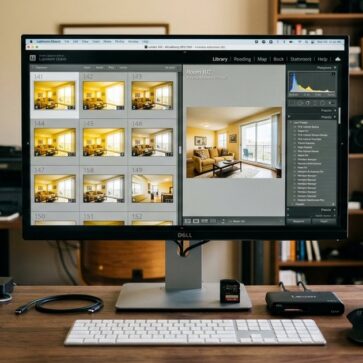
When lighting conditions cannot be fully controlled during shooting, post-processing can help correct exposure, contrast, and color balance while preserving a natural and accurate representation of the space.
Mistake #2: Shooting Before Decluttering
Clutter is one of the most visible causes of bad real estate photos. It pulls attention away from the space and toward individual objects, making rooms feel smaller, less organized, and harder to interpret.
Items like cords, toiletries, paper piles, laundry baskets, and personal belongings can quickly distract from layout, storage, and natural light.
From a buyer’s perspective, this directly affects how the space is read. Instead of understanding the room’s function and flow, viewers focus on what’s in the way instead of the space itself.
This mistake typically happens during the pre-shoot preparation stage, when spaces are not fully cleared before photography.
To avoid it, remove unnecessary items from countertops, tables, and floors. Personal photos, children’s items, pet supplies, and trash bins should be taken out of the frame to keep the space visually open and neutral.
A small number of intentional decorative elements can support the scene, but the room should remain clean and easy to read.
If clutter cannot be fully removed before shooting, AI HomeDesign’s item removal tool allows you to eliminate unwanted objects afterward, either across the entire image or in specific areas, helping restore clarity without reshooting.
Mistake #3: Using the Wrong Lens for the Space
Using the wrong lens is another common reason otherwise well-prepared properties still result in bad real estate photos. Even when a room is clean and well-lit, incorrect focal length can distort how the space appears.
A lens that is too wide can stretch walls, furniture, and floor lines, while a lens that is too narrow can make the room feel smaller and more confined than it actually is. In some cases, vertical lines begin to lean, and the layout no longer appears accurate.
This directly affects how size, proportion, and flow are interpreted in the final images. Distorted images can make spaces feel unrealistic or misleading, reducing clarity and confidence in the listing.
This issue begins during the shooting stage, when the lens does not match the size or function of the room.
Wide-angle lenses are typically more effective in smaller spaces such as bathrooms, hallways, and compact rooms, while larger spaces often benefit from lenses that preserve more natural proportions, which is a key factor in choosing the right lens for real estate photography.
Keeping the camera level is equally important to prevent vertical distortion in walls, cabinets, and door frames.
Mistake #4: Shooting Without a Tripod
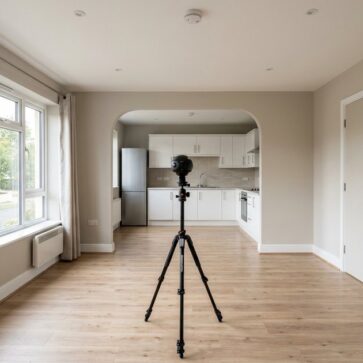
Some listing photos appear soft without an obvious cause. In many cases, the issue comes down to camera stability. Even slight hand movement can soften edges, reduce detail in surfaces like cabinets, tile, or trim, and make images appear less sharp and less professional.
For listing photos, this reduces visual clarity and consistency, making the space harder to interpret accurately.
This issue becomes visible during the shooting stage, especially in situations that require multiple exposures or precise framing.
Techniques such as HDR photography, window pulls, and composition adjustments depend on the camera remaining fixed in the same position. Without that stability, images can lose alignment and visual consistency.
A tripod also helps maintain straight vertical lines and consistent composition across multiple shots of the same room, improving overall image quality. In real estate photography workflows, it functions as a baseline tool for producing stable, repeatable, and accurate listing images.
Mistake #5: Overprocessing
Overprocessing is a common cause of bad real estate photos, especially when editing goes beyond correcting the image and starts altering how the property actually looks.
While editing is essential for adjusting exposure, correcting color balance, and removing minor distractions, excessive changes can reduce visual accuracy.
Oversaturated colors, unnatural contrast, glowing highlights, heavy sharpening, or artificial sky replacements can make images appear unrealistic and less trustworthy.
In many cases, photos do not fail because they were poorly captured; they fail because they were edited past the point of credibility.
In property listings, this affects buyer trust and interpretation. When surfaces lose texture, colors shift unnaturally, or lighting appears exaggerated, the image no longer represents the property accurately.
This issue occurs during the post-processing stage, when editors apply changes without maintaining visual consistency and realism.
The goal is to produce a clean and accurate representation of the property. Floors should retain texture, walls should reflect natural tones, and brightness should enhance visibility without removing depth.
Controlled editing tools, such as AI-based enhancement solutions, can help maintain this balance by correcting technical issues without introducing visual distortion.
When used properly, editing supports clarity and presentation; overprocessing does the opposite.
Final Thought
Bad real estate photos do not just reduce visual quality; they weaken how a listing is perceived and how much buyers trust what they see.
When images appear dark, cluttered, distorted, unstable, or overprocessed, the property itself can feel less clear, less accurate, and less appealing.
Most of these issues do not originate in the final image. They develop across the listing preparation process, from how a space is set up before the shoot, to how it is captured, and how it is edited afterward.
Improving listing photos is therefore less about fixing individual images and more about controlling each stage of the workflow.
Clear preparation, stable shooting conditions, and restrained editing together produce images that communicate the space accurately.
Keeping these five mistakes in mind helps ensure that listing photos support the property rather than work against it.
FAQs
Not necessarily. As long as agents follow MLS specifications, MLS platforms do not remove their listings. However, low-quality images can reduce the perceived value of the property and make the listing appear less reliable or carefully prepared.
Poor lighting, visible clutter, distorted vertical lines, soft focus, and excessive editing are among the most common issues. These factors make the space harder to interpret and reduce the overall clarity and appeal of the listing.
Not by itself. Wide-angle lenses are standard in real estate photography because they help capture more of the room in a single frame. The issue arises when distortion becomes excessive, and the space no longer appears accurate.
Editing becomes excessive when colors appear unnatural, highlights look artificial, textures are lost, or the image no longer reflects the property accurately. The goal is to improve clarity while maintaining a realistic representation of the space.