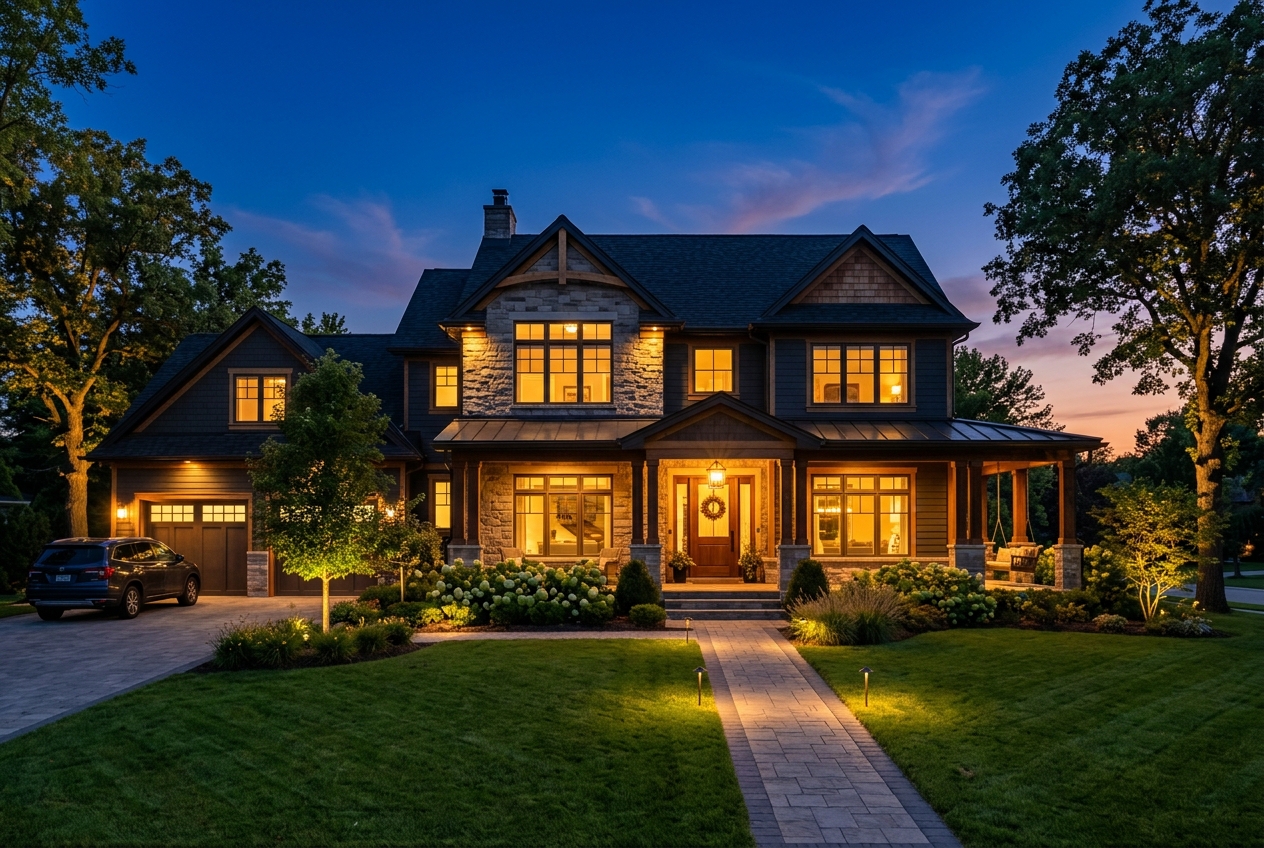
Buyers scroll fast, and a single exterior image often decides whether a listing earns a save. Twilight real estate photography stands out because it combines a calm blue sky with warm interior light, even on an average home. The same impact also ties into broader real estate photography tips that shape the full photo set.
Twilight has two legitimate paths. Photographers can shoot a real blue-hour exterior and composite it cleanly. Agents can also create a convincing twilight look from a daytime photo through AI day-to-dusk editing. Both can be ethical and listing-ready when the workflow and the Disclosure are handled correctly.
The sections below break down timing, gear, settings, editing, AI virtual twilight, and the decision points that matter for real listings.
Why Twilight Photos Matter for Real Estate Listings
Listing feeds punish average exteriors. A mid-day facade can look flat, and harsh sun can add deep shadows under eaves and porches. Twilight flips that problem. Warm window glow adds life, and the sky holds color without the blown highlights that often show up in daytime exteriors.
Marketing also gets simpler. A twilight hero shot works as the first MLS image, the social cover image, and the postcard image. That single asset can carry the whole campaign. Agents often use it as the lead photo for open house posts because it reads clearly on small screens.
Twilight images also set expectations. A polished exterior suggests a polished listing process. That matters for sellers who compare agents based on presentation, not just price. The photo itself becomes proof that the listing will not look like every other one.
A practical rule helps keep twilight from becoming a time sink: twilight usually earns its keep as one hero exterior, not a full gallery. The hero shot should match the property’s strongest angle, then the rest of the set can stay daytime for speed and consistency.
Twilight Real Estate Photography Timing and Planning
Missed timing causes most failed twilight attempts, not camera quality. The sky changes fast, and the best window lasts only minutes after sunset. A shot that starts too early looks like late afternoon. A shot that starts too late turns into a noisy night exposure with muddy shadows.
Good planning starts before arrival. Sunset time changes by date and location, so agents and photographers should lock the schedule with a sun-tracking app. That planning also helps set seller expectations. Interior lights need to be on early, and exterior lights need time to warm up and reach full brightness.
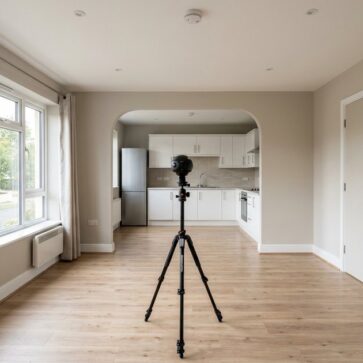
Arrival time matters as much as the capture time. A solid workflow starts with a full exterior walk, then a locked composition on a tripod. Composition decisions should happen before the best light arrives. The hero angle should show the front door, the driveway edge, and enough sky for a natural gradient.
Edge conditions also change the plan. Heavy cloud cover can shorten the usable window. Strong streetlights can add ugly color casts on siding and driveway concrete. In those cases, a daytime capture for later virtual twilight can protect the schedule and still deliver the hero image.
Gear and Property Prep That Make Twilight Easier
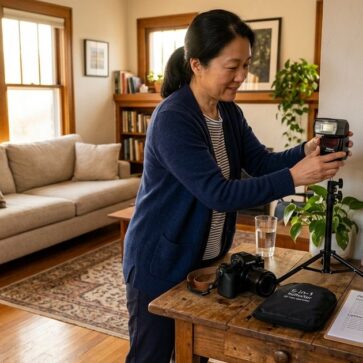
Twilight rewards stable technique. A sturdy tripod is not optional because shutter speeds slow down as ambient light drops. A remote trigger helps, but a simple camera timer can also prevent shake. Fresh batteries matter more than usual, since long exposures and flash use drain power fast.
Lens choice shapes realism. A wide-angle lens can show the whole facade without pushing vertical lines into an exaggerated lean. A camera body that handles clean shadows helps, but lens quality and technique usually matter more than a body upgrade. For deeper gear selection, the guides on best cameras for real estate photography and best lenses for real estate photography give clear starting points.
Lighting tools separate a usable twilight from a premium one. A speedlight with a simple diffuser can fill dark landscaping and porch details. Radio triggers help when flash placement moves around. A small constant light can also help on paths and entries, but it can create harsh hotspots if it sits too close.
Property prep needs a checklist, not memory. The seller or agent should turn on every interior light that shows through a window. Exterior lights, landscape lights, and pool lights also need to be on. Cars should leave the driveway, trash bins should move, and porch clutter should go. Those details become hard to fix later without heavy editing.
How to Shoot and Composite a Real Twilight Hero Shot
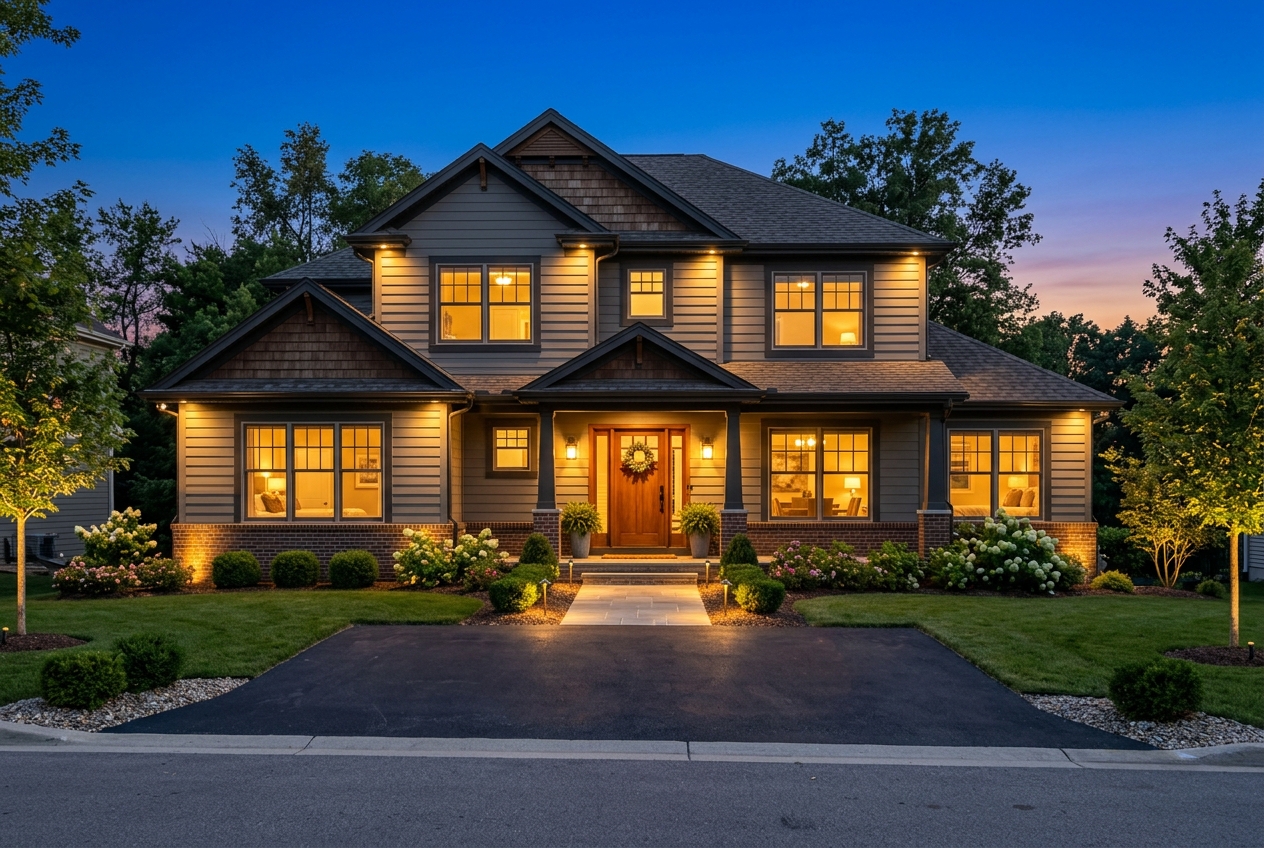
Twilight shoots feel rushed because the light shifts while the camera sits on a tripod. A calm workflow prevents mistakes. The goal is a clean base exposure, extra frames that protect highlights and shadows, and a flash layer that adds shape without breaking the natural look.
Bracketing and blending also fit inside a broader exposure workflow. The same thinking shows up in HDR real estate photography, but twilight adds the extra constraint of time pressure and mixed light sources. A consistent routine keeps the final composite believable.
A reference baseline helps photographers and non-photographer agents understand what “normal” looks like at dusk.
| setting | practical starting point | why it matters |
|---|---|---|
| file format | RAW | keeps highlight and shadow detail for blending |
| exposure mode | manual | locks the look as ambient light changes |
| aperture | f/8 to f/11 | holds facade sharpness and window detail |
| ISO | low ISO | keeps shadows cleaner as the scene darkens |
| shutter | slow shutter on tripod | balances sky color and house exposure |
| focus | single point on facade | prevents focus hunting in low light |
Step one: Scout the hero angle and lock the frame
The photographer picks one exterior angle and commits. The tripod goes down early, and the camera stays level to protect vertical lines. The frame should leave room for a clean sky gradient and avoid clipping roof peaks.
This step matters because re-framing wastes the best light. A locked composition also makes layer blending easier later. The expected result is a stable hero composition that can carry multiple exposures.
Step two: Set the base exposure for the sky
The camera exposure should protect the sky first. The facade can sit slightly dark in the base frame, but the sky should hold color and detail. White balance should stay consistent across frames to simplify the composite.
Sky-first exposure matters because a blown sky never looks like twilight. A strong base sky also reduces the need for aggressive sky replacement. The expected result is a clean sky layer with believable color.
Step three: Capture bracketed frames for windows and shadows
A short bracket sequence adds safety. One frame protects bright windows and exterior fixtures. Another frame lifts darker landscaping and porch areas. Each frame should stay on the tripod without shifting.
Brackets matter because twilight mixes bright points with deep shadows. Blending a few exposures looks more natural than pushing one file too far. The expected result is a set of frames that cover the full tonal range.
Step four: Add a flash layer with controlled flash painting
A speedlight can fill dark siding, columns, and landscaping. The flash should stay subtle, and the direction should feel like existing exterior lighting. Multiple small pops often look more natural than one strong blast.
Flash painting matters because ambient dusk light often leaves the front elevation flat. A controlled flash layer restores shape while keeping the sky believable. The expected result is a separate frame with clean, lifted foreground detail.
Step five: Shoot a safety frame and stop before the light collapses
A final frame should capture the best overall balance, even if it feels redundant. Once the sky loses color, the session should end. Extra angles rarely pay off at this stage.
This step matters because late frames increase noise and color shifts. A safety exposure also protects against minor mistakes like a flash misfire. The expected result is one “all-purpose” frame that can rescue the deliverable.
Step six: Blend the layers for a natural composite
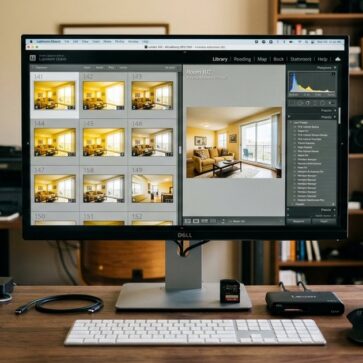
Photoshop stacking works best when each layer has a job. The sky layer provides the color and gradient. Bracketed frames supply clean windows and shadow detail. The flash layer adds shape in dark areas without changing the scene’s structure.
Layer blending matters because twilight should look like one moment, not a collage. Careful masks and restrained contrast keep it believable. The expected result is one hero exterior that matches the rest of the listing set.
Real Estate Twilight Photo Editing That Stays Natural
Strong twilight edits look quiet. Over-saturated blues and glowing orange windows create an artificial look fast. A clean edit keeps the property believable, then lets the sky and warm windows do the work.
Color control comes first. Mixed lighting creates green and orange casts on white siding and driveway concrete. Local adjustments can neutralize those areas without flattening the whole scene. Window glow should stay warm, but it should not clip into pure white.
Sky edits require restraint. If a sky replacement becomes necessary, the new sky needs the same direction, cloud scale, and horizon brightness as the original capture. Hard edges around tree lines ruin the illusion. Examples that show the difference between heavy-handed edits and clean edits are easier to spot in real estate photo editing before and after.
Delivery also needs an operational rule. A twilight hero shot works best when agents can schedule a listing launch around it. A practical standard is delivery within two days of the shoot. That window leaves time for careful masking while still supporting a fast go-live plan.
Mistakes often repeat because teams skip a review step. A quick check against common real estate photography mistakes can catch tilted verticals, unnatural color, and blown windows before the files go out.
Virtual Twilight Photos With AI Day to Dusk Editing
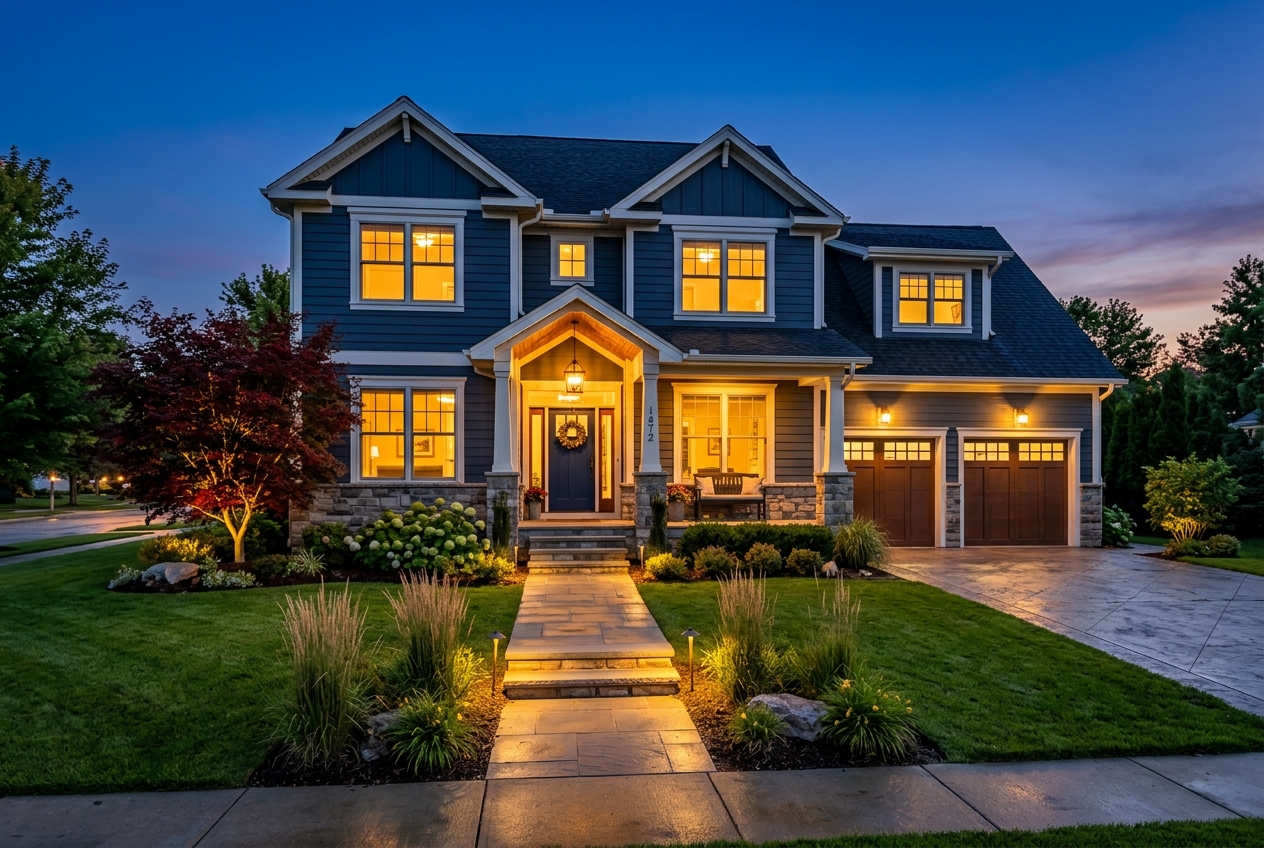
Virtual twilight starts with a simple idea. A daytime exterior can become a believable dusk scene through sky changes, window glow, and color grading. The manual version uses Photoshop and patient masking. The modern version uses AI to automate most of the work.
Outsourcing sits in the middle. Many teams send a daytime exterior to real estate photo editing services for a day-to-dusk edit. That path can work well, but it still adds vendor coordination and wait time.
AI Day to Dusk tools remove the schedule problem. AI HomeDesign can generate a virtual twilight result from a daytime photo in about half a minute, and the workflow does not require a tripod or Photoshop. The output also preserves original fixtures and structure for MLS use, which helps teams avoid edits that change the home itself.
Input quality still drives output quality. The best daytime source image shows a clean facade, visible sky, and straight vertical lines. Deep shadows across the front elevation can limit realism, since the AI has less true detail to work with. A bright, evenly lit daytime capture often produces the most convincing dusk conversion.
Real Shoot vs. AI: Cost, Disclosure, and the Right Call
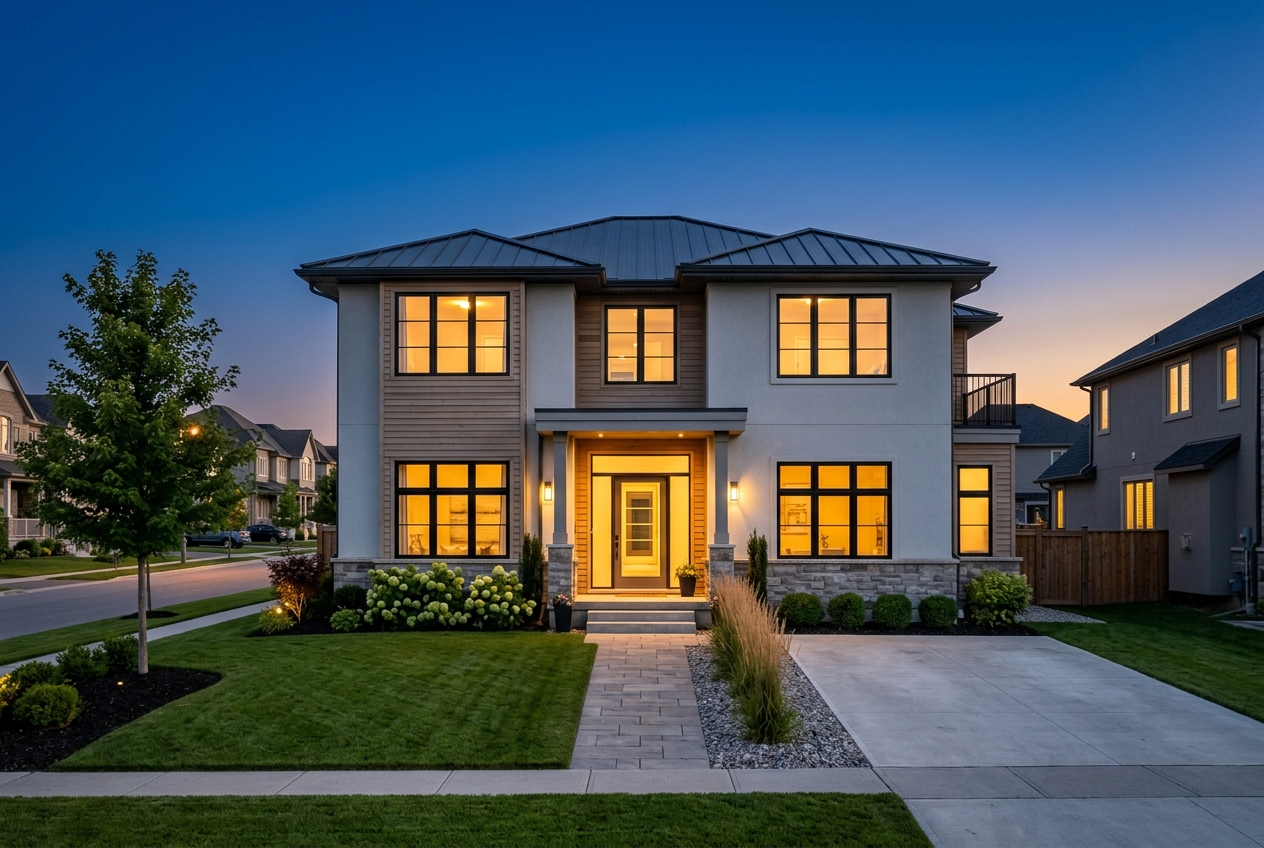
Twilight decisions rarely come down to pride. They come down to schedule, budget, and risk. A real shoot demands a narrow time window, on-site coordination, and careful editing. AI virtual twilight trades some ceiling quality for speed and repeatability.
A side-by-side view makes the trade-offs obvious.
| factor | real twilight shoot | AI virtual twilight |
|---|---|---|
| on-site requirement | requires the property at dusk | uses a daytime exterior photo |
| timing risk | high, the sky changes quickly | low, retries are easy |
| editing labor | heavy masking and blending | automated with minor review |
| delivery expectation | delivery within two days | near-immediate turnaround |
| best fit | luxury listings, signature architecture, portfolio work | fast launches, budget control, weather disruptions |
Disclosure needs equal attention. MLS Rules vary by board, but many require a clear Disclosure when an image is digitally altered. A safe practice is to label the image wherever the platform allows a caption. Clear language also reduces consumer confusion.
A practical caption template keeps it simple: “Disclosure: virtually enhanced image. Exterior twilight created with AI day-to-dusk editing.” That wording states the edit without implying a physical condition that did not exist. Misrepresentation starts when edits add features like fire pits, new landscaping, or lights that the property does not have.
Some situations also call for a different plan. Rural homes with minimal exterior lighting may not deliver a strong real twilight, even with flash. Homes with strict HOA lighting rules can block the prep checklist. Properties surrounded by dense trees can hide the sky and make both real and virtual twilight less effective. In those cases, a clean daytime hero shot or an aerial alternative can outperform a forced dusk look.
Aerial twilight adds another option when the facade does not read well from street level. The guide on real estate drone photography also covers practical limits around low light and safety.
Deliverables should stay clean and focused. A photo deliverable should include final images, file sizes for MLS and marketing, and any required Disclosure language. Commission splits, marketing fees, or service line items should stay in a separate agreement or invoice. That separation prevents confusion, keeps marketing assets shareable, and aligns with common brokerage compliance workflows.
##
Frequently Asked Questions
What time window produces the best twilight exterior color?
Blue hour usually gives the cleanest balance between sky color and interior window glow. The exact timing depends on the season and location, so teams often use PhotoPills or The Photographer’s Ephemeris to plan the session. Scheduling also needs buffer time for a full exterior walk, tripod placement, and lighting checks before the usable light peaks.
Can a phone camera capture a usable twilight listing photo?
A phone can work when it supports a stable tripod mount and manual control of exposure and focus. The biggest limitation is noise in shadows as light drops. Phones also struggle with mixed color from streetlights and interior bulbs. For a consistent result, many agents capture a strong daytime exterior on a phone and use virtual twilight editing.
Why do some twilight photos have bright windows but a dark yard?
The camera exposure often protects the windows, then leaves the landscaping underexposed. A single frame cannot always hold both bright points and deep shadows at dusk. Bracketing exposures or adding a subtle flash layer can lift the yard detail. In editing, local shadow recovery should stay restrained to avoid a flat, gray foreground.
Does virtual twilight require the home lights to be on in the daytime photo?
Lights do not have to be on, but a source photo with visible interior light often looks more believable after the edit. Lit windows also help the AI estimate where glow should appear. If lights cannot be turned on, virtual twilight can still work, but the final image may need a more subtle window treatment to stay realistic.
How should virtual twilight be disclosed on a listing?
Disclosure should be clear, plain, and easy to spot. A caption that states the image is virtually enhanced and specifies a virtual twilight or day-to-dusk edit usually meets the intent of most MLS Rules. If a platform does not support captions, a short line in the listing remarks can serve the same purpose. Local requirements still vary.
What file version should be delivered for a twilight hero image?
Most teams benefit from two exports: an MLS-sized file that loads fast and a high-resolution file for print and social campaigns. The deliverable should also include a consistent naming convention so the hero image stays easy to find. When virtual edits were used, the deliverable package should include the Disclosure text for reuse across platforms.