The NAR home staging statistics from 2017 to 2025 reflect two parallel trends. On one hand, staging continues to help buyers visualize a property as a future home. On the other hand, fewer agents stage every listing, as rising costs make full staging less practical for many sellers. Overall, the data points to a clear conclusion: staging remains important, but a single approach no longer fits every listing.
Key Home Staging Insights (2017–2025)
- Buyer perception remained stable, with around 80% of agents reporting that staging helps buyers visualize a home.
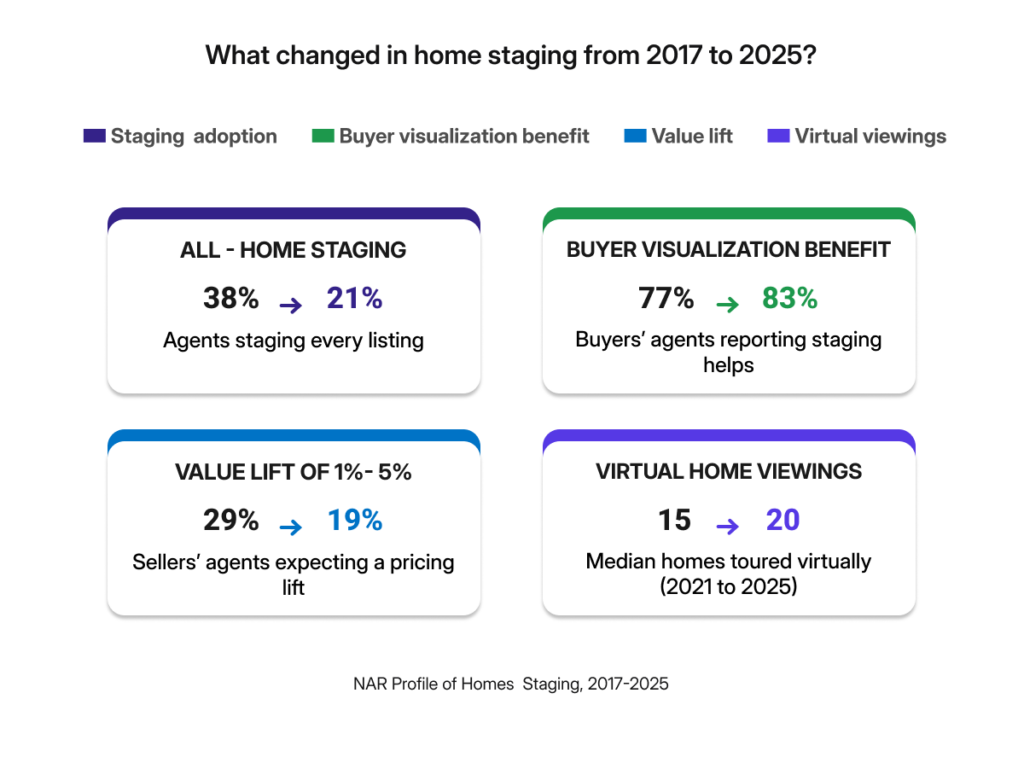
- The share of agents staging all listings declined from 38% in 2017 to 21% in 2025.
- Staging costs fluctuated significantly, ranging from $400 to $1,500 across reporting years.
- The impact of staging on offer price became less consistent over time.
- Buyers increasingly evaluate properties online before visiting in person.
- Home staging shifted from a default practice to a more selective, strategy-driven decision.
Do Buyers Still Value Home Staging? What the Data Shows
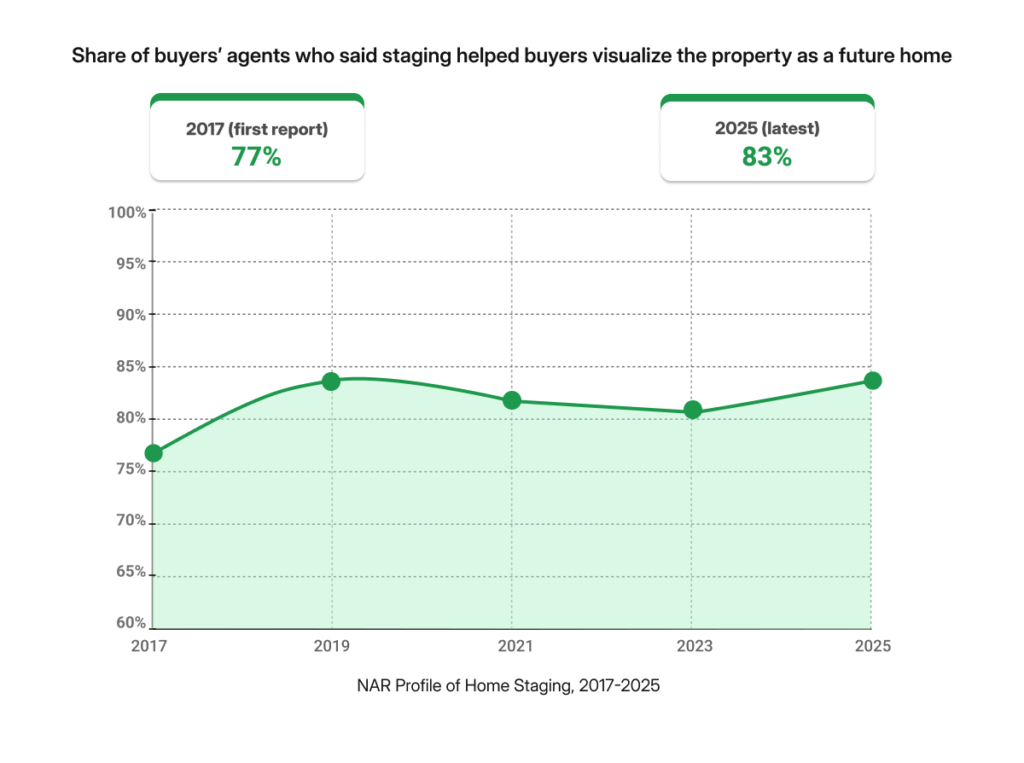
Buyers’ agents continued to report a clear benefit from staging: it helps buyers visualize the home, a pattern that aligns with broader findings from the NAR Profile of Home Buyers and Sellers. The share stood at 77% in 2017, rose to 83% in 2019, remained at 82% in 2021, reached 81% in 2023, and returned to 83% in 2025.
The core value of staging hasn’t changed. Buyers still respond to spaces that feel lived in, easy to interpret, and ready for everyday use. Listing conditions and costs have changed. The role of staging in shaping buyer perception hasn’t.
How Home Staging Adoption Changed Among Agents
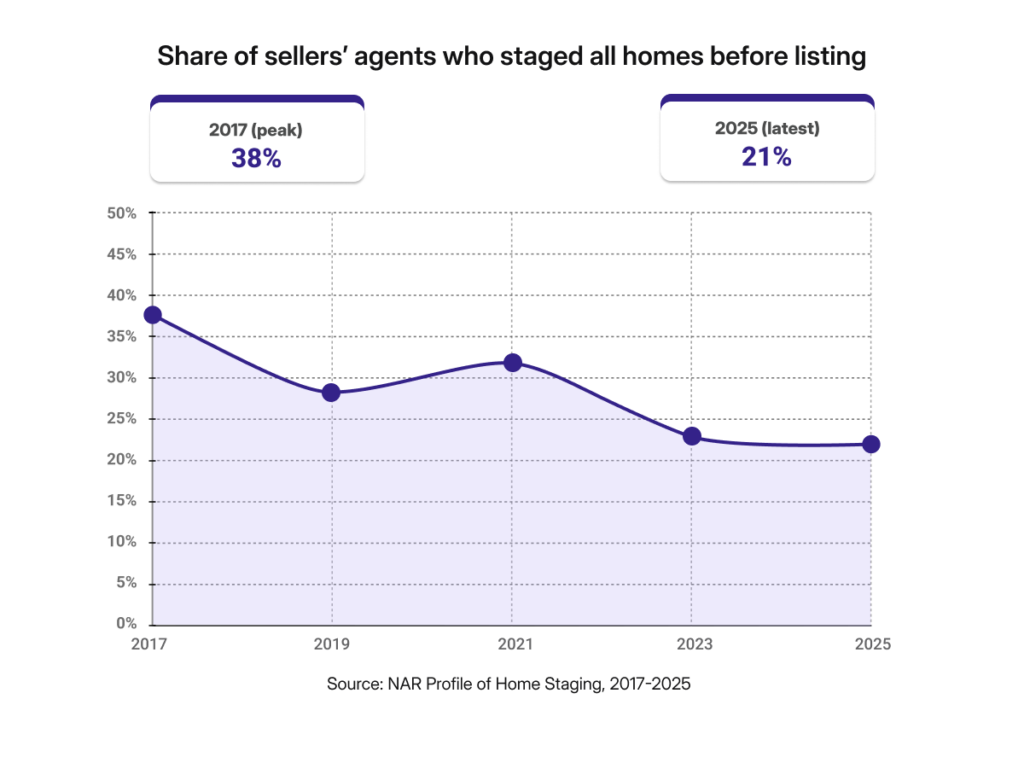
This is where the shift becomes clear. In 2017, 38% of sellers’ agents reported staging all homes before listing. That share declined to 28% in 2019, rose slightly to 31% in 2021, and then dropped to 23% in 2023 and 21% in 2025.
Full staging moved from a common practice to a more selective decision. Agents continue to use staging, but many now reserve full staging for properties that require additional visual support, higher-priced homes, or listings facing stronger competition.
How Home Staging Costs Changed (2019–2025)
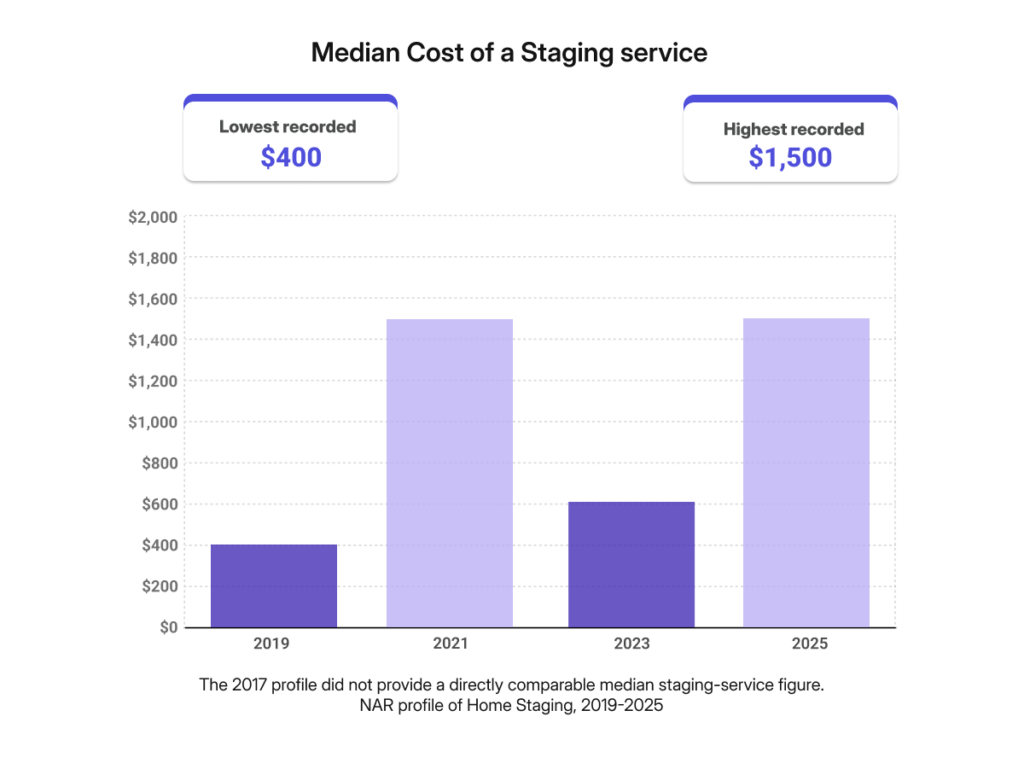
NAR data shows that staging costs did not follow a steady upward trend. The reported median cost was $400 in 2019, rose to $1,500 in 2021, declined to $600 in 2023, and returned to $1,500 in 2025.
Staging costs vary by market, service scope, and agent decisions. Costs increased in some periods, but not in a straight line.
The gap between lower-cost years and the $1,500 range helps explain why many sellers now evaluate staging more carefully before committing to full-service options.
How Home Staging Affects Property Value
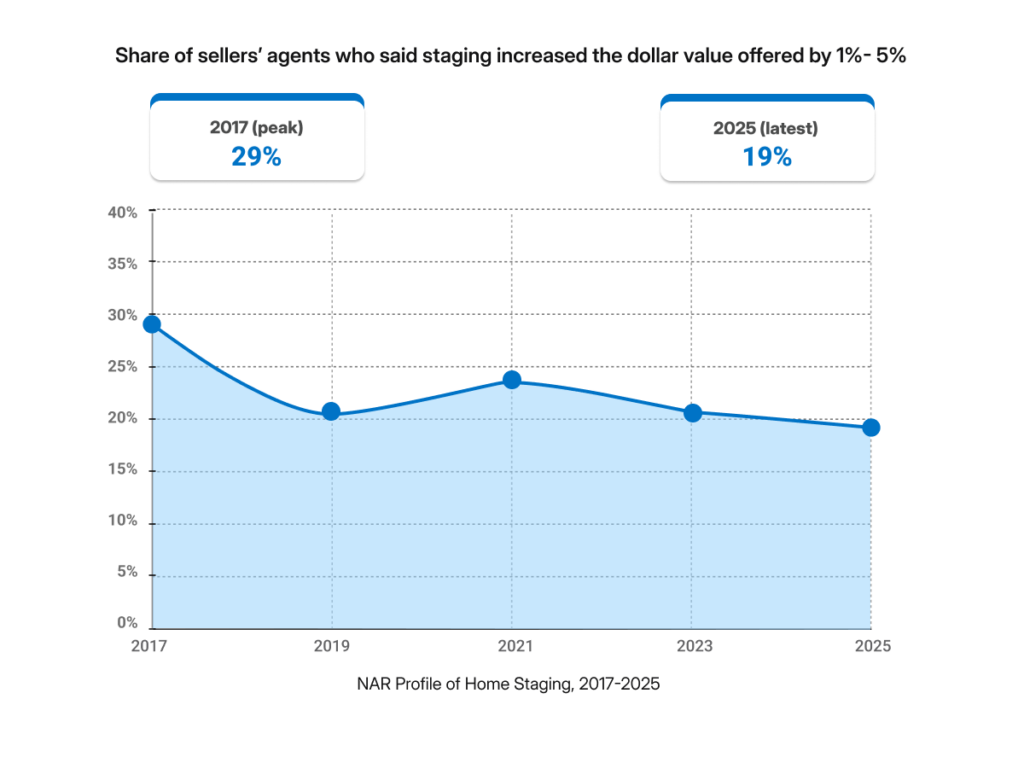
NAR data also points to a more selective return on staging. In 2017, 29% of sellers’ agents reported that staging increased the dollar value offered by 1% to 5%. That share declined to 22% in 2019, remained at 23% in 2021, and fell to 20% in 2023 and 19% in 2025.
Staging didn’t lose its impact. But the results are no longer consistent across listings. Staging still improves how a property is perceived and presented, but fewer agents now expect a predictable increase in offer price in every case.
Shift from In-Person to Digital Home Viewing
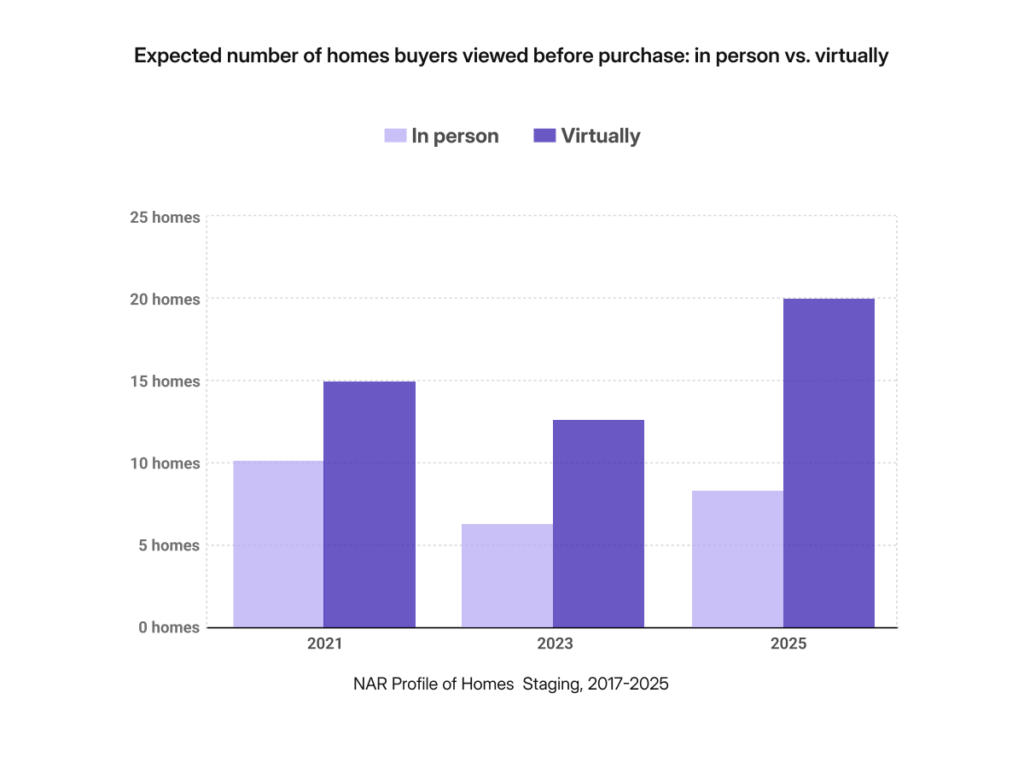
NAR data also highlights a shift in how buyers explore listings. In 2021, buyers expected to view a median of 10 homes in person and 15 homes virtually. By 2025, that changed to eight homes in person and 20 homes viewed online.
This shift does not reduce the role of physical staging. But it does increase the importance of how a property appears online. When more initial screening happens digitally, the first impression is often formed before a buyer visits the property.
That shift explains the growing importance of digital presentation. For listings that require stronger visual clarity online, techniques such as virtual staging and real estate photo editing can help present the space more clearly in listing photos.
What These Trends Mean for Home Staging Today
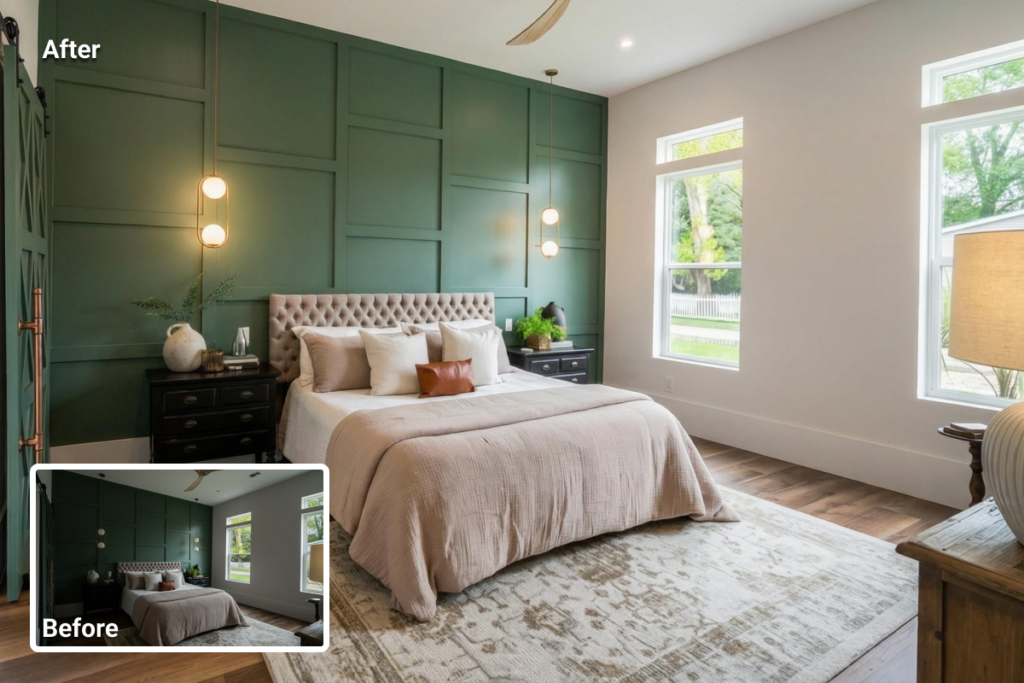
The NAR home staging statistics do not support staging every listing, nor do they support abandoning staging altogether. They point to a more selective approach. Staging still plays an important role, but more of its impact now occurs online before a buyer visits the property.
Buyers often evaluate listings through photos before deciding which homes to see in person. At the same time, the cost of physical staging is not always justified, especially when the expected return is limited.
Some properties still benefit from full physical staging. Others may perform better with strong photography, decluttering, minor visual adjustments, or digital staging for unfurnished rooms.
When to Use Physical vs Virtual Staging
The NAR data suggests that staging decisions are becoming more context-dependent. The choice between physical and virtual staging depends on the condition of the property, the target market, and the expected return, a distinction explored in more detail in virtual staging vs real staging.
Physical staging is typically more suitable for higher-end properties, occupied homes, or listings where buyers will visit in person and expect a fully furnished experience. It can help reinforce perceived value when the investment aligns with the property’s price point.
Virtual staging is often more practical for vacant homes, mid-range listings, or situations where cost and turnaround time are key considerations. It allows agents to present a furnished version of the space without the logistics of physical staging.
In many cases, agents combine approaches, using photo editing, decluttering, or minor visual adjustments alongside staging techniques to improve how a property is presented online.
How Home Staging Fits into Modern Listing Strategy
The data doesn’t support an all-or-nothing approach. It shows a shift toward more selective listing strategies.
Buyers now form strong first impressions online, reflecting broader shifts in real estate market trends, which increase the importance of listing photos in the decision process.
At the same time, the cost of physical staging is not justified for every property, particularly when the expected return is limited.
This often becomes part of a broader decision for homeowners, especially when they are weighing whether to sell or rent their property. In that context, staging shifts into a different role: still relevant, but no longer a default choice for every listing.
In this context, virtual staging is a practical option for empty or under-furnished homes, while strong photography, decluttering, and minor visual adjustments can continue to support how a property is presented.
FAQs
They point to a more selective market. Staging still helps buyers picture a home, but fewer sellers’ agents stage every listing than they did in earlier reports. At the same time, virtual staging and online presentation carry more weight in the buying process than before.
NAR’s reports show higher reported staging costs in later years, but not in a straight line. The median dollar value spent on a staging service was $400 in 2019, $1,500 in 2021, $600 in 2023, and $1,500 in 2025. That range helps explain why physical staging does not fit every property.
Because many buyers judge a home through its listing photos before they decide to visit in person. That means the online presentation often does more of the early selling than it did before.
Physical staging makes the most sense when stronger presentation is likely to help a home sell faster or support a better sale price. That usually applies to properties in good condition, in locations where buyer demand is strong, and in cases where the added cost has a fair chance of paying off. It can also help with vacant homes or spaces that feel hard to understand in photos.