Real estate email subject lines often decide whether a message gets opened, ignored, or deleted. Agents may spend time writing the email body, choosing the listing photo, or preparing the offer, but the subject line is what first appears in the inbox.
The best subject lines are short, specific, and matched to the right audience. A past client, a first-time buyer, a seller lead, and an open house visitor should not all receive the same generic line.
This guide shows agents how to write stronger subject lines for listings, follow-ups, newsletters, open houses, and client outreach. The goal is not to sound clever. It is to make the email feel relevant enough to open.
Why Email Subject Lines Matter in Real Estate Campaigns
A real estate email can have a strong listing, useful market insight, or a helpful follow-up note. But none of that matters if the subject line does not earn the open.
That is why real estate email subject lines need to be specific. A buyer lead, seller lead, past client, and open house visitor should not all receive the same generic line. Personalization can help, especially when personalized real estate email subject lines go beyond a first name and use details such as neighborhood, price range, property type, or client stage.
Length matters too. Mobile inboxes often show only about 33–43 characters of a subject line, so the first few words carry the most weight. Put the most useful detail early: the neighborhood, price change, property type, appointment reminder, or client concern.
Deliverability Risks Hiding in Plain Sight
Some words and formats can make emails look spammy. Phrases such as “act now,” “guaranteed,” “free,” or “limited time” can raise red flags, especially when combined with heavy punctuation, all caps, too many links, or weak sender reputation.
Agents do not need to avoid urgency completely. They just need to make it specific and honest. Instead of “ACT NOW!!!,” write something like “Offer deadline is Friday” or “Open house ends at 3.” Specific subject lines feel more useful, and they are less likely to sound like mass marketing.
Prerequisites: Clean Lists, Segmentation, and Compliance

A strong subject line still needs the right audience. A buyer lead, seller lead, past client, and cold lead will not open emails for the same reason. Before writing subject lines, agents should clean the list and divide contacts by intent.
Segment Before Sending
At a minimum, agents can separate contacts into four groups:
- Active buyers
- Active sellers
- Past clients
- Cold or early-stage leads
Each group needs a different subject-line angle. Buyers may respond to price, neighborhood, or new listing alerts. Sellers may care about pricing, timing, equity, or market demand. Past clients may open emails about home value, local updates, or seasonal reminders.
For seller-focused campaigns, agents can pair subject lines with a cma in real estate, but only when the message goes to the right segment. A seller subject line sent to a mixed buyer list will feel irrelevant.
Keep the List Clean and Compliant
List hygiene matters. Remove bounced addresses, duplicate contacts, and long-inactive subscribers. A clean list gives more reliable open-rate data and protects sender reputation.
Compliance matters too. Under CAN-SPAM, commercial emails must use accurate sender information, avoid deceptive subject lines, include a valid physical postal address, and provide a clear way to opt out. CASL also requires consent, sender identification, and an unsubscribe mechanism for commercial electronic messages.
The practical rule is simple: send relevant emails to the right people, make it easy to unsubscribe, and never use a subject line that promises something the email does not deliver.
Step 1: Match the Subject Line to the Goal and Audience
Each audience segment opens emails for a different reason. A first-time buyer may care about affordability or available homes. A seller may care about pricing, timing, and local demand. A past client may respond better to a helpful check-in than a sales message.
Before writing the subject line, define the purpose of the email. Is it a listing alert, market update, nurture email, open house reminder, or referral request? One clear goal makes the subject line easier to write and easier to test.
Why Segment Match Matters
Buyer-focused subject lines should speak to inventory, location, price range, or next steps. Seller-focused lines can reference pricing trends, home value, timing, or listing preparation. Past-client emails should feel helpful and low-pressure.
For example, Real estate agents helping first-time homebuyers should avoid seller-style subject lines about equity strategy. First-time buyers usually need clarity around budget, loan preparation, neighborhoods, and what happens next.
Do not write the subject line before choosing the segment. A vague line may feel safe, but it often gives no one a strong reason to open.
By the end of this step, the agent should have two things: a clear audience segment and one email goal. Every subject line should match both.
Step 2: Write for Brevity and Mobile Screens
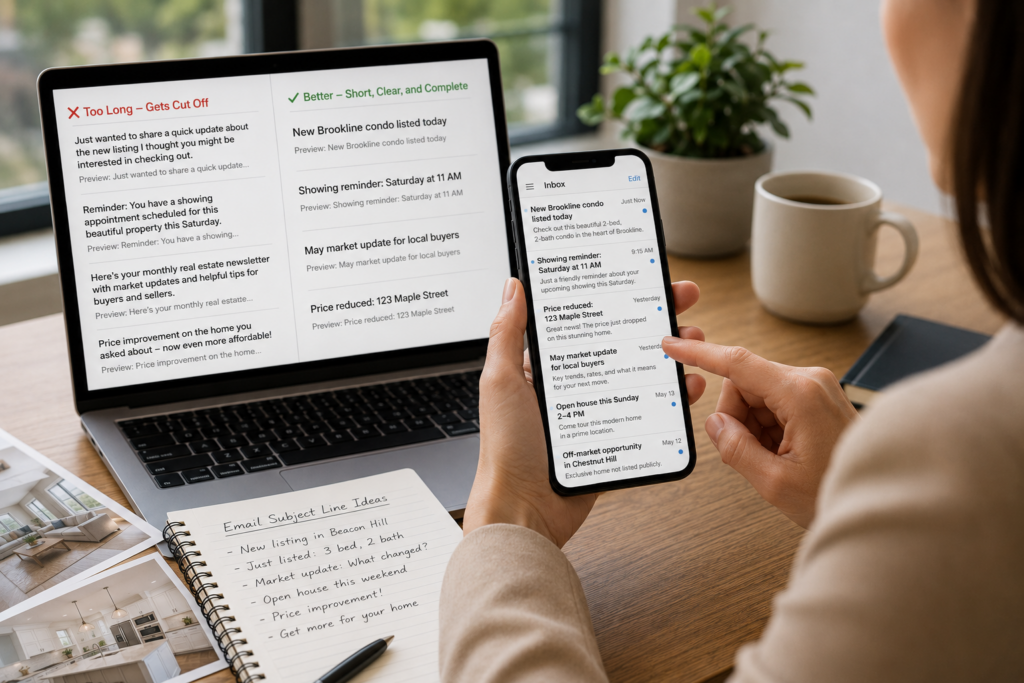
Many recipients see email subject lines on a phone first. Long subject lines can get cut off before the main point appears, so the most important detail should come early.
For real estate agents, that usually means leading with the neighborhood, listing type, price change, appointment reminder, or client concern. A subject line such as “New condo in Midtown” works harder than “A quick update you might like.”
The Short-Line Editing Method
A useful target for real estate email subject lines is four to nine words, or roughly under 40 characters when possible. This keeps the message easier to scan on mobile screens.
Start by writing the full idea. Then cut from the end until only the clearest version remains.
Before:
Just wanted to share a new listing in Brookline
After:
New Brookline listing today
Weak openers like “Just wanted to share…” or “Quick update about…” waste space before the reader gets to the value.
The same rule applies to newsletter emails. Instead of leading with “Monthly Newsletter,” lead with the useful detail inside:
- Mortgage rate update for buyers
- Three homes sold in Oakwood
- What changed in the local market
Concrete subject lines usually give readers a better reason to open than broad labels.
Step 3: Use Hyper-Local Personalization Beyond First Names
First-name merge tags can help, but they are not enough on their own. In real estate, location often carries more meaning than a name. Hyper-local subject lines that mention a neighborhood, subdivision, zip code, or school district can feel more relevant than broad market updates.
NAR research on home buyers and sellers shows how much location and neighborhood factors shape housing decisions. That makes local email angles useful for agents, especially when the subject line reflects what the contact actually cares about.
The swap is simple:
Generic: New listing you might like
Better: New listing in Riverside Heights
The second line gives the reader a reason to pay attention before opening. It signals that the email is tied to a place they know or have shown interest in.
How to Set This Up in a CRM
Most CRM platforms allow tags or custom fields beyond first and last name. Agents can add fields for neighborhood interest, zip code, price range, school district, or property type. Those fields can then guide subject line templates.
For example:
- New listing in [Neighborhood]
- Price drop near [School District]
- Homes under [Budget] in [City]
- Your [Neighborhood] market update
Always use a fallback value. If the neighborhood tag is empty, the subject line can break and read like this: “New listing in .” Set a default such as the city name or “your area” to avoid that problem.
Step 4: Use Psychological Triggers: Curiosity, Urgency, and Pain Points
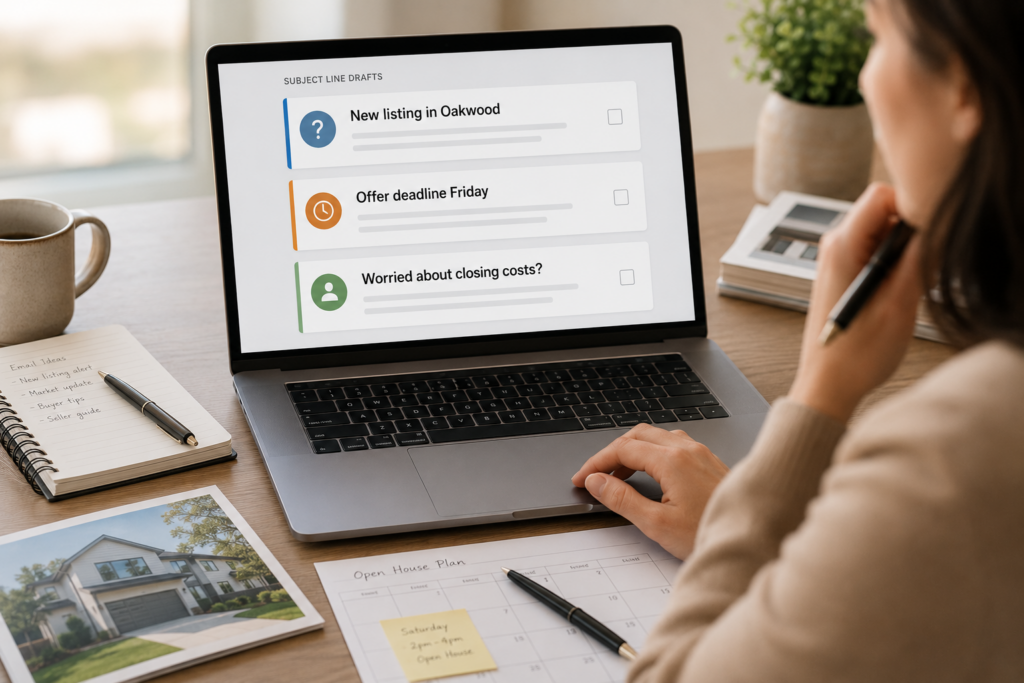
Flat subject lines usually fail because they give the reader no clear reason to open. A stronger subject line uses one clear trigger: curiosity, urgency, or a specific concern.
Curiosity
Curiosity works when the subject line points to a useful answer without giving everything away.
Example:
The fee buyers often miss
This works better than a vague tease because it names a real concern. The email still needs to deliver on the promise. If the subject line creates curiosity but the message feels thin, readers lose trust.
Real Urgency
Urgency works only when the timing is real. A new listing, open house, offer deadline, rate update, or closing window can give readers a clear reason to act.
Examples:
- Open house ends at 3
- Offer deadline is Friday
- New listing in Oakwood today
Avoid fake scarcity. If every email sounds urgent, none of them will feel urgent for long.
Pain-Point Relevance
Pain-point subject lines work when they reflect a concern the reader already has. Buyers may worry about rates, hidden costs, inventory, or bidding pressure. Sellers may worry about timing, pricing, repairs, or whether their home will sit.
Examples:
- Worried about closing costs?
- Is your price too high?
- Fewer homes in your range this week
These lines feel more useful than broad updates because they connect to a real decision or concern.
A Note on Emojis
Emojis can work in some real estate emails, but use them carefully. One emoji at the end is usually enough, and only when it supports the message. Too many emojis, all caps, or heavy punctuation can make the email feel less professional.
Step 5: A/B Test Subject Lines and Track What Works
Subject line testing works best when it is simple. Instead of changing several things at once, test one variable per campaign.
For example, compare:
- Personalized vs. generic
- Question vs. statement
- Short vs. medium length
- Neighborhood mention vs. no neighborhood mention
- Urgency vs. no urgency
Testing more than one variable at a time makes the result harder to read. If open rates change, the agent will not know which change caused it. Start with one test, review the result, then test another variable in the next campaign.
Generate Variants Quickly
AI writing tools can help agents create several subject line options from one campaign idea. The agent should still choose the two strongest options and make sure both match the email content.
This is useful for hyper-local email marketing for real estate, where small wording changes can matter. For example, a subject line with a neighborhood name may perform differently from one with a general city reference.
It can also help when promoting visual services or listing updates, such as generative ai in real estate photography announcements. The subject line should make the benefit clear without sounding too technical.
Sample size matters. Avoid drawing conclusions from a very small recipient group. Track open rate, click-through rate, replies, and unsubscribe rate over several campaigns. Over time, agents can see which subject line patterns work best for their own audience.
Ready-to-Use Real Estate Email Subject Line Templates by Use Case
Subject Line Templates by Use Case
Use these examples as starting points, then customize the placeholders for each audience segment.
New Listing Alerts
- Just listed in [Neighborhood]
- New [Neighborhood] home today
- [Neighborhood] listing just went live
- 3BR home in [Neighborhood]
- New condo near [Landmark]
Market Update Emails
- [City] home prices this month
- [Neighborhood] inventory changed
- One [City] trend to watch
- What changed in [Neighborhood]?
- [City] market update for owners
Buyer Nurture
- Worried about rates?
- New options in [Neighborhood]
- Homes under [Budget] in [City]
- Is [Neighborhood] still in range?
- What buyers should know this week
Seller Outreach
- What is your [Neighborhood] home worth?
- Recent [City] sales to know
- [Neighborhood] homes are moving
- Thinking about selling this year?
- Your local value update
Past Client Re-Engagement
- Still happy in [Neighborhood]?
- Quick check-in, [First Name]
- Your [City] home update
- Has anything changed since closing?
- A quick homeowner reminder
Open House Invitations
- Open house in [Neighborhood]
- [Date] showing in [Neighborhood]
- Tour [Address] this [Day]
- Open house details inside
- [Neighborhood] home open this weekend
Replace bracketed fields with accurate CRM data before sending.
Generic subject lines treat every contact the same. Better templates use the recipient’s location, stage, or interest to make the email feel more relevant.
Use bracketed fields such as [Neighborhood], [City], [Date], or [First Name] only when the CRM data is accurate. Agents should also keep mls rules for property listings in mind when referencing property details, pricing, views, square footage, or availability.
New Listing Alerts
- Just listed in [Neighborhood]
- New [Neighborhood] home today
- [Neighborhood] listing just went live
- 3BR home in [Neighborhood]
- New condo near [Landmark]
Market Update Emails
- [City] home prices this month
- [Neighborhood] inventory changed
- One [City] trend to watch
- What changed in [Neighborhood]?
- [City] market update for owners
Buyer Nurture
- Worried about rates?
- New options in [Neighborhood]
- Homes under [Budget] in [City]
- Is [Neighborhood] still in range?
- What buyers should know this week
Seller Outreach
- What is your [Neighborhood] home worth?
- Recent [City] sales to know
- [Neighborhood] homes are moving
- Thinking about selling this year?
- Your local value update
Past Client Re-Engagement
- Still happy in [Neighborhood]?
- Quick check-in, [First Name]
- Your [City] home update
- Has anything changed since closing?
- A quick homeowner reminder
Open House Invitations
- Open house in [Neighborhood]
- [Date] showing in [Neighborhood]
- Tour [Address] this [Day]
- Open house details inside
- [Neighborhood] home open this weekend
Final Thought
Strong real estate email subject lines are not about clever wording. They are about matching the right message to the right person at the right time.
Agents get better results when they segment their lists, keep subject lines short, use local details, and test one variable at a time. A buyer lead, seller lead, past client, and open house visitor should not all receive the same subject line.
AI tools can help generate options faster, but agents still need to review tone, accuracy, and local relevance before sending. The subject line should match the email content and the landing page it points to.
This matters even more when emails link to listing pages. First impressions depend on both the words in the inbox and the visuals buyers see after they click. Agents thinking about the full presentation can also consider how interior design and real estate sales work together.
A practical next step: review the last ten campaigns. Note which subject lines earned the highest open rates, then look for the pattern they share.
FAQs
Can agents use the same subject line formula for cold leads and past clients?
Usually, no. Cold leads need more context because they do not know the agent yet. Past clients may respond better to familiar check-ins, home value updates, or local market notes. The subject line should match the relationship stage.
How often should agents rotate subject line styles?
There is no fixed rule. A practical approach is to rotate the main angle every few campaigns. Move between curiosity, urgency, local value, and helpful updates. If open rates start falling on a repeated format, test a new one.
Does a question mark improve real estate email open rates?
Not by itself. A question works when it matches the reader’s concern. For example, “Is now a good time to sell?” may work for seller leads, but not for buyers looking at new listings. Relevance matters more than punctuation.
How can agents compare subject lines without built-in A/B testing?
Split the list into two similar groups. Send version A to one group and version B to the other at the same time. Keep the sender name, email body, and send time the same. After a day or two, compare open rates, clicks, replies, and unsubscribes.