Real estate landing pages work best when each page has one clear audience, one clear offer, and one clear next step. Sending every visitor to the homepage can create lead leaks because buyers, sellers, investors, and open house visitors are not all looking for the same thing.
A strong real estate website needs targeted pages for specific actions: viewing listings, requesting a home valuation, exploring neighborhoods, booking a consultation, downloading a buyer guide, or registering for an open house. These pages work best when they are part of broader real estate marketing strategies, not isolated one-off campaigns.
This article breaks down eight real estate landing pages agents can use to capture better leads, support different buyer and seller intents, and move visitors toward the right next step.
Why Dedicated Real Estate Landing Pages Outperform a Homepage
A homepage has to serve many visitors at once: buyers, sellers, past clients, curious neighbors, and people researching the agent. That makes it useful as a general brand hub, but weaker as the destination for a specific campaign.
Dedicated real estate landing pages work better when the visitor has one clear intent. A seller who clicks a “What is my home worth?” ad expects a home valuation page, not a general homepage with a contact form buried halfway down. A buyer searching in a specific neighborhood expects relevant listings, local context, and a clear next step.
The advantage is message match. The page headline, visuals, form, and CTA all support the same goal. Instead of asking one homepage to serve every type of lead, agents can create focused pages for specific actions: home valuation requests, buyer consultations, neighborhood searches, open house registrations, or listing inquiries.
The eight page types below each support a different lead goal, from capturing seller intent to helping buyers continue their search on the agent’s own website.
How These 8 Landing Page Types Were Evaluated
A home valuation page built for sellers will not help a buyer searching for neighborhood listings. The right landing page depends on the visitor’s intent, the offer, and the action the agent wants them to take.
Each page type was reviewed across four practical criteria:
- Lead goal: Is the page built for buyers, sellers, investors, open house visitors, or listing leads?
- SEO value: Can the page support local search through neighborhoods, property types, or market-specific content?
- Conversion elements: Does the page support a clear CTA, short form, trust signals, and relevant visuals?
- Mobile performance: Is the page easy to read, tap, and submit on a smartphone?
Page Structure and Tooling Notes
Each landing page type below follows the same structure: what it does, who it fits, key conversion elements, and the main limitation to consider. That makes the recommendations easier to compare and helps agents avoid building pages that look good but do not match the lead goal.
The article also references tools where they fit the page type, including Unbounce, Placester, B12, and AI HomeDesign. Pricing should be treated as directional unless verified directly, since website builder and landing page platform plans can change over time.
The 8 Must-Have Real Estate Landing Pages
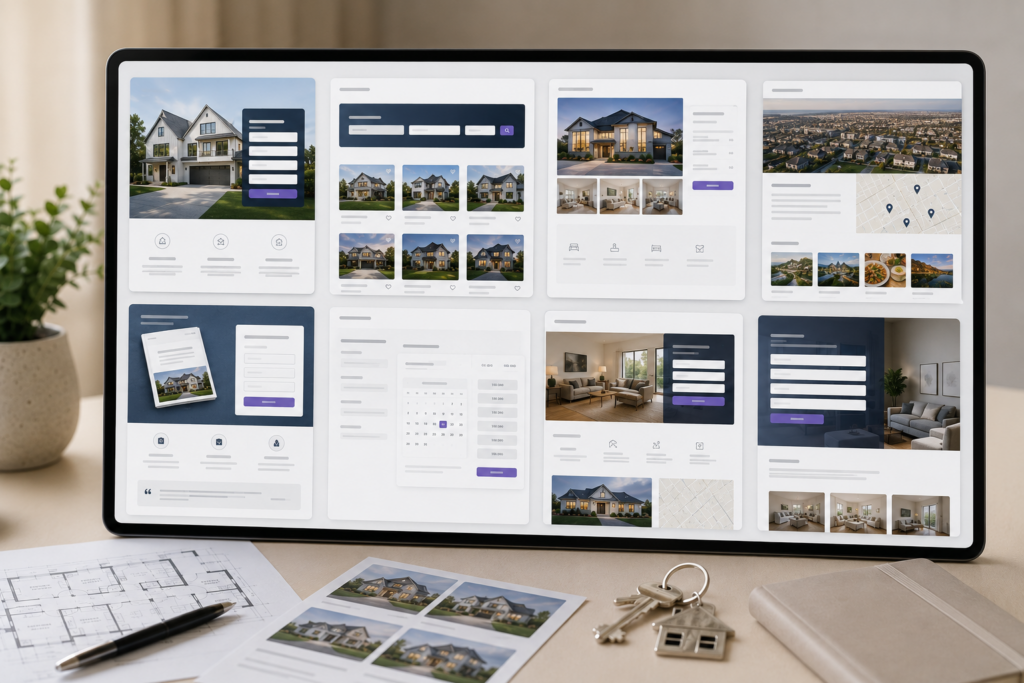
Different lead types need different entry points. A seller looking for a home valuation, a buyer searching a neighborhood, and an open house visitor should not all land on the same generic page. Each landing page below supports a specific audience, moment, and conversion goal.
1. Home Valuation Landing Page
A home valuation landing page targets seller leads by offering a property value estimate in exchange for contact details. It works best for listing agents who want to build a seller pipeline.
Key conversion elements:
- Simple address input field
- Short form for name, email, and phone
- Trust signals such as recent sales, local experience, or market data
Main limitation:
This page usually needs AVM or valuation-tool integration if the estimate is delivered automatically.
2. Property Search / IDX Landing Page
A property search landing page helps buyers browse listings directly on the agent’s website instead of leaving for third-party portals. It is useful for agents who want to capture buyer intent while visitors are actively searching.
Key conversion elements:
- Live or regularly updated listings
- Filters for price, location, bedrooms, and property type
- Save-search or inquiry CTA
Main limitation:
This page needs an active IDX or MLS feed to work properly.
3. Single Property Showcase Page
A single property showcase page is built around one listing. It works especially well for luxury homes, new listings, unique properties, or homes that need a stronger visual presentation.
Strong listing photos are essential here. For vacant or dated spaces, Virtual staging can help buyers understand room function, layout, and scale before they book a showing.
Key conversion elements:
- High-quality listing photos
- Clear inquiry or showing request form
- Virtual tour, floor plan, or video link
- Property highlights and neighborhood context
Main limitation:
The page may lose search value after the property sells unless it is redirected, archived properly, or repurposed as a sold-listing case study.
4. Neighborhood / Community Profile Page
A neighborhood page targets buyers searching by location, zip code, school district, or lifestyle fit. It can support long-term local SEO because the content stays useful beyond one listing cycle.
Key conversion elements:
- Local market snapshot
- Lifestyle and commute details
- School, amenity, and neighborhood context
- Related listings or search links
Main limitation:
These pages require ongoing content updates to stay accurate and useful.
5. Free Resource / Lead Magnet Page
A lead magnet page offers a buyer guide, seller checklist, relocation guide, or market report in exchange for an email address. It works best for visitors who are researching but not ready to book a call yet.
Key conversion elements:
- Clear resource title
- Short benefit-focused description
- Minimal form, usually name and email
- Follow-up email sequence after download
Main limitation:
Lead quality can vary because some visitors only want the resource, not immediate agent help.
6. Appointment Booking Landing Page
An appointment booking page has one clear goal: schedule a call, consultation, valuation appointment, or showing. It works best when the visitor already has some trust or clear intent.
Key conversion elements:
- One primary CTA
- Calendar booking tool
- Short reassurance copy
- Testimonials or trust signals near the form
Main limitation:
Cold traffic may not book immediately without enough context, proof, or lead nurturing first.
7. Open House Registration Page
An open house registration page turns casual visitors into trackable leads before the event. It works well for agents with active listings and scheduled open houses.
Key conversion elements:
- Property address or event location
- Date and time
- Short registration form
- Confirmation email or calendar reminder
Main limitation:
The page has a short lifespan and should be updated or removed after the event.
8. Seller / Listing Presentation Landing Page
A seller presentation page acts like a digital listing pitch. It is useful when an agent is competing for a listing and wants to show marketing strategy, local expertise, and proof of results.
Key conversion elements:
- CMA or pricing strategy section
- Recent sold comparables
- Marketing plan
- Testimonials or case studies
- Clear consultation CTA
Main limitation:
It works best when shared directly with a warm seller lead. It may not perform as well as a cold-traffic page without prior context.
Key Conversion Elements Every Real Estate Landing Page Needs
Most real estate landing pages lose visitors because of friction. A long form, unclear CTA, slow load time, weak visuals, or too many competing links can make a good campaign underperform.
Short Forms and Clear Trust Signals
Lead capture forms should stay as short as possible. For many landing pages, name, email, and phone number are enough. For lower-intent offers, such as a downloadable buyer guide, name and email may work better because the commitment is smaller.
Trust signals help reduce hesitation. Client testimonials, recent sales, review counts, brokerage affiliation, local experience, and recognizable market data can all make the page feel more credible. Place these close to the CTA or form, where visitors are deciding whether to submit their information.
One CTA and a Mobile-First Layout
Each landing page should focus on one main action. That might be requesting a home valuation, booking a consultation, registering for an open house, or viewing listings. Extra menus, sidebar links, and competing offers can pull attention away from that goal.
Mobile performance also matters. Many buyers and sellers browse on phones, so the page should load quickly, display cleanly, and make the form easy to complete. Strong real estate photo editing can also help listing visuals look clearer and more professional without making the page feel cluttered.
For listing-based landing pages, image preparation matters too. Agents should know how to prepare real estate photos for MLS, so the same visuals work well across listing platforms, property pages, and email campaigns.
Test Before Scaling
A/B testing can help improve headlines, CTA copy, form length, and hero images. Start with the basics first: one clear offer, one main CTA, fast loading, and a form that is easy to complete.
Use urgency carefully. Open house registration deadlines or limited showing slots can be useful when they are real. Avoid artificial scarcity, because it can weaken trust.
Best Tools for Building Real Estate Landing Pages
The best landing page builder depends on what the page needs to do. A paid ad campaign needs fast testing and message match. A property search page needs IDX support. A service-focused agent website may need appointment booking and simple site management.
| Tool | Best For | IDX Support | A/B Testing | Best-Fit Page Type |
|---|---|---|---|---|
| Unbounce | Paid ad landing pages | No | Yes | Home valuation, appointment booking, campaign pages |
| Placester | Real estate websites with IDX | Yes | Limited | IDX search, neighborhood pages, agent websites |
| B12 | Service-style agent websites | No | Limited | Appointment pages, consultation pages, simple full-site builds |
Unbounce
Unbounce is the strongest fit for agents running paid ad campaigns. Its Dynamic Text Replacement feature can match landing page copy to the visitor’s search terms, which helps keep the ad and page message aligned. It also supports A/B testing, so agents can test headlines, CTAs, and form variations before scaling a campaign.
The limitation is IDX. Unbounce is not built as a real estate search platform, so it works better for home valuation pages, appointment booking pages, lead magnet pages, and single-campaign landing pages than for live property search.
Agents using Unbounce for listing campaigns can pair it with external visual tools. For example, ai interior design tools can help improve room presentation before those visuals appear on the landing page.
Placester
Placester is a stronger fit when the landing page needs real estate website infrastructure, especially IDX listing display. Its pricing page and third-party profiles position it around agent websites, IDX listing tools, pages, CRM features, and real estate site management.
That makes it useful for IDX search pages, neighborhood pages, agent websites, and listing-driven lead capture. The tradeoff is that it may be less flexible than a dedicated landing page platform for rapid A/B testing or paid ad experimentation.
B12
B12 is better suited to agents who need a simple service-style website with appointment pages, intake forms, email marketing, contact management, and client-facing tools. Its current pricing page highlights website creation, analytics, integrations, online payments, invoicing, client intake, email marketing, contact management, contracts, and eSignature features.
It is not the best fit for IDX search pages, but it can work for consultation pages, appointment booking, agent service pages, or simple lead capture flows where the main goal is to get a visitor to submit a form or book a call.
How AI Virtual Staging Strengthens Single Property Showcase Pages
Vacant rooms can make a single property showcase page harder to engage with. Buyers may understand the room size, but still struggle to imagine how the space could function with furniture, flow, and daily use.
AI virtual staging can help by turning empty rooms into clearer, more useful listing visuals. On a single property page, this matters because the hero image, gallery, and room-by-room visuals often shape whether a visitor keeps scrolling or leaves.
Virtual Staging for Interior Rooms
Virtual staging works best when it helps buyers understand the room without changing the property itself. A vacant living room, bedroom, or dining area can be staged digitally before the page goes live, giving the listing a more polished presentation without delaying the launch.
The key is realism. Furniture should fit the room’s scale, layouts should feel practical, and the final image should still represent the property accurately. When staged visuals feel believable, buyers can better understand the space and move toward the next step, such as viewing the gallery, watching a tour, or requesting a showing.
Exterior Photos and Day-to-Dusk Enhancement
Exterior photos matter too, especially on single property pages where the first image sets the tone. A strong exterior can make the listing feel more polished before the buyer even opens the gallery.
A day-to-dusk enhancement can help when the original exterior photo looks flat or was taken in harsh midday light. The goal is to create a warmer, more inviting first impression while keeping the property realistic. The edit should not fabricate views, hide exterior issues, or make the home look different from what buyers will see in person.
Together, realistic virtual staging and careful exterior enhancement can make a single property page feel more complete, more professional, and easier for buyers to act on.
Mobile Optimization and Page Speed for Real Estate Lead Pages
Real estate landing pages need to work well on smartphones. Buyers and sellers may click from ads, emails, social posts, or listing links while browsing on a mobile device. If the page loads slowly, the form is hard to use, or the CTA is difficult to tap, many visitors will leave before taking action.
Mobile performance also affects paid campaign efficiency. A slow or cluttered landing page can increase bounce rates and weaken the return from ad traffic. For real estate lead pages, speed, layout, and form usability should be part of the conversion strategy from the start.
Platform Setup Matters
Different landing page builders handle mobile layouts in different ways. Some give agents more design control but require manual mobile adjustments. Others rely on responsive templates that reduce setup time.
For agents managing pages without a developer, the best choice is usually the platform that makes mobile editing easy and keeps forms, images, and CTAs clean on smaller screens.
Practical Mobile Performance Checklist
- Compress listing photos before upload
- Use lazy loading so images load as visitors scroll
- Keep forms in a single-column layout
- Make CTA buttons large, centered, and easy to tap
- Add click-to-call for mobile visitors
- Keep the page focused on one primary action
- Test the page on a real phone before launching
Small mobile details can have a large effect on lead capture. A short form, fast-loading visuals, clear CTA, and easy contact option make the page feel simpler and more trustworthy for visitors browsing on the go.
Tracking Setup: How to Measure Real Estate Landing Page Conversions
A real estate landing page should not launch without basic tracking. Agents need to know which traffic source, ad, keyword, or campaign produced each lead. Otherwise, it becomes difficult to tell which pages are actually working.
Start by adding UTM parameters to every campaign URL. These tags help show whether a visitor came from Google Ads, Facebook, Instagram, email, organic search, or another source.
Retargeting and Event Tracking
Tools such as Google Tag and Meta Pixel can help track visitor behavior and support retargeting campaigns. For example, someone who visits a home valuation page but does not submit the form can later receive a follow-up ad.
The most useful conversion events to track are:
- Form submissions
- Phone call clicks
- Appointment bookings
- Home valuation requests
- Open house registrations
- Buyer guide downloads
Each action should be tracked as a separate event. That keeps reporting clean and helps agents understand which landing pages bring in serious leads.
CRM Integration and A/B Testing
Connecting the landing page to a CRM keeps lead data organized. Form submissions can move directly into a contact record, follow-up sequence, or lead pipeline without manual entry.
A/B testing also matters, but results need enough data before making decisions. Test one major element at a time, such as the headline, CTA, form length, or hero image. Once one version performs better across a meaningful number of conversions, it can become the new control.
How to Choose the Right Landing Page Type
The right landing page depends on the lead goal. A seller looking for a valuation, a buyer searching for homes, and a visitor from a paid ad all need different page experiences.
Use the page type that matches the visitor’s intent:
Seller leads: Use a home valuation landing page with a simple address field, short form, and local trust signals.
Buyer leads: Use an IDX property search page so buyers can browse listings directly on the agent’s website.
Paid Google or Meta ads: Use a focused appointment booking page or campaign landing page with one CTA and strong message match.
Long-term organic traffic: Use a neighborhood profile page with local market context, lifestyle details, and related listings.
Active listings: Use a single property showcase page with strong photos, property details, a showing CTA, and supporting visuals.
Nurture campaigns: Use a free resource or lead magnet page for buyer guides, seller checklists, relocation guides, or market reports.
Budget and Team Size
Budget and team size also shape the decision. Solo agents usually benefit from one focused page type before building a full landing page system. Teams running paid campaigns may need stronger testing tools, CRM integration, and campaign-specific pages. Brokerages may need a platform that supports IDX, lead capture forms, multi-user access, and consistent branding across agents.
Visual preparation matters too. A single property showcase page is only as strong as the listing assets it uses. For agents managing several listings, AI staging and photo enhancement can make showcase pages more practical by improving vacant or hard-to-read rooms before the page goes live.
Tool and Feature Summary
| Tool | Best For | Main Role in Landing Page Strategy |
|---|---|---|
| Unbounce | Paid ad campaigns and A/B testing | Builds campaign-specific pages with strong message match |
| Placester | IDX search and real estate websites | Supports property search pages, neighborhood pages, and real estate site structure |
| AI HomeDesign | Listing photo enhancement and virtual staging | Improves listing visuals used on single property pages, ads, and lead capture pages |
Final Thought
The right tool depends on the primary lead goal. Agents running paid search or social campaigns may get more value from a CRO-focused builder like Unbounce, especially when they need campaign-specific pages, headline testing, and strong message match.
Agents who need live property search on their own website have a different need. For buyer-focused pages, IDX support matters more than A/B testing. In that case, a real estate website platform such as Placester is a better fit for property search, neighborhood pages, and listing-driven lead capture.
Visual quality supports every landing page, but it matters most on single property showcase pages. Tools such as AI HomeDesign can help agents improve listing photos, stage vacant rooms, and create stronger visuals before those images appear on the page.
The most practical starting point is simple: build the page that matches the highest-priority lead goal. Seller-focused agents should start with a home valuation page. Buyer-focused agents should start with an IDX search or neighborhood page. Agents promoting active listings should start with a single property showcase page.
Building all eight pages at once is rarely necessary. Start with one or two high-intent pages, track performance, then expand the landing page system once the workflow is easier to manage.
FAQs
Can one landing page builder handle all eight page types?
Not always. General builders like Unbounce can work well for lead capture, appointment booking, resource downloads, and single property pages. IDX property search pages usually need a real estate website platform or IDX integration.
Do real estate landing pages work for off-market listings?
Yes. Single property showcase pages can work well for off-market or pocket listings because they do not need a live MLS feed. Agents can upload photos, property details, and a contact form manually.
How long should an A/B test run before making a decision?
It depends on traffic volume. A low-traffic landing page may need several weeks before the results are reliable. Avoid choosing a winner after only a few visits or form submissions.
Is a home valuation landing page compliant with real estate advertising rules?
It can be, but the page needs clear agent and brokerage identification. Agents should also avoid presenting automated valuation estimates as formal appraisals. Local MLS, brokerage, and advertising rules should be checked before launch.
Can neighborhood pages rank against Zillow or other large portals?
Broad city keywords are difficult to win. Hyperlocal pages have a better chance when they target specific neighborhoods, subdivisions, school districts, or local search intent. The content needs to be useful, specific, and updated over time.