Real Estate Advertising: Channels, Costs & What Converts
Real estate advertising costs by channel, what converts, and how to use cost per closing plus better creative and follow-up to stop wasting spend.
In short
- Think in closings: cost per lead hides conversion and payback time.
- Buy pipes wisely: match each channel to intent level and incubation window.
- Fund the asset: stronger visuals and faster follow-up make every channel cheaper.
Comparing lead price across real estate ads sounds rational. It also explains why many ad budgets create busy calendars but thin pipelines. A low cost per lead can still produce an expensive closing if the leads need long nurture or weak follow-up.
Real estate advertising works better when teams treat it as a system, not a set of platforms. The system includes the creative asset that earns the click, the channel that distributes it, and the speed that turns interest into a conversation. The details live inside the wider real estate marketing playbook, but paid media forces the trade-offs to show up fast.
This guide maps the main channels, shows how to think in cost per closing, and explains the conversion levers that make the same spend perform very differently.
Real Estate Advertising as Two Layers: Asset and Pipe
Most teams treat channels like competing products. In practice, each channel acts like a pipe. The same listing photo, headline, and offer flows through Google, Meta, a portal, or direct mail. Better assets make every pipe work harder.
The “pipe” choices still matter. Some pipes capture intent, while others create it. Portals and search ads meet buyers already shopping. Social ads and direct mail often reach people earlier, before a move feels urgent. That timing drives both lead quality and the time it takes to see a closing.
The “asset” layer usually decides whether the pipe stays affordable. Weak visuals lower click-through rate, which pushes cost per click up in auction-based channels and lowers the share of attention in portals. Strong visuals do the opposite. That is why teams can see two agents run the same channel in the same ZIP code and report very different results.
A practical planning rule helps: fund the asset first, then pick pipes. A campaign can survive a slightly imperfect channel mix. It rarely survives a generic image and slow follow-up.
Channel Benchmarks for Pipes, Not Promises
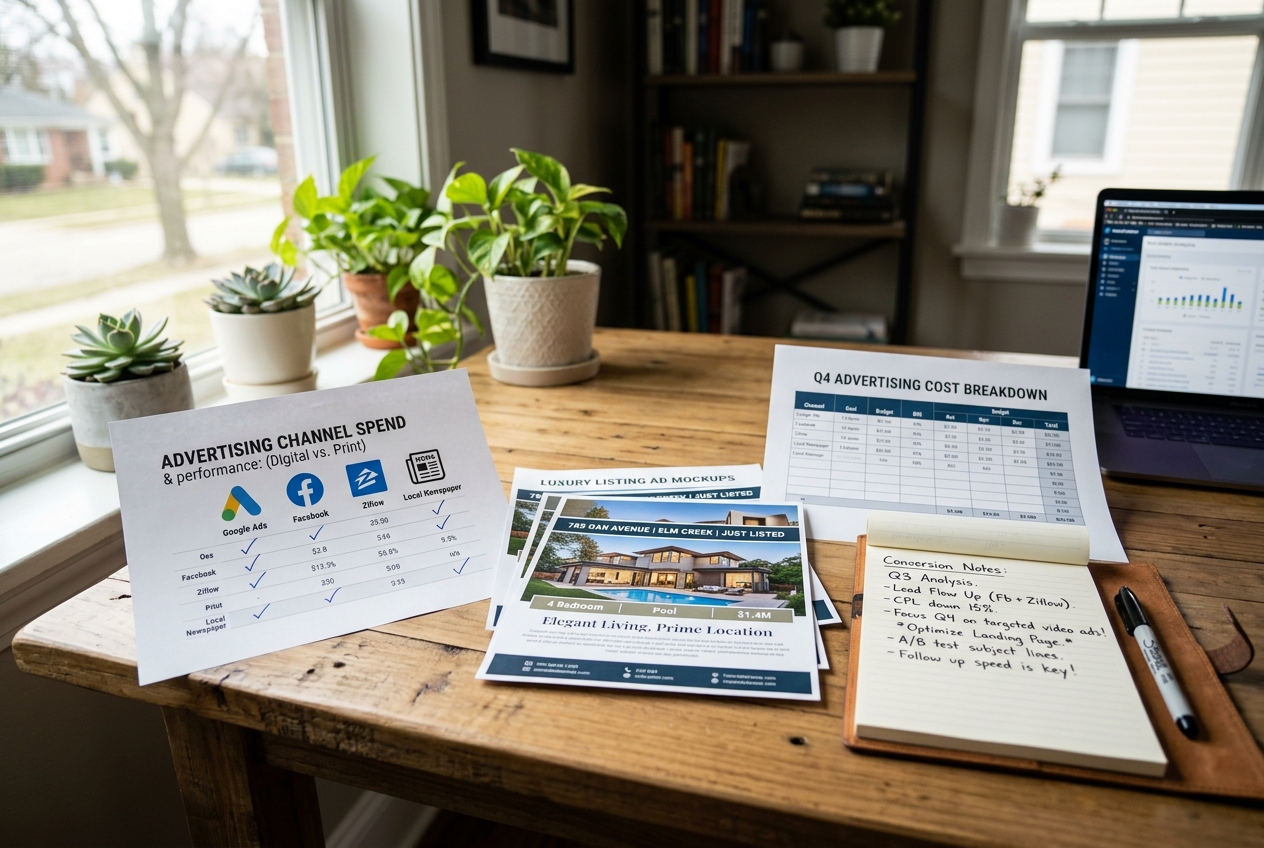
Benchmarks help set expectations, but they can mislead when they get treated like guarantees. Market, seasonality, price point, and follow-up speed can move results dramatically. The right use of benchmarks is directional: which pipes usually cost more, which ones close faster, and which ones compound over time.
The table below uses plain-language bands instead of precise figures. That avoids fake precision and keeps the focus on the decisions that matter: intent level, payback window, and whether the channel compounds.
| Channel | Lead cost tendency | Conversion tendency | Payback window | Compounds or resets |
|---|---|---|---|---|
| Portals such as Zillow and Realtor.com | High | High | Short to medium | Resets |
| Google search ads | Medium to high | Medium | Short | Resets |
| Meta ads | Low to medium | Low | Medium to long | Resets |
| SEO and Google Business Profile | Low over time | High | Long | Compounds |
| Email and database | Low | Medium | Short to medium | Compounds |
| Referrals | Low | High | Short to medium | Compounds |
| Direct mail and farming | Medium | Medium | Medium to long | Compounds with consistency |
| Signage and open houses | Low to medium | Medium | Short | Mixed |
Relative benchmarks help compare payback windows and lead quality by channel.
The next step is to translate those tendencies into one decision-grade metric. That metric does not start with cost per lead.
Cost Per Closing: The Math That Moves Budget
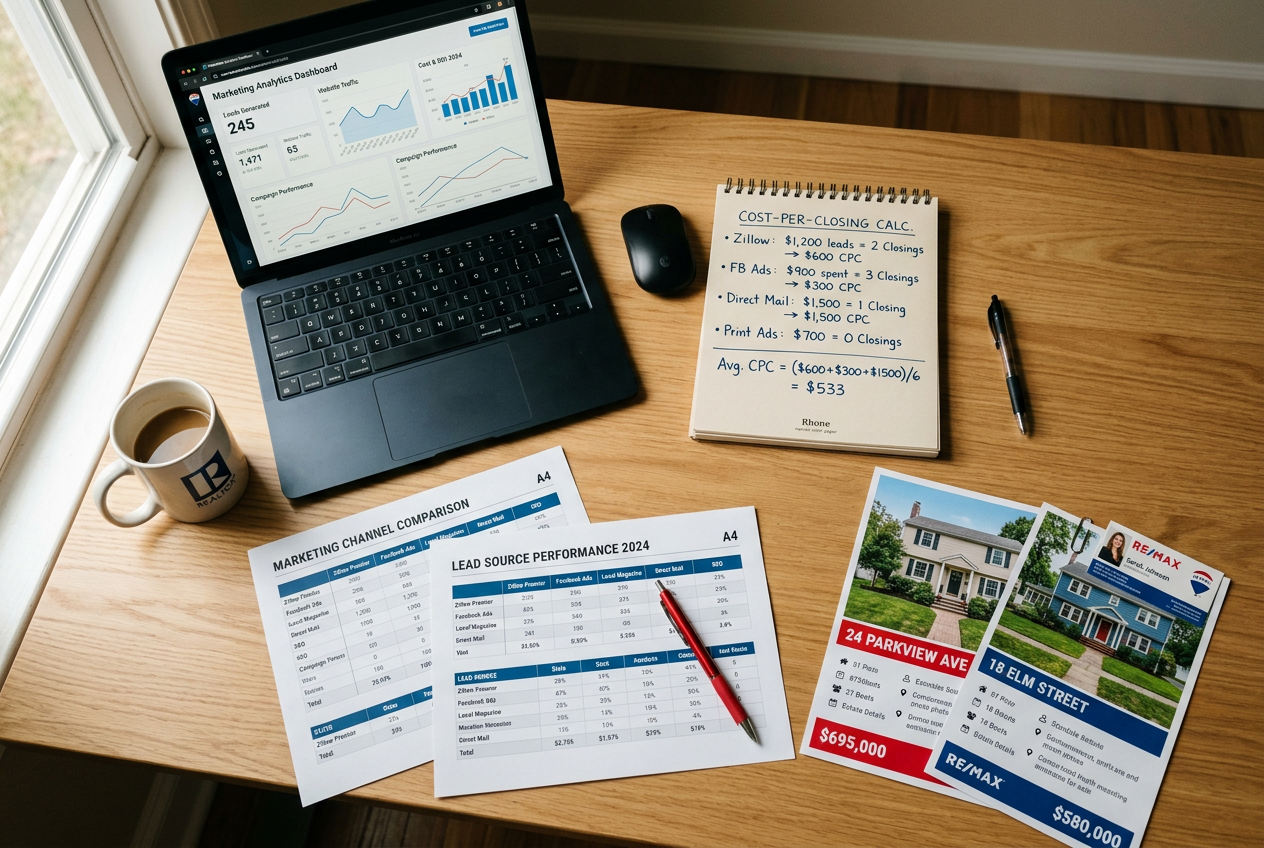
Lead price works like a sticker price. It tells only one part of the story. The number that decides whether a channel deserves budget is cost per closing, because it forces conversion rate into the same equation.
Agents can calculate it with a simple formula: cost per lead divided by lead-to-close conversion rate. Teams can run that math by channel, by campaign, and even by listing type. Then they can compare the result to gross commission income and to the time value of waiting.
This is also where “cheap” social leads often flip. If a channel converts a small fraction of leads, the channel can look efficient on cost per lead while still producing expensive closings. On the other hand, an expensive portal lead can still look efficient if it converts quickly and at a higher rate.
Cost per closing also protects against a common budgeting error: chasing whatever feels busy. When cost per closing rises, the fix might be different creative, tighter follow-up, or a better offer. The fix might also be a different lead source. That is why teams keep a short list of backups, such as the full lead generation tactic list, instead of betting the year on a single pipe.
Portals and Search Capture Intent Fast
Portals sell proximity to in-market shoppers. That high intent can produce a faster payback window than many other channels, but it also creates structural risk. The budget can feel like rent, because lead flow stops the day spend stops.
Another pressure sits underneath: costs rise as more agents bid for the same attention. One industry benchmark reports that portal lead costs increased by 1,107% over time. That kind of climb matters because commissions do not rise at the same pace in many markets.
Google search ads can play a similar role with a different control panel. Search captures “hand-raised” intent, which makes it useful for specific neighborhoods, property types, and seller services. It also turns on fast, so it can support a short-term pipeline gap. The downside is that search ads punish sloppy landing pages. If the ad promise and the page do not match, cost rises quickly.
Both channels reward clarity. The best-performing campaigns usually feel specific: a defined area, a clear next step, and an ad asset that looks like it belongs in that market.
Meta Ads Create Demand and Need Nurture
Meta ads trade intent for volume. The lead often arrives earlier in the decision cycle, which changes what “success” looks like. A campaign can generate many contacts without producing a closing soon, especially when the follow-up system is weak.
Creative carries more weight on social than almost anywhere else. The platform sells attention, and a single image often decides whether someone pauses. That makes listing visuals, short-form video, and simple offers more important than clever copy.
Meta also rewards a funnel mindset. A practical structure pairs an initial offer with a retargeting layer, then routes leads into a nurture track that builds familiarity over time. The tactical build details sit in how to structure a Meta ad campaign step by step. Teams that want a lower-cost complement can also treat organic social as the free half of the same channel and use it to build trust between paid touches.
Meta can work well for seller-side marketing, too, but only when the offer fits the platform. A “home value” hook often performs better than a generic buyer ad because it creates a reason to respond.
Owned Channels That Compound
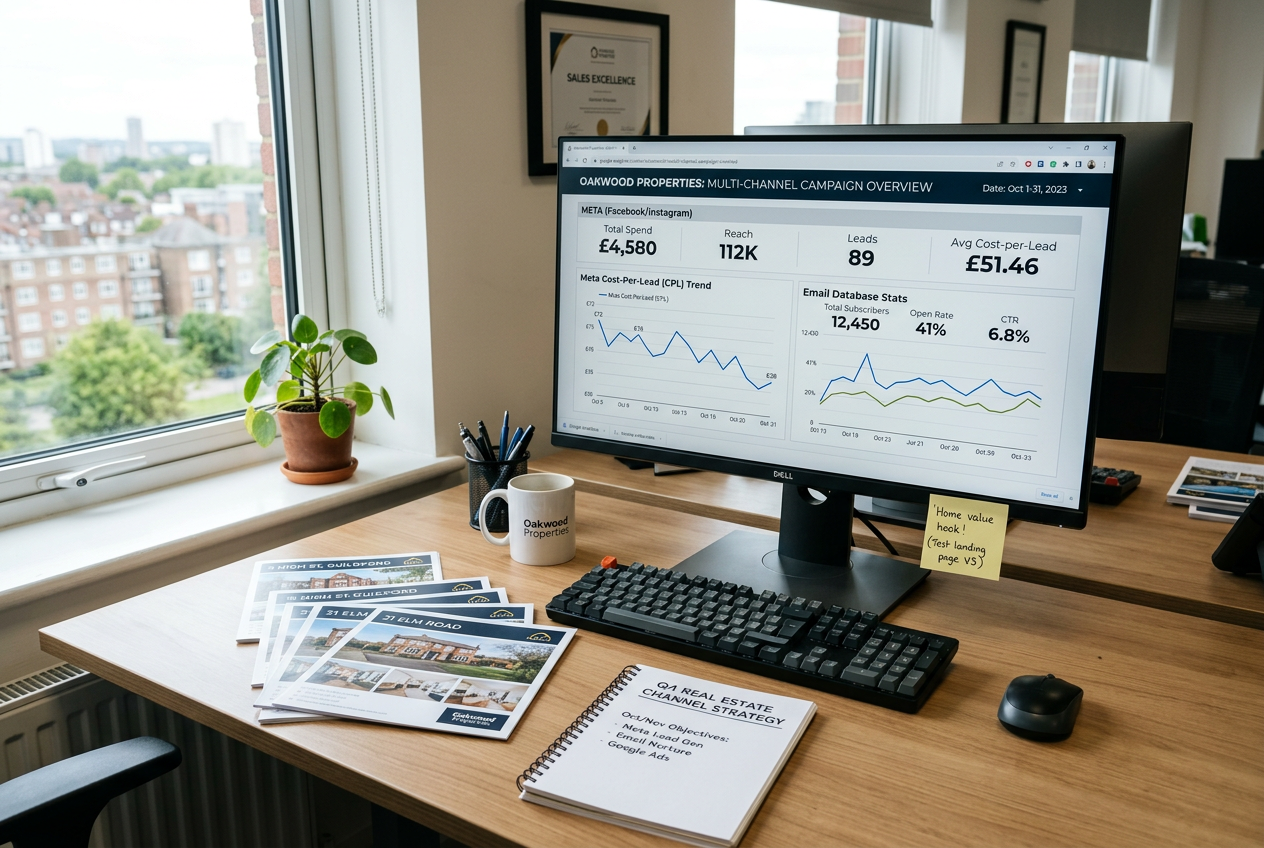
Owned channels feel slower at the start, but they change the long-run math. When a team keeps publishing, ranking, and reactivating a database, the channel often gets cheaper per lead over time instead of resetting every month.
Local SEO and a Google Business Profile represent the core compounding engine for many agents. Searchers arrive with clear intent, and organic visitors can convert at about 14.6% in some benchmarks, which can make the cost per closing attractive even if lead volume grows slowly. The foundation work sits inside local SEO and Google Business Profile.
Email and database reactivation often produce the most predictable closings for established agents because the trust already exists. The main cost is consistency, not media spend. A simple cadence, clear local value, and one call-to-action can outperform a flashy template. Many teams start with a monthly newsletter to your sphere, then layer in targeted “just sold” proof for likely movers.
Referrals sit in the same owned bucket. They usually convert well because someone else pre-sold trust. The bottleneck is attention to relationships, not platform settings.
Offline and Seller-Side Advertising That Still Works
Direct mail, signage, and open houses can look old-school, but they still win in one scenario: local saturation. These channels work best when the message stays consistent for long enough that neighbors start to recognize it.
Mail also supports seller-side advertising in a way digital sometimes cannot. “Just listed” and “just sold” pieces combine proof with repetition. The channel rarely works as a one-off drop. It works as a cadence that turns a neighborhood into a familiar audience.
Farming strategy matters more than design tricks. A tight area, a clear offer, and consistent proof usually beat a scattered list of addresses. Agents who want the longer view can map a farm with geographic farming and build creative around outcomes the neighborhood cares about.
Costs add up quickly offline, so creative needs discipline. One strong hero image, one message, and one next step often outperform a postcard that tries to say everything. For teams that want a practical production checklist, direct mail creative and cost per piece helps keep the spend tied to a measurable response goal.
What Converts: Creative, Destination, Speed, and Budget Mixes

Conversion rarely comes from a “better channel” alone. It usually comes from four levers working together: creative that earns the click, targeting that earns the right audience, a destination that holds attention, and follow-up speed that turns interest into a conversation.
The creative lever stays underpriced in most budgets. A small spend on Image Enhancement, AI Virtual Staging, AI Item Removal, or Day to Dusk can lift performance across every paid pipe because the same upgraded asset appears everywhere. AI HomeDesign is one example of an asset-layer workflow that produces those visuals fast. The deeper mechanics sit inside what strong visuals actually do to listing engagement.
Video fits the same category. One benchmark cites 403% more inquiries for listings that include video, which helps explain why a simple walkthrough can change results even when spend stays flat. The point is not the format. The point is scroll-stopping proof.
After the click, the listing page does the selling. If photos load slowly, the description feels generic, or the call-to-action hides, leads get more expensive. Teams can treat the landing page as part of the ad, not a separate project, starting with enhancing the listing the ad points to.
A practical budget mix usually follows the same pattern at every spend level: keep one intent channel for near-term pipeline, fund one compounding channel for next year, and reserve time for follow-up speed. When a campaign underperforms, this checklist isolates the lever that broke:
Frequently Asked Questions
How much should a real estate agent spend on advertising?
A useful budget starts with the pipeline goal and the time available to wait for results. Newer agents often need at least one intent-driven channel that can pay back sooner, while established agents can spend more on compounding channels. Any plan works better when it includes an asset line item for strong visuals and a clear follow-up system.
What is a good cost per lead in real estate?
A “good” cost per lead depends on the channel, the offer, and the speed of follow-up, so lead price alone can mislead. The more reliable target is cost per closing, because it forces conversion rate into the same equation. If cost per lead drops but appointments and signed clients do not rise, the leads likely need a different offer or nurture path.
Which real estate advertising channel converts best?
High-intent sources such as referrals, strong local search visibility, and some portal traffic often convert better than interruption-based channels, but conversion does not equal profit. The best channel is the one with an acceptable cost per closing inside the team’s payback window. Faster channels usually cost more per lead, while compounding channels trade speed for long-run efficiency.
Are portal leads worth the money?
Portal leads can be worth it when the team needs near-term pipeline and can respond fast enough to win the conversation. They also create a dependency risk because lead flow stops when spend stops, and costs can rise over time in competitive areas. A safer approach pairs portals with owned channels, so the business does not rent the entire pipeline.
Do better listing photos really lower advertising costs?
Better photos can lower effective advertising costs because they improve click-through rate and engagement, which helps the same spend produce more qualified inquiries. Strong visuals also improve the destination after the click, which supports conversion. Virtual staging and light photo enhancement help most when the home looks empty, dated, or poorly lit in the original images.
How long does it take for real estate ads to produce a closing?
Time to close varies by channel because channels capture different levels of intent. Search and portals can create conversations quickly because the consumer already shops, while social ads often start earlier in the decision cycle and need nurture. Owned channels such as SEO, email, and referrals can build a steadier pipeline, but they reward consistency over a longer horizon.