AI for Multifamily Real Estate: Investor AI Tool Stack
A multifamily deal usually lands as a PDF offering memorandum, a rent roll with inconsistent unit types, and a trailing twelve statement that never ties out cleanly. AI for multifamily real estate earns its keep when it removes rekeying and normalization work before anyone debates assumptions.
This guide maps AI to five jobs across the deal lifecycle and names only tools with verified, published facts. It also flags which vendors publish pricing and which run on quotes, since that difference changes how a sponsor runs a demo and budgets implementation.
The broader context is covered in how AI is reshaping real estate, but multifamily has its own unit-level data reality. That reality drives the stack below.
What makes multifamily different from the rest of CRE AI
Multifamily underwriting lives at the unit level, not the building level. A sponsor cares about lease start dates, concessions, loss to lease, renewal risk, and which units sit below market. That detail often hides inside messy unit-type labels, handwritten notes, and one-off credits that travel with a resident instead of a unit.
Operations data adds another layer of noise. A trailing twelve statement mixes recurring expenses with non-recurring items, then adds owner-level costs that do not belong in stabilized operations. Multifamily also carries constant turns, vacancy loss, and maintenance triage. Those items show up in multiple systems and rarely agree on naming.
Generic CRE AI tools often start from abstractions that fit office and industrial, like lease clauses and tenant credit. Multifamily asks a different question: which specific units can move, by how much, and what work is required to deliver that premium. That forces AI output to stay auditable down to the line and page.
The result is a clear order of operations. First, tools that extract rent rolls, operating statements, and offering memoranda into structured data. Second, tools that keep the pipeline and investment committee record clean. Third, tools that keep LP reporting and distributions consistent. Only then do portfolio analytics and value-add execution tools deliver compounding returns.
AI for multifamily real estate stack mapped by job

A useful AI stack in multifamily is not one platform. It is a set of narrow capabilities that pass clean outputs to the next step. Inputs matter more than models here, since most teams already trust their underwriting template and only need the data to arrive clean.
The stack starts with sourcing and screening, where the “AI” work is often document ingestion. The next layer is underwriting and modeling, where rent roll AI extraction and T-12 analysis AI reduce manual spread work but do not replace the investment committee. The middle layers cover capital raising, LP onboarding, investor reporting, and distribution math. The final layers cover operating monitoring and showing a value-add plan in a way lenders, LPs, and prospective residents can actually picture.
The table below frames each job by its real inputs and outputs. Tool selection should follow the output that must survive scrutiny, not the vendor category label.
| Job in the deal lifecycle | Real inputs | Output that must survive scrutiny |
|---|---|---|
| Sourcing and screening | Offering memoranda, broker emails, listing and market data | Structured deal fields and a screened pipeline record |
| Underwriting and modeling | Rent rolls, trailing twelve statements, pro formas | Normalized unit-level rents and expense lines mapped to the underwriting template, each traceable to a source page or line |
| Capital raising and LP onboarding | Subscription documents, investor questionnaires, signatures | Completed onboarding records and a clean investor register |
| Investor reporting and distributions | Approved financials, waterfall terms, ownership splits | Consistent LP reports and distribution math that ties to the financials |
| Operating monitoring and value-add execution | Property management system data, renovation scope, unit photos | Variance checks against the underwriting case, plus finish previews lenders, LPs, and prospective residents can picture |
For teams running operations in-house, the operating layer needs to connect to the system of record. For a deeper look at that layer, see AI property management tools. For many sponsors, that layer stays lighter at first, while underwriting and reporting automation carry the highest early ROI.
Tools with verified facts, organized by investor job

A practical shortlist starts by refusing to over-credit AI. AI offering memorandum analysis helps most when it converts documents into structured, checkable fields. AI investor reporting multifamily workflows help most when they reduce repetitive LP communications and distribution math. Tools that claim “insights” matter less than tools that preserve traceability and export cleanly.
The list below includes only tools with published, verifiable facts. Pricing stays exactly as published when available, and quote-based vendors stay quote-based here. “Not publicly listed” appears where no verified fact exists.
Tool fit also depends on who owns the work. An analyst needs rent roll AI extraction and T-12 normalization first. A sponsor needs a pipeline record that survives committee questions. An investor relations lead needs a system that produces consistent reporting without manual copy paste.
HouseCanary and CanaryAI: fit the valuation and analytics layer with property data, AVMs, forecasting, and neighborhood heatmaps. HouseCanary publishes Basic at $190 per year, shown as $15.83 per month billed yearly. Published higher tiers include Pro at $790 per year, Teams at $1,990 per year, and Enterprise priced by contact.
For teams that want a standardized workflow around extraction and auditability, the underwriting layer pairs well with an AI deal analysis workflow for investors, since the workflow forces citations and spot checks before the narrative memo is written.
Where each tool sits
Price against speed. Bottom-left is cheap and fast, top-right is pricey and slower.
Dealpath and Procore are not plotted: both are quote-based, so no published price or speed figure exists to place them.
The tools in detail

AgoraTop pick
Agora: fits the LP fundraising and reporting layer. Published positioning covers onboarding, reporting, distributions, and waterfall automation, plus an AI assistant for investor inquiries. Agora publishes Essential pricing that starts at $749 per month, with Pro and Enterprise priced by sales contact.
View Agora →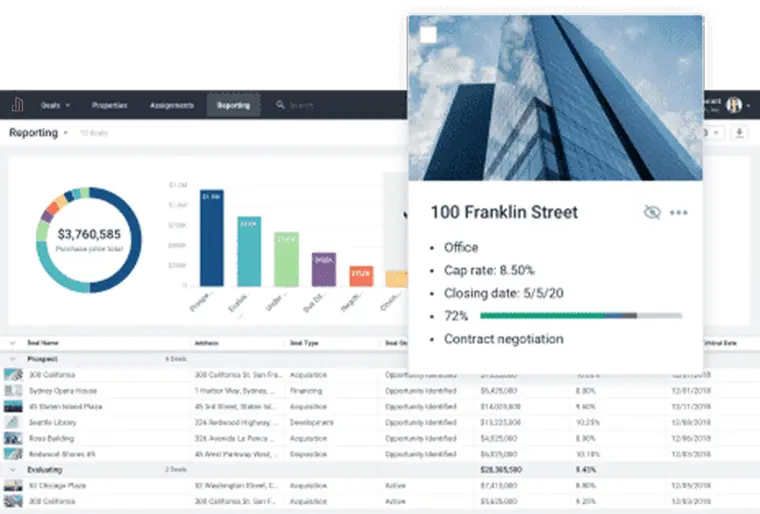
Dealpath
Dealpath: fits the sourcing-to-close layer as deal management software that screens using OMs, rent rolls, T-12s, BOVs, and pro formas. Pricing is quote-based with no published figure, which signals that seats, configuration, and minimums may shape the real cost. Dealpath also positions an AI Excel assistant for validating assumptions and comps, which matters most when a firm has multiple analysts.
View Dealpath →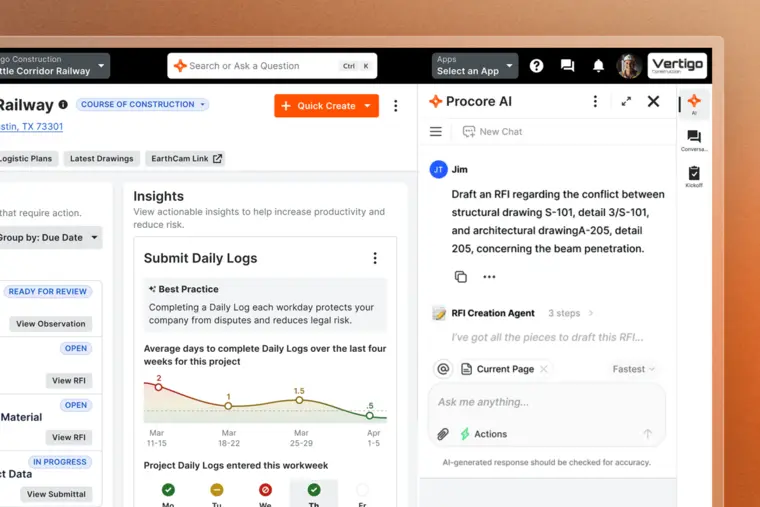
Procore
Procore: belongs on the contractor side of a value-add program, not in the investor’s underwriting stack. Procore positions a construction management platform with built-in job-specific AI agents, including 18 or more agents and a Datagrid feature for compiling data into one place. Pricing is quote-based and a sponsor typically encounters it through the general contractor.
View Procore →
Kolena
Kolena: fits the underwriting layer when the bottleneck is parsing OMs, rent rolls, and T-12s into structured data. The verified entry point is a free AI offering memo tool with no signup, and a published pace of about two minutes per page. A sponsor still needs a named reviewer to confirm mappings and exceptions before numbers land in a model.
View Kolena →
HouseCanary (CanaryAI)
- Institutional-grade property data + generative AI assistant for investor workflows
- Automated Valuation Models (AVMs) and valuation support
- AI-driven market forecasting and predictive analytics
- Neighborhood analysis with heatmap visualizations
What it really costs per deal
Pick a tool, set how many deals you underwrite a month, and see the real per-deal cost. Only the 3 tools that publish a monthly price are listed.
Minimum viable AI stack for a first 20-unit deal
Small sponsors rarely need a heavyweight platform on day one. The first deal bottleneck is usually clean extraction and repeatable packaging, not a complex permissioning system. A minimum viable stack should keep every output exportable to the underwriting model and the investor update, with clear “human sign-off” points.
Start with document extraction that produces structured fields from the offering memorandum, rent roll, and trailing twelve statement. Kolena’s free offering memo tool is a practical first test because it allows a real document run with no signup and a published turnaround pace. The goal is not to accept outputs blindly, but to reduce the time spent on first-pass mapping so the analyst spends more time checking anomalies.
Add a data and valuation layer only if it tightens the underwriting loop. HouseCanary and CanaryAI can fill that role for teams that need property data, AVMs, and forecasts while staying inside published pricing. The value is not “predicting returns,” it is sanity-checking assumptions against market context and storing comparable notes consistently.
Delay quote-based platforms until the work volume demands them. Deal pipeline software with AI becomes worth it when multiple deals run in parallel and committee process needs structure. LP reporting platforms become worth it when onboarding and distributions consume a material share of close and quarter-end work. Quote-based pricing usually implies configuration, training, and seat counts, which can swamp a small syndicator’s tool budget.
The last layer is the visual layer. Even at small scale, showing a realistic finish direction can reduce scope churn. That layer can stay light until renovation planning and lease-up marketing become the limiting factor.



Every tool a listing needs, on one account
Free trial credits, no credit card. Staging, photo editing, and renovation on one account.
Try AI HomeDesign freeWalkthrough: a 200-unit acquisition from OM to LP update

A large multifamily acquisition forces discipline because the data volume leaves less room for ad hoc processes. A sponsor often has a three-day sprint between first look and internal positioning, then a tighter loop once a letter of intent and a best and final process begins.
Day one starts with OM ingestion and rent roll normalization. An underwriting extraction pass can convert unit rows into a structured view, but a reviewer still needs to spot-check mappings against the source pages. A sensible control is sampling about one out of ten units across different unit types and lease dates, then confirming concessions did not get treated as base rent.
Day two focuses on the trailing twelve statement. The analyst separates recurring operating expense from one-off items and confirms that any capex-like line did not leak into stabilized operations. At this point, a valuation and market data layer helps stress test exit assumptions and rent premium logic. For a deeper overview of where AVMs fit, see AI property valuation and appraisal models.
Day three is where workflow tools earn value. The deal record gets updated with the normalized assumptions, an investment committee memo draft begins, and every number that survives into the memo needs a citation back to the page or line it came from. That audit trail matters more than a polished narrative, since committee questions tend to target the few lines that move returns.
After a term sheet and due diligence window opens, the renovation story becomes part of underwriting. Scope changes start to move returns more than small rent changes. Post-close, the reporting cadence begins and the LP update becomes a product of the same structured data, not a separate manual process.
Value-add scope and lease-up marketing, the visual layer most stacks forget

Value-add underwriting assumes a rent premium, but the premium only becomes real when the delivered unit looks like the assumed finish level. That makes visual planning an investment workflow, not a marketing afterthought. It also creates an efficiency edge in multifamily because most buildings repeat floor plans. A sponsor can stage and preview one representative unit per floor plan, then reuse the imagery across identical units.
Finish package decisions benefit from working off photos of the actual unit, not a mood board. A sponsor can compare cabinet fronts, paint, counters, flooring, and lighting in a single frame, then pressure-test the premium assumed in the pro forma. That reduces late scope churn and supports cleaner lender and LP communication.
This is where AI HomeDesign fits as the visual layer of the stack, covering virtual staging, photo editing, and renovation previews across 11 specialized tools on one account and one credit pool, with free regenerations and pricing from $0.24 a photo, MLS-compliant by default. The economics work best when staging targets the few photos that sell the premium, and when each floor plan is staged once and reused.
For a deeper look at this workflow, see AI virtual renovation previews. Cost planning also matters, since virtual staging is priced very differently than physical staging, and the operating budget should reflect that. A separate breakdown is covered in what virtual staging actually costs.
Risk, controls, and what must be audited before IC
The main risk in multifamily AI is not that a tool “gets creative.” The real risk is silent mis-mapping that looks plausible enough to survive a quick skim. Those errors reach an investment committee memo when a team treats extraction output as analysis.
Common failure points include unit types mapped to the wrong bed bath, square footage mismatched across two sources, concessions treated as base rent, and a non-recurring expense pulled into stabilized operations. Another risk is a confident figure with no citation back to the source page. One more shows up when a model fills a blank cell quietly, which hides missing inputs.
Controls need to be explicit and named. A sponsor can require citations for every extracted line that changes the model, plus a sampling check across unit types and time periods. A second reviewer can run variance checks against prior periods and confirm that rent, vacancy, and payroll lines moved for known reasons. A named approver should sign the final figures before they enter an IC memo or an LP report.
The visual layer needs controls too. MLS Rules and local advertising standards often expect Disclosure when photos have been digitally altered or virtually staged. A simple control is a Virtually Staged Watermark on staged images and a clear note such as “virtually staged image; furnishings and finishes shown are illustrative.” More detail and edge cases are covered in disclosure rules for AI-edited listing photos.
Published vs quote-based pricing and what to ask on demos
Published pricing changes buying behavior because it allows an investor to budget before a call. It also creates cleaner tool comparisons, since a sponsor can compare a published entry plan against the internal cost of manual work. In this set, Agora publishes Essential from $749 per month, and HouseCanary publishes Basic at $190 per year, shown as $15.83 per month billed yearly.
Quote-based pricing changes the demo agenda. It often signals that implementation effort, seat counts, data access, and minimum terms will matter as much as the feature set. In this list, Dealpath and Procore are quote-based with no published pricing figure, and Kolena’s free tool is published while the paid platform pricing is not publicly listed.
A sponsor can protect time by asking pricing and implementation questions early. Useful questions include minimum term, seat minimums, and whether configuration carries a separate fee. Another key question is what counts as a billable document, report, or record, since document-heavy workflows can scale cost quickly.
Data exit matters too. Sponsors should ask what happens to deal records, extracted fields, and investor communications if a contract ends. The best answer is an export that preserves the audit trail, since the audit trail is what makes AI output safe to reuse across quarters and across deals.
Find your pick
Tap your situation for a quick recommendation.
Frequently asked questions
The lowest-cost entry point is usually document extraction. Kolena publishes a free AI offering memo tool with no signup required and a published pace of about two minutes per page. Running a real OM through an extraction pass, then checking key fields against the source pages, gives a clear read on fit before paying for a platform.
Pricing splits into published and quote-based models. Agora publishes an Essential plan that starts at $749 per month, with higher tiers priced by sales contact. HouseCanary publishes Basic at $190 per year, shown as $15.83 per month billed yearly, plus higher tiers at published annual prices. Dealpath and Procore are quote-based.
No. The verified value is extraction and structuring, not final judgment. Tools can parse offering memoranda, rent rolls, trailing twelve statements, and pro formas into structured fields and help populate models. Assumptions, exit pricing, and the investment committee decision still require a named human review with citations back to published sources.
Agora is the tool in this set positioned for LP fundraising, onboarding, reporting, and distributions. Verified features include an AI-guided Smart Questionnaire for onboarding signatures, automated waterfall calculations for complex distribution models, and an AI assistant aimed at handling investor inquiries faster. Agora publishes Essential pricing that starts at $749 per month.
Procore is construction management software built for builders. It includes job-specific AI agents, including 18 or more agents, and it uses quote-based pricing with no published entry figure. It matters to sponsors because a general contractor on a value-add program may run it, but it is not an underwriting or LP reporting tool.
AI visuals fit in two places: underwriting the renovation premium and accelerating lease-up. Sponsors can preview finish packages on photos of representative units, then compare scope options against the rent premium in the pro forma. For marketing, virtual staging can stage a model unit photo once per floor plan and reuse it across identical units.